
When a Civilization Learns to Organize Order: The Birth of Durable Power
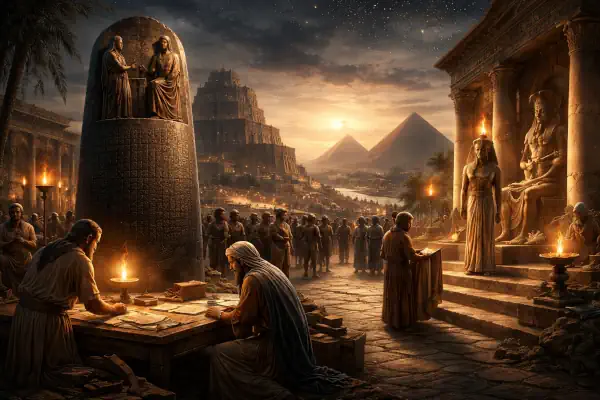
The first great civilizations do not become powerful only because they build temples, cultivate irrigated land, or win wars. They become durable when they manage to organize power through time. That requires rules, archives, executing agents, procedures, and a recognized form of legitimacy.
In Mesopotamia as in Egypt, this transformation is decisive. Royal or priestly speech is no longer enough. Authority must become readable, predictable, and transmissible. Law, accounting, taxation, registers, and judicial decisions thus become instruments of stability. A society is no longer governed only by the presence of a ruler; it is governed by structures that prolong that ruler’s will.
It is in this threshold that the first forms of the state emerge. Not yet the modern state, but an administration capable of recording, ordering, collecting, judging, and inscribing hierarchy in the long term.
To me, one of the deepest lessons here is that the evolution of human technology does not begin only with tools and machines. It also begins with systems of organization. The moment a civilization learns to stabilize authority through rules, records, and procedures, it starts to engineer society itself.
Law and administration are not born to decorate power: they are born to make it durable, legible, and capable of organizing society beyond individual lives.
The Code of Hammurabi: When Law Becomes Visible and Justice Becomes an Institution
The stele of Hammurabi represents one of the strongest moments in this history. By engraving laws into stone, Babylonian power accomplishes a major gesture: it gives normativity a stable, public, and lasting form. Law is no longer transmitted only through custom, habit, or speech; it is inscribed in a medium that tears it away from the immediate moment.
This inscription should not be understood merely as a legal collection in the modern sense. It also stages royal authority. The king presents himself as the guarantor of a just order, capable of arbitrating conflicts, framing transactions, protecting certain social categories, and reminding society that it rests on a regulated hierarchy.
The principle of talion, often isolated, does not summarize the entire text. What matters historically is above all the will to codify, classify cases, fix sanctions, and make justice into a domain assumed by power. Law thus becomes an instrument of social organization as much as a political sign.
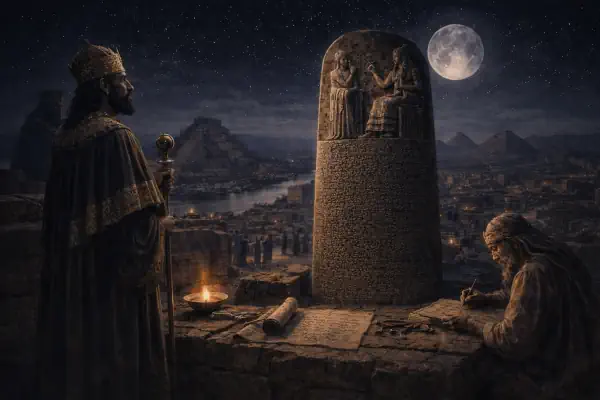
What strikes me most is that writing and calculation changed human destiny not only in trade or science, but also in justice. Once a society can write the rule, compare cases, and preserve decisions, power ceases to be purely immediate. It becomes something that can endure, be consulted, and shape collective life beyond a single ruler.
In Egypt, Governing Means Preserving Ma’at: Justice as the Balance of the World
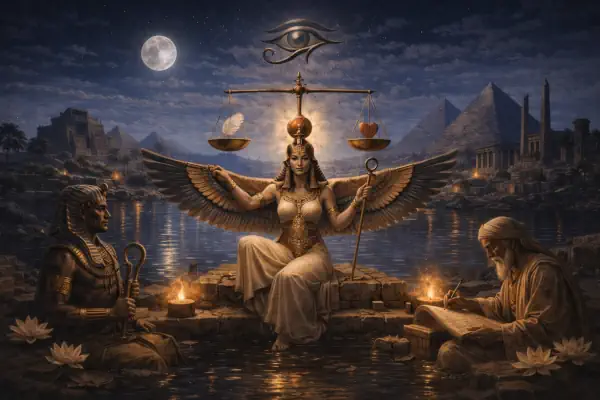
In Egypt, the logic of power takes a different yet equally structuring form. The principle of Ma’at combines truth, justice, balance, and cosmic order. Governing does not mean merely imposing decisions; it means preserving the stability of the human world in continuity with the order of the cosmos.
This perspective gives justice a scope broader than simple punishment. The decisions of the pharaoh, administrative procedures, levies, and arbitrations do not belong only to a political technique. They participate in a higher requirement: maintaining the harmony of the kingdom, avoiding disorder, and guaranteeing continuity between humans, gods, and territory.
That is why the role of scribes, archives, and administrative texts is so important. They serve not only to count harvests or record taxes; they help stabilize a social order that pharaonic power presents as just, necessary, and cosmologically grounded.
Taxes, Scribes, Archives, and Officials: The Rise of an Administrative Apparatus
A law, however prestigious, is not enough to hold a civilization together. There must be people to apply it, documents to preserve its trace, registers to count resources, agents to collect taxes, and structures to organize labor, cults, lands, and populations. This is where administration becomes decisive.
In Mesopotamia as in Egypt, scribes occupy a central place. They are the technicians of political memory. Through them, harvests are counted, rations distributed, labor organized, decisions recorded, and exchanges monitored. Writing becomes the concrete extension of power.
This rise of administration announces a major transformation: society ceases to be regulated only by personal or local ties. It can now be directed on a larger scale through procedures, accounts, documents, and specialized agents. This is one of the deepest roots of state formation.
What this administration makes possible
- collecting and redistributing resources across an organized territory
- preserving a written memory of decisions, taxes, and obligations
- transforming political authority into a durable system rather than a merely immediate domination
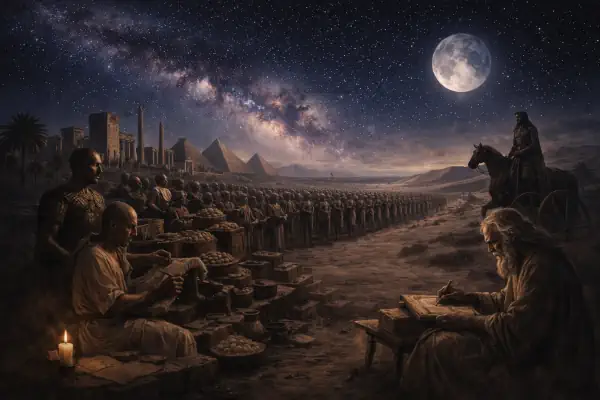
I find this profoundly modern. Administration, calendars, engineering, and transmission belong to the same civilizational movement: the will to make collective life durable through organized intelligence. In that sense, the first civilizations did not only found states; they founded our way of structuring the world.
Why These First Institutions Remain Foundational for Understanding Modern Power
Contemporary societies obviously do not reproduce either Babylon or pharaonic Egypt. Yet some of their foundational intuitions remain. Durable authority requires texts, procedures, decision frameworks, archives, intermediary agents, and symbolic justification. Without them, it remains fragile, local, or arbitrary.
The Code of Hammurabi shows the importance of making the rule visible. Ma’at reveals that power does not endure by constraint alone, but also through an idea of just order. Scribes and officials remind us that the state truly begins when it knows how to record, coordinate, and redistribute. Together, these elements help explain how authority becomes institution.
That is why the laws, power structures, and administrations of the first civilizations are not an archaic curiosity. They constitute one of the moments when humanity learns to transform force into organization, decision into archive, and domination into a durable system.
From Babylon to the Nile: When the First Civilizations Invent the Long Form of the State
In Mesopotamia as in Egypt, power crosses a threshold when it rests on laws, principles, archives, and administrations. From that moment onward, governing no longer means only commanding; it means organizing resources, arbitrating conflicts, producing memory, and giving collective order a stable form.
These civilizations thus show us that political greatness does not lie only in monuments or conquests. It also lies in the capacity to make a common framework endure, to render justice intelligible, and to inscribe authority into institutions capable of surviving individuals.
That is why their legacies remain decisive: they reveal how the history of power has also been, from the beginning, a history of writing, rule, and organization.
My own reading is analytical, admiring, and future-oriented. The first civilizations founded our modern way of organizing the world because they understood something essential: power lasts only when it can be recorded, structured, transmitted, and justified. Writing and calculation changed human destiny not only by supporting trade or knowledge, but by making administration, law, and political memory possible on a new scale. To me, this is one of the deepest turning points in history. Egypt and Mesopotamia did not simply invent early states; they launched the long evolution of organized civilization itself.
