
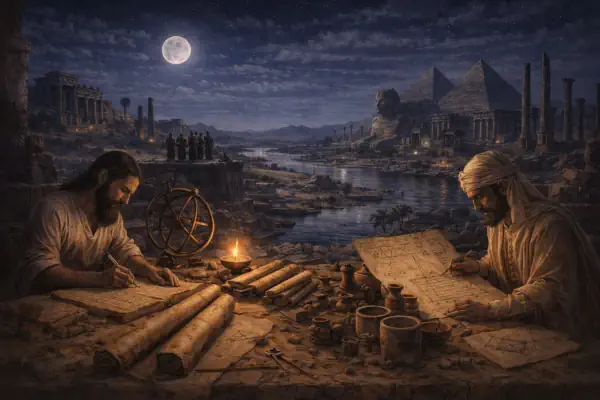
When Knowledge Becomes a Tool of Civilization: Counting, Predicting, Healing, and Building
Ancient sciences do not yet resemble the specialized disciplines of the contemporary world. They emerge in fields, temples, workshops, palaces, and construction sites. Their first function is not to theorize for its own sake, but to make the world more understandable, more predictable, and more governable.
In Egypt and Mesopotamia, knowledge takes root in concrete needs: measuring harvests, distributing water, tracking celestial cycles, treating wounds, designing durable buildings, organizing labor, and preserving the memory of procedures. This closeness between practice and reflection is precisely what gives these early learned traditions their strength.
That is why their legacy remains so fundamental. They show how a civilization becomes more powerful when it transforms experience into method, observation into calculation, and ingenuity into transmission.
What I find most decisive here is that these civilizations did not begin by dreaming of technology in the modern sense; they began by creating reliable ways of acting on reality. To me, this is the true beginning of the long evolution of human technology: the moment when practical intelligence becomes organized, transmissible, and cumulative.
The first sciences do not emerge at a distance from the real world: they are born from the need to organize the land, read the sky, preserve life, and build for the long term.
Mathematics: Measuring Land, Distributing Resources, and Making the World Calculable
Mathematics appears very early as a language of organization. In Mesopotamia, counting means managing reserves, distributing rations, tracking exchanges, and controlling flows of grain, livestock, or oil. Accounting systems, numerical tablets, and scribal practices show that a complex society needs numbers in order to hold together.
In Egypt, this mathematical rationality is expressed with remarkable clarity in land surveying, volume measurement, granary management, and the planning of major works. The floods of the Nile require the boundaries of fields to be recalculated and available resources to be assessed with precision. Number thus becomes a tool of power as much as an instrument of understanding.
Mathematical papyri reveal that these civilizations already know how to solve sophisticated practical problems. Their calculations are not a matter of mere empiricism. They reflect an effort of formalization that announces a structured way of thinking about surfaces, proportions, volumes, and problem-solving procedures.
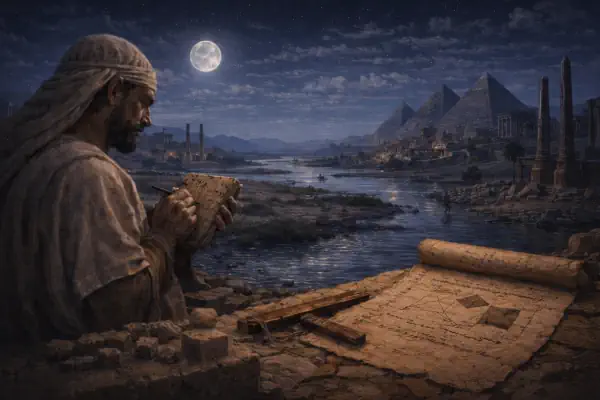
In my view, writing and calculation changed the human destiny because they changed the scale of what societies could remember, coordinate, and build. Once a civilization can count precisely, it no longer depends only on instinct or immediate memory. It can plan, compare, forecast, and project itself forward.
Astronomy: Reading the Sky to Master Time, Seasons, and the Rhythm of the World
Very early on, the first civilizations understand that observing the sky makes it possible to organize the earth more effectively. The phases of the Moon, the apparent movement of stars, heliacal risings, and celestial phenomena become essential points of reference for regulating calendars, preparing agricultural labor, and structuring ritual life.
In Mesopotamia, astronomical observation takes on a particularly methodical form. Priest-scribes track the movements of planets, constellations, and eclipses with a rigor that turns the sky into a space of calculation and anticipation. This knowledge serves agriculture, ritual, and a broader understanding of cycles.
In Egypt, astronomy is intimately connected to the Nile and to the calendar. The heliacal rising of Sirius becomes a decisive signal, associated with the flood and with the organization of the year. Time ceases to be a simple empirical succession of days: it becomes an order that can be identified, measured, and integrated into collective life.
What astronomy makes possible in the first civilizations
- anticipating agricultural seasons and structuring the calendar
- ordering rituals, festivals, and major cycles of time
- linking observation of the sky to a broader vision of cosmic order

I find it deeply inspiring that one of the first great scientific gestures in history was simply to look upward in order to organize life below. Our calendars, our planning, and even our modern systems of coordination still prolong that same ambition: turning the movement of the world into a readable order for human society.
Medicine: Healing, Diagnosing, and Transmitting the Experience of the Body
Ancient medicine reveals another essential dimension of knowledge: its link with human vulnerability. Faced with wounds, infections, pain, fractures, or illness, societies must observe, compare, experiment, and transmit what works. Care thus becomes a field of methodical accumulation of experience.
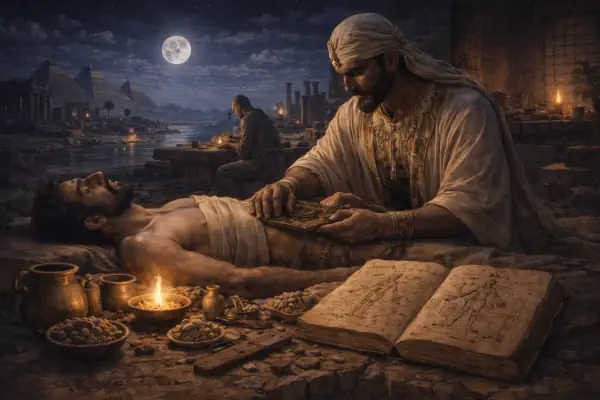
In Egypt, medical papyri testify to a surprisingly structured corpus. They contain remedies, prescriptions, descriptions of symptoms, practical advice, and at times genuine diagnostic approaches. This medicine is not yet separated from religion, but neither is it a mere set of beliefs: it also proceeds through classification, observation, and repetition of cases.
In Mesopotamia, medical practices likewise combine concrete expertise, pharmacopoeia, ritual, and learned interpretations. The ancient physician works at the frontier between the visible and the invisible, but this complexity should not conceal the essential point: ancient societies already develop a culture of care, examination, and technical transmission.
Architecture and Engineering: Transforming Stone, Water, and Space into Durable Power
Great ancient constructions are not only matters of symbolic prestige. They require calculations, plans, logistical chains, knowledge of materials, labor organization, and territorial control. Every monument, every canal, and every dike reveals knowledge that has been accumulated and coordinated.
Mesopotamian ziggurats show how architecture can order the city and connect the human world to a cosmic vision. Egyptian pyramids, for their part, concentrate geometry, spatial orientation, construction-site engineering, and resource management. Their technical effectiveness is inseparable from their political and symbolic function.
Engineering does not stop at monuments. Irrigation systems, canals, dikes, and storage devices reveal an applied science of water and territory. To control river flows, feed populations, transport materials, and stabilize agricultural production already required a very high level of technical intelligence.
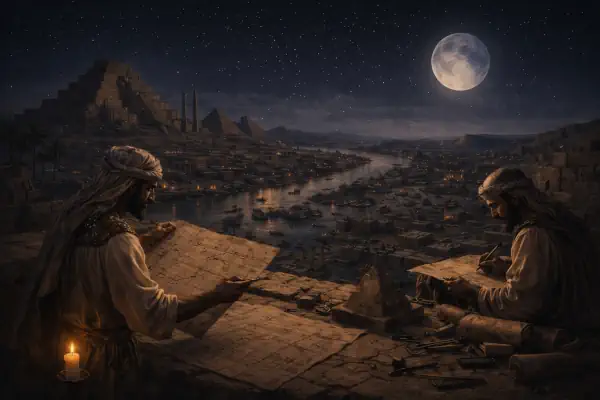
To me, this is where admiration becomes unavoidable. These civilizations were not only thinking the world; they were engineering it. Their administration, their calendars, their construction methods, and their capacity to transmit procedures all announce something profoundly modern: the idea that a society progresses when intelligence becomes structure.
Why the Knowledge of Egypt and Mesopotamia Remains Decisive for the History of Science
The importance of these early learned traditions does not lie only in their antiquity. It lies in the fact that they reveal a fundamental moment: the moment when humanity begins to transform vital needs into methods, observations into procedures, and experience into transmissible technical memory.
In both Egypt and Mesopotamia, mathematics organizes resources, astronomy structures time, medicine formalizes the experience of the body, and engineering connects knowledge to matter. This convergence reveals a powerful idea: science was not born at a distance from social life, but was built at the very heart of everyday challenges.
That is why these civilizations remain foundational. They show us how a world becomes intelligible when it can be calculated, observed, healed, and built according to accumulated knowledge.
My own view is both analytical and forward-looking: the first civilizations founded our modern way of organizing the world. Administration, calendars, engineering, and transmission did not simply emerge as isolated inventions; together, they formed the first coherent architecture of technical civilization. Writing and calculation changed the human destiny because they gave societies the power to preserve intelligence outside the individual, to coordinate action across time, and to pass method forward. In that sense, Egypt and Mesopotamia did far more than open a chapter of ancient history: they set in motion the very long evolution of human technology.
