
Leonardo da Vinci and the transformation of knowledge
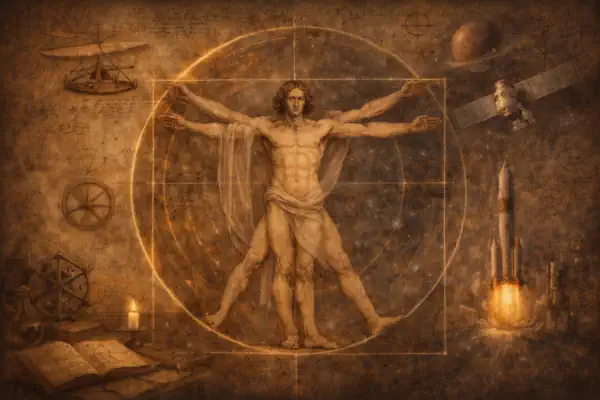
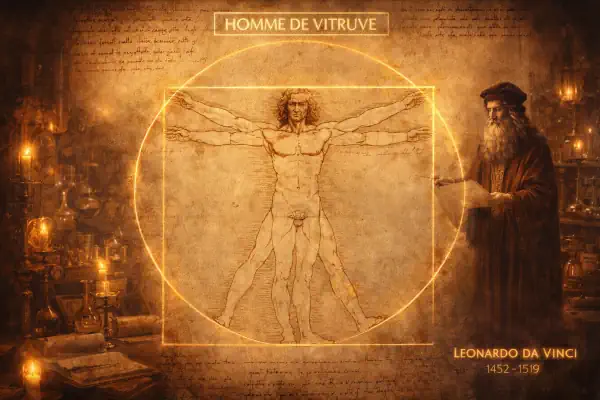
Around 1490, Leonardo da Vinci drew a human body inscribed within a circle and a square: the Vitruvian Man. The drawing has become iconic, but its true importance is intellectual. Leonardo did not merely seek visual harmony; he confronted an inherited theory with direct observation. He measured, compared, and annotated. He did not simply receive knowledge: he tested it.
Behind this gesture lies one of the Renaissance's great ideas: knowledge was no longer grounded solely in the authority of texts, but in verification, experience, and confrontation with the visible world. Ancient heritage remained central, but it ceased to be untouchable.
Vitruvius's treatise, written in Antiquity to think of architecture as a balance between solidity, utility, and beauty, thus became the basis for a new reflection. In Leonardo's hands, that basis was reinterpreted through drawing, anatomy, mechanics, and experimentation.
The Renaissance was not limited to rediscovering the Ancients: it inaugurated a new way of producing truth, grounded in the circulation of ideas, observation, and experimentation.
Humanism, the printing press, and the circulation of ideas
One of the Renaissance's great ruptures lies in the new mobility of knowledge. Ancient texts rediscovered in Italy were studied, translated, compared, and corrected. Humanism placed the study of humanity, languages, the arts, and texts at the heart of a new intellectual culture. Knowledge became a living space of dialogue, no longer a simple repetition of inherited authority.
The invention of the movable-type printing press by Gutenberg, around 1450, radically changed the scale of the phenomenon. The book ceased to be a rare and local object. Texts became more stable, more widely diffused, and easier to compare. This silent standardization permanently transformed Europe's intellectual memory.
What the printing press made possible
- faster dissemination of texts and ideas
- critical comparison of versions and translations
- the emergence of knowledge that was more cumulative, more collective, and more transmissible
With the printing press, thought changed speed. Knowledge ceased to be essentially local and gradually became a European network of intellectual circulation.
The emerging scientific revolution
The Renaissance also opened a new way of interrogating reality. In 1543, with Copernicus, the universe gradually ceased to be conceived through the old uncontested geocentric model. This theoretical displacement was immense: if Earth was no longer the stable center of the cosmos, then humanity's place in the universe had to be reconsidered as well.
This turning point did not concern astronomy alone. It announced a method. Observe, measure, calculate, correct: truth was no longer guaranteed only by the age of a text, but by the coherence of a demonstration and its capacity to withstand reality.
In this logic, the Renaissance no longer merely thought the world; it began to verify it. That was the starting point of a more experimental scientific culture, one that would prepare the great developments of the modern age.
Exploration, maps, and the widening of the world
The Renaissance's intellectual transformation went hand in hand with a geographical upheaval. Maritime voyages, new trade routes, and great explorations suddenly widened the European horizon. Maps had to be corrected, distances rethought, and knowledge of the world reorganized.
Here again, experience prevailed over tradition. Observed reality compelled inherited knowledge to be revised. Navigation, cartography, applied astronomy, and measuring instruments became concrete tools of a new age of knowledge.
The Renaissance therefore produced more than new ideas. It also changed the scale of the known world, and with it the ambition of European societies.
When understanding becomes a power
What makes the Renaissance decisive is not only the richness of its works or the prestige of its figures. It is the deeper shift it produced in the relationship between knowledge and action. Mathematics served navigation, anatomy nourished art and medicine, optics improved instruments, and workshops became places of invention as much as of production.
The artist could become an engineer. The scholar became an experimenter. The text became an object of inquiry. And the world itself became verifiable—and therefore transformable.
This is perhaps the true birth of scientific modernity: the moment when Europe understood that to know was no longer simply to contemplate or comment, but to acquire a new capacity to act upon reality.
