
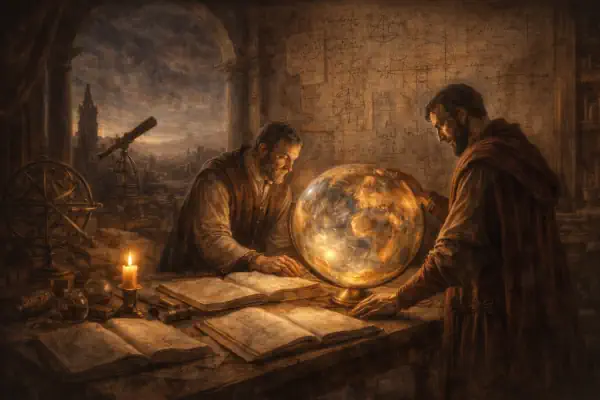
When knowing is no longer enough: it must be measured
The great break of modern science begins when understanding is no longer enough. For centuries, learned thought sought above all to order the world through concepts, authorities and inherited systems. From the Renaissance onward, another gesture asserts itself: one must now observe methodically, measure precisely, compare results and test hypotheses.
Reality is no longer merely interpreted; it becomes verifiable. This transformation is decisive. It shifts knowledge from a contemplative logic to an instrumental one, capable of producing evidence, maps, laws and, soon enough, technologies.
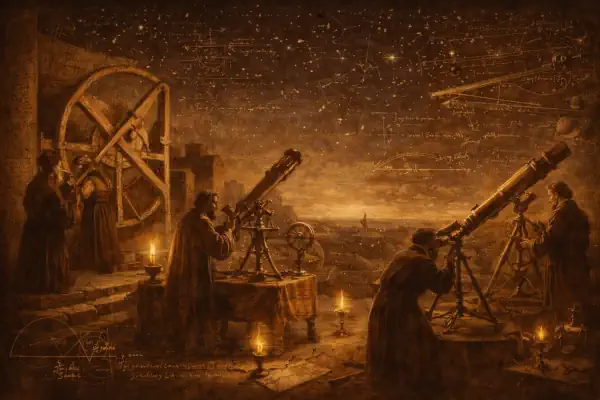
The scientific revolution is born not only from new ideas, but from a new demand: to make the world speak through observation, calculation, instruments and experiment.
Observation becomes a method
With Copernicus, and above all with Galileo, the sky ceases to be merely a symbolic order inherited from Aristotle and Ptolemy. It becomes an object of inquiry. When Galileo improves the telescope and observes the mountains of the Moon, the phases of Venus or the satellites of Jupiter, he does not simply produce new images: he changes the very status of proof.
Ancient authority is now challenged by instrument-based observation. The human eye alone is no longer enough; it is extended by technology. Truth no longer rests solely on inherited texts, but on what can be seen, described, repeated and discussed.
This methodological transformation is one of the cores of scientific modernity. The world begins to become quantifiable because it becomes observable in a more rigorous way.
Measuring and mathematizing the world
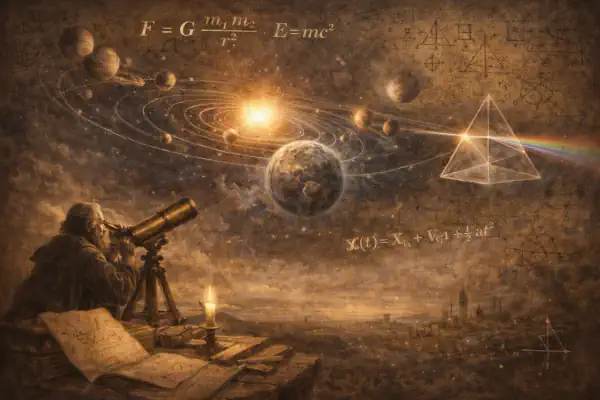
The scientific revolution does not stop at observation: it translates reality into mathematical language. With Descartes, analytic geometry unifies shapes and equations. With Newton, the motion of celestial bodies and that of terrestrial objects can be described within the same mathematical framework.
The change is immense. The world is no longer merely a set of visible phenomena; it becomes a system of quantifiable relations. Nature appears as an order that can be analyzed and represented in abstract yet operational models.
What mathematization makes possible
- comparing phenomena on a common basis
- predicting motions and effects
- uniting formerly separate realities within a single logic
From that point on, measurement no longer serves only to describe: it allows anticipation, calculation and soon the more efficient transformation of the material world.
Mapping to reduce the unknown
Modern science also develops on Earth. Mapping the world, tracing routes, fixing coordinates and measuring the shape of the planet is not merely a matter of geographic curiosity. It is a way of turning space into something manageable.
With Mercator and the great scholarly expeditions, cartography becomes a central tool of intelligibility and power. The world gradually ceases to be a vast uncertainty and becomes a surface that can be identified, calculated and administered.
This dynamic shows that the scientific revolution does not concern only laboratories or observatories. It also affects navigation, empires, exchanges and the political construction of a global space.
Experimenting: provoking nature
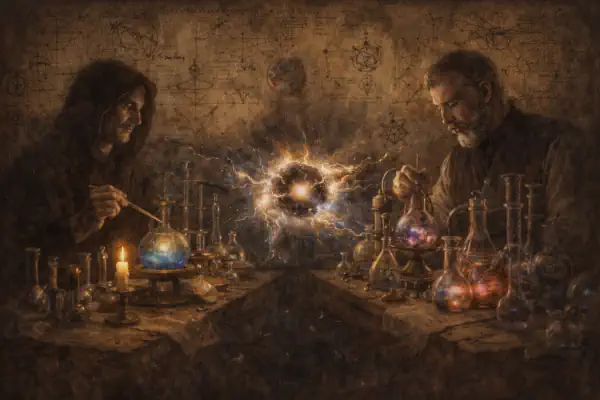
The decisive step probably lies in the very idea of experiment. Observation is no longer enough: one must create the conditions for a phenomenon, reproduce it, isolate variables and verify results. With Francis Bacon, and later with learned institutions such as the Royal Society, nature becomes an object of active interrogation.
This logic gives birth to a new discipline of the mind. Knowledge no longer depends solely on reading or speculation, but on protocol, repeated gestures and shared validation. Science gradually becomes collective, public and cumulative.
The work of Boyle in the physics of gases or Lavoisier in chemistry shows how far this transformation goes: matter itself becomes measurable, weighable and transformable according to identifiable laws.
When knowledge becomes power
Little by little, one principle imposes itself: to know is to be able to act. Science no longer limits itself to describing reality; it becomes capable of modifying its conditions. This is where the scientific revolution prepares the industrial revolutions to come.
Observe, measure, map and experiment become the four founding verbs of a new world. This world will soon be that of machines, controlled energy, networks, industries and large-scale techniques.
But this rise in power also introduces a lasting question: if everything can be measured and understood, how far should transformation go? Modern science therefore opens both an era of mastery and an era of responsibility.
