
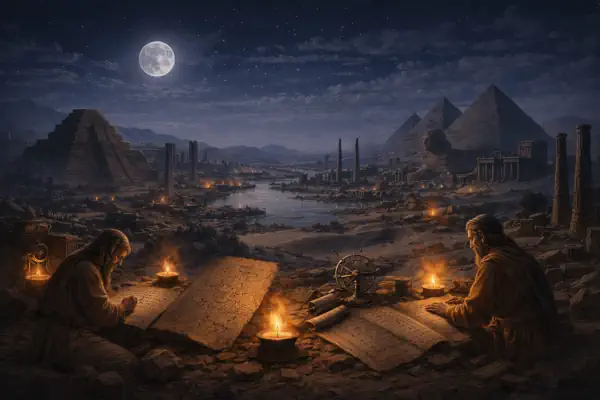
The World Before Writing: Humanity Without a Material Memory
Before the appearance of writing, entire societies already existed: they farmed, traded, built, believed, and passed on skills and traditions. Yet their memory remained fundamentally fragile. It depended on speech, repetition, elders, and ritual. When voices vanished, part of the human world vanished with them.
That is precisely what changes between Egypt and Mesopotamia. Human beings learn to fix information into matter. A decision, a stockpile, a royal name, an offering, or a rule can now outlive those who formulated it. History begins at the moment when time no longer erases everything.
This threshold should not be understood as a simple technical improvement. It is a major anthropological transformation: societies become capable of representing themselves at a distance, across time, through traces that are verifiable, transmissible, and durable.
To me, this is one of the deepest turning points in the human adventure. A civilization becomes truly historical when it no longer depends only on memory carried by bodies and voices, but learns to externalize its own continuity. Writing is not merely a tool of communication; it is a machine for preserving human presence beyond absence.
One of humanity’s greatest inventions was not only to write, but to make power, knowledge, and memory capable of enduring beyond generations.
Uruk and Cuneiform: When Writing Is Born from Management
Around 3300 BCE, in Uruk, in southern Mesopotamia, the earliest forms of cuneiform writing appear. Contrary to a romantic vision, writing does not begin with poetry or grand narratives. It emerges from a concrete need: recording harvests, tracking herds, counting rations, and controlling stored goods.
This administrative origin is essential. It reveals that the first great inventions of History emerge within societies that have become complex enough to require tools of archiving, accounting, and verification. Writing is first a technology of reality: it transforms economy, taxation, and the organization of labor.
What writing immediately makes possible
- fixing information without relying solely on oral memory
- controlling exchanges, reserves, and obligations
- extending administrative authority beyond the physical presence of rulers
Once invented, writing does not remain confined to accounts. It gradually opens the way to archives, laws, learned texts, literature, and durable intellectual traditions.
Hieroglyphs and Kingship: When Power Becomes Archivable
In Egypt, the first hieroglyphs emerge at nearly the same historical horizon as the earliest Mesopotamian signs. Here too, writing is closely tied to power, royal names, offerings, monuments, and administration. Rule is no longer exercised only in the present; it can now be inscribed, transmitted, and displayed on a monumental scale.
The figure of Narmer, associated with the unification of Upper and Lower Egypt around 3100 BCE, illustrates this transformation well. With objects such as the Narmer Palette, power becomes visible and memorable. It no longer merely acts in the present: it stages itself in order to endure through time.
This culture of the trace is one of the foundations of Egyptian civilization. Inscriptions, stelae, monuments, and archives help maintain a constant bond between authority, memory, and the continuity of the kingdom.
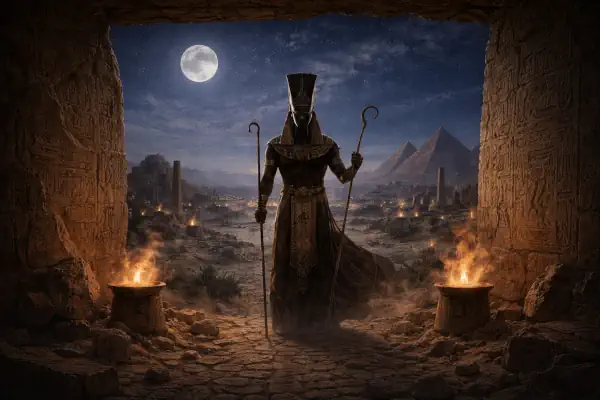
What strikes me here is that writing does not only preserve facts; it organizes legitimacy. The moment authority can be recorded, displayed, and transmitted, it changes nature. Power becomes more than force: it becomes narrative, administration, continuity, and symbolic permanence.
Law, Archives, and Administration: The Invention of a Governable Order
Once writing is mastered, societies can move further: not only recording, but also regulating. In Mesopotamia, legal and administrative texts reveal the emergence of a world in which obligations, sanctions, transactions, and responsibilities can be formulated with precision. The rule no longer depends only on the chief’s memory or on immediate testimony; it can be written down.
The great legislative traditions, among which the Code of Hammurabi remains one of the best-known examples, show that political authority expands in reach when it becomes textual. To write the law is to make it visible, comparable, transmissible, and, to a certain extent, impersonal.
Administration follows the same logic. Accounts, censuses, lists, inventories, and correspondence give rise to a more durable power, because it rests on procedures and not only on immediate force. A civilization capable of archiving can govern on an unprecedented scale.
I see in this moment the remote origin of nearly every structured society that follows. States, institutions, courts, registries, and even our contemporary databases inherit this same ambition: to make collective life legible enough to be administered. That is both a civilizational strength and a permanent political question, because every archive is also a form of power.
Mathematics, Medicine, Astronomy: When Knowledge Becomes Cumulative
The other major revolution is intellectual. With writing, knowledge ceases to be transmitted only from master to student through living memory. It can now be accumulated, corrected, resumed, compared, and extended. This is one of the fundamental conditions of any learned tradition.
In Mesopotamia, scribes develop traditions of calculation, astronomical observation, and measurement that play a central role in the administration of time, space, and human activities. In Egypt, medical and technical papyri testify to an effort of description, classification, and transmission. Knowledge becomes documented.
This transformation is decisive: once knowledge becomes cumulative, a society can learn beyond the immediate experience of each generation. Egyptian and Mesopotamian civilizations therefore produce not only monuments, but also methods of conservation and intellectual progression.
Why These Inventions Truly Laid the Foundations of History
When we say that History begins with writing, this is not meant to diminish the importance of prehistoric societies. It means that from this threshold onward, the past is no longer reconstructed only from objects, remains, or landscapes: it is also narrated, recorded, and partly explained by those who lived it.
Egypt and Mesopotamia occupy a unique place here. They see the near-simultaneous emergence of tools that transform the very structure of society: writing, administration, law, archives, measurement, and specialized knowledge. These inventions form the invisible framework of everything that states, libraries, sciences, institutions, and collective memory will later become.
We still live inside this legacy. Every contract, every registry, every calendar, every legal text, and every database extends, in new forms, a gesture born more than five thousand years ago: making the human world readable, memorable, and transmissible. It is in this profound sense that these inventions laid the foundations of History.
My own reading is clear: Egypt and Mesopotamia did not simply invent a few useful tools, they established the durable infrastructure of civilization itself. From my perspective, that is why their legacy remains so modern. The ability to write, classify, archive, regulate, and preserve knowledge is not a secondary layer of history; it is the very architecture that allows a society to endure, to organize itself, and to project its intelligence into the future.
