
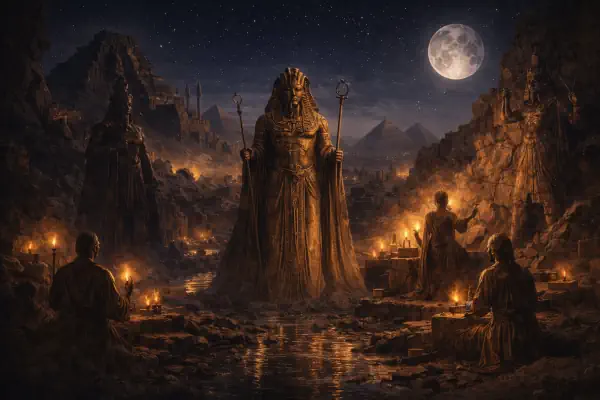
When the Image Becomes a Tool of Power and Memory
In the first great civilizations, art is never neutral. It belongs neither to simple ornament nor to a purely aesthetic search detached from social reality. As societies become more hierarchical, more religious, and more monumental, images receive a strategic function: they stage beliefs, order relationships of force, and stabilize a collective memory.
This function is particularly visible in Egypt and Mesopotamia. The walls of temples, the reliefs of palaces, votive statues, royal regalia, steles, and inscriptions form a coherent language. That language states who governs, in the name of which powers, within which cosmic order, and according to which hierarchies. In other words, art does not merely represent power: it helps to produce it.
When a society engraves its narratives, victories, gods, and kings into stone or clay, it transforms present authority into durable authority. The image becomes an archive.
What this article reveals to me is the many-sided nature of art, from antiquity to the present. One could say that art is a tool that can take very different forms depending on who uses it. In the ancient world, it structured society through visible order; in later ages, it could also become a space for interpretation, thought, and creation.
In the first civilizations, art does not merely show the world: it serves to impose an order of the world, make it visible, and transmit it.
Statues, Temples, and Frescoes: When Representing Means Making the Sacred Exist
In Mesopotamia, the votive statues found in temples already show this power of the image. The absent worshipper can be replaced by a sculpted form, hands clasped, eyes wide open toward the divine. The work is not decorative; it acts as a mediating presence. Art therefore becomes a religious technique, a way of maintaining a durable relationship between humans and gods.
In Egypt, this logic goes even further. Statues, funerary frescoes, and ritual images do not merely symbolize. They participate in a vision of the world in which cosmic order, the survival of the deceased, and the power of the sovereign must be constantly reaffirmed. Representation becomes active: it protects, legitimizes, encodes, and perpetuates.
What religious and political art accomplishes
- making the divine perceptible and durable in social space
- associating royal power with a higher sacred order
- transforming religious and funerary spaces into organized places of memory
In this framework, representing never means merely copying reality. To represent is to produce a legitimate presence, maintain a link with the sacred, and make hierarchy intelligible in the eyes of all.
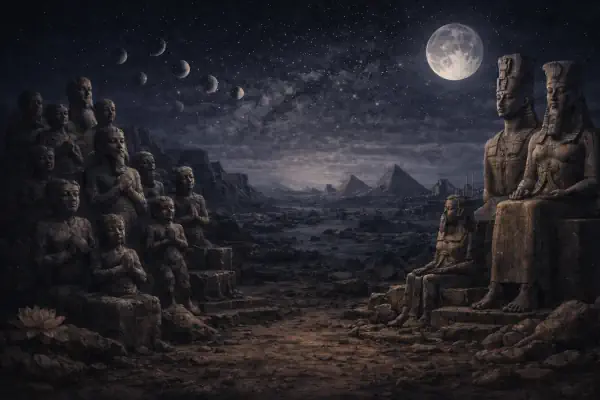
Crowns, Scepters, Royal Reliefs: The Visual Grammar of Authority
As the first societies become more centralized, power learns to make itself recognizable at a glance. In Mesopotamia as in Egypt, certain objects, poses, attributes, and visual disproportions become markers of authority. The king is not represented as an ordinary individual; he is enlarged, elevated, framed by symbols, or brought closer to the divine.
This logic reaches a peak in works such as the Stele of Naram-Sin or the Narmer Palette. In these images, military victory, political domination, and proximity to celestial powers are made immediately legible. Even without reading a text, one understands who commands, who triumphs, and what order is presented as legitimate.
In Egypt, the double crown, the scepter, the uraeus, and the codified posture of the pharaoh constitute a genuine syntax of power. In Mesopotamia, helmets, triumphal reliefs, and the staging of enemies participate in the same strategy: making the image a support of recognition and adherence.
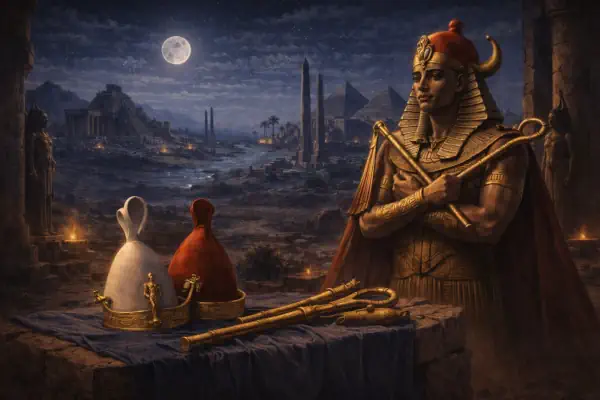
In my view, these symbols were above all a necessary language for structuring society. They made hierarchy visible, readable, and recognizable in worlds where the image had to communicate immediately. That is one of the deepest lessons of this article: art can become a social tool before it becomes an autonomous field.
Propaganda Before the Media: How the Image Manufactures Consensus
The term propaganda is modern, but the mechanism is ancient. From the earliest civilizations onward, the image serves to select what deserves to be remembered, magnify the sovereign’s glory, humiliate the enemy, and present power as natural, necessary, or cosmologically grounded. Victories are magnified, defeats erased, authority staged as self-evident.
This propaganda is all the more effective because it does not depend only on text. It acts through forms, scales, placements, and symbolic repetitions. A temple, a stele, a triumphal relief, or an illustrated procession can tell an entire population what it must see, admire, or fear.
Art thus becomes a long-term medium. It does not merely transmit religious beliefs or cultural values; it also structures the political imagination. It teaches a society who stands at the top, who is subjected, and in what order of the world each person must situate himself.
I would still make an important distinction with the modern world. Today, images on social networks, in media, branding, or politics often suggest a direction, influence, or open the way to reflection and even philosophical meditation. Their common ground remains creative art, whereas in antiquity the image was more directly tied to authoritative control and the public staging of power.
When Art Crosses Centuries: The Transmission of a Visual Culture
One of the major strengths of ancient art lies in its ability to survive political time. Kingdoms change, dynasties follow one another, conflicts disrupt territories, yet visual forms persist. Motifs, poses, symbols, techniques, and iconographic conventions can be reproduced for centuries, sometimes for millennia.
In Egypt, this continuity is especially striking. Rules of representation do not arise from mere formal conservatism; they serve to guarantee a cultural stability. To preserve the same codes is to preserve the same order of the world. In Mesopotamia, seals, reliefs, symbolic forms, and visual narratives circulate with exchange networks, scribes, and artisans, creating bridges between regions and traditions.
Why this visual transmission is decisive
- preserving beliefs and hierarchies across generations
- linking human groups through recognizable and intelligible codes
- offering future societies a direct memory of ancient practices, powers, and visions of the world
Art thereby becomes a sensitive archive of civilization. Where texts fix names, accounts, or laws, images preserve the way a society sees itself, legitimizes itself, and imagines its own continuity.
Why the Art of Egypt and Mesopotamia Remains Foundational for History
The importance of ancient art lies not only in its antiquity or beauty. It lies in the fact that it allows us to understand how the first great civilizations learned to organize visual memory, make power legible, and circulate representations capable of acting socially.
In Egypt as in Mesopotamia, the image fulfills several functions at once: religious, political, identity-based, pedagogical, and memorial. It is this density that makes it a major historical object. A statue, a painted wall, a stele, or a seal tells us not only about art: it tells us about the state, the sacred, hierarchy, communication, and collective order.
In this sense, the first civilizations do not merely invent artistic forms. They also invent a way of using images to govern minds, stabilize narratives, and transmit a world. Their legacy remains fundamental because it reveals the extent to which the history of images is also a history of power.
What this article reveals to me, analytically, is that art has always had several faces. From antiquity to the present, it can structure society, embody the sacred, support authority, influence perception, or open a space for thought. That is why I would not reduce art to propaganda alone. Art is a tool, but a tool whose meaning changes according to the civilization, the political order, and the hand that uses it. In the ancient world, it was a necessary language of structure; in the modern world, it often becomes a language of suggestion, questioning, creation, and reflection. That continuity is precisely what makes the history of art so intellectually powerful.
