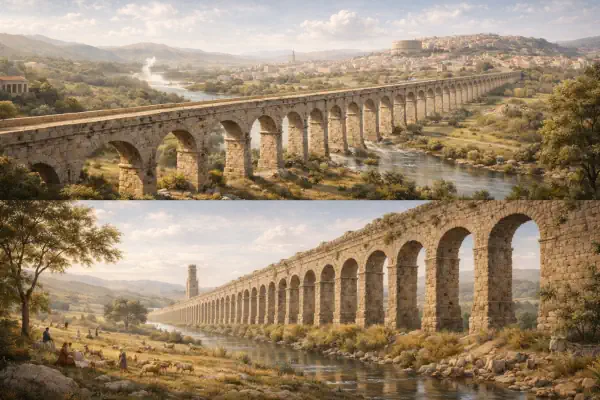
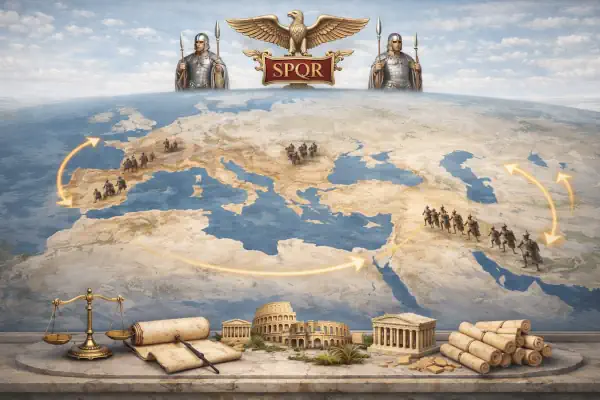
When Number Leaves Theory and Enters the Field
Rome's singularity lies less in the production of grand mathematical theories than in a remarkable capacity for application. Where the Greek tradition privileged demonstration and the search for general truths, Rome asked something else of calculation: measure a plot of land, align a road, distribute a burden, fix a boundary, secure a flow, or organize a city.
This orientation is not a sign of intellectual inferiority. It reveals a different hierarchy of priorities. The Romans inherited Greek knowledge, understood it, and in some cases transmitted it, but redirected it toward use. Number was not glorified for its own sake: it became an instrument of decision, fieldwork, and government.
One could summarize this logic in the following way: the Romans did not seek first to demonstrate the world, but to make it measurable, administrable, and workable. Their mathematics was a mathematics of reality, tied to space, time, resources, and the needs of an empire.
My personal view is that Rome reveals something essential here: technique becomes truly great when it serves reality. That is what gives Roman mathematics its enduring force. It does not shine by abstraction alone, but by its ability to act on the world. I find that profoundly modern, because it reminds us that the value of knowledge is not only in what it proves, but also in what it makes possible.
For the Romans, to calculate did not mean moving away from the world: it meant making the world more stable, more legible, and more governable.
Measuring Space: Cadastre, Urban Planning, and Territorial Order
One of the earliest major uses of mathematics in Rome concerned the measurement of territory. The agrimensores, the surveyors of the state, played a decisive role here. They laid out plots, delimited land, organized colonies, and prepared the basis of taxation. In the Roman world, to measure the soil was already to organize power.
Their emblematic instrument was the groma, which made it possible to draw straight axes and regular angles. With it, roads, camps, colonies, and cities could be ordered according to a clear geometry. The orthogonal plan was not merely a practical solution: it expressed a will toward legibility, repetition, and control of space.
What measurement made possible in the Roman world
- defining land boundaries and fiscal frameworks
- organizing cities through reproducible and governable axes
- transforming conquered territory into administered space
This applied geometry helps explain the visual and functional coherence of many Roman sites. To trace straight, divide precisely, and distribute according to clear modules: behind these gestures lies a political vision of territory. Space was no longer simply occupied; it was ordered.
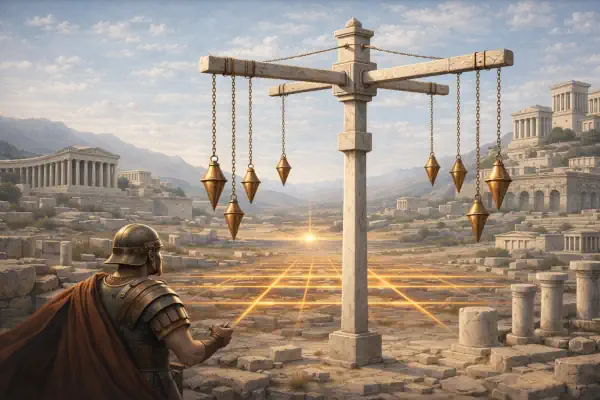
This is where the parallel with our own time becomes striking. Today, data, cartography, GPS, urban planning systems, and logistical mapping all continue this same ambition: to make space readable in order to make action more precise. The tools have changed, but the underlying intuition remains close to Rome. A territory that can be measured can be managed. A space that can be mapped can be transformed.
Simple Instruments, Yet of Decisive Effectiveness
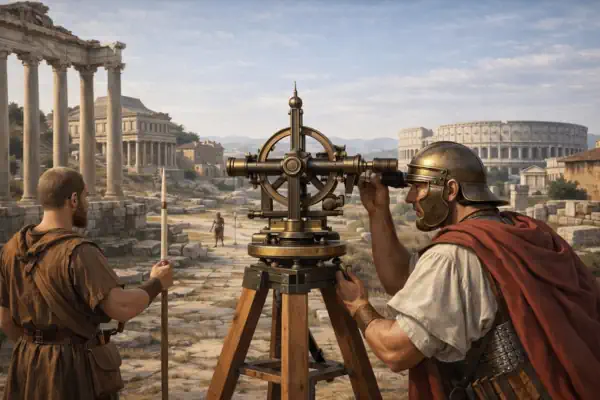
The strength of Roman techniques can be read in their instruments. The groma served for surveying and the laying out of axes. The chorobates, described by Vitruvius, made it possible to measure very slight gradients with enough precision for aqueducts. The dioptra, a more elaborate instrument of sighting and alignment, accompanied certain complex topographical operations.
None of these tools had the outward prestige of modern science. And yet they translate a remarkable technical intelligence. They were designed to be handled on the ground, in real conditions, with a clear objective: to provide measurement that was usable, repeatable, and reliable. Roman technique was a technique of the construction site, not a technique of the laboratory.
This practical dimension explains the robustness of Roman achievements. Instruments mattered not because of abstract sophistication, but because of their capacity to produce sound decisions in a materially constrained world. Measuring a slope, aligning an axis, or fixing a level thus became acts of concrete precision.
What inspires me most here is that Roman technique never separates intelligence from execution. That remains a crucial lesson for our age of algorithms and artificial intelligence. The best systems are not those that appear the most complex on paper, but those that can still produce clear, reliable, and meaningful decisions in reality. A tool becomes powerful when it passes the test of the real world.
Proportions, Modules, and Experience: Calculation in Construction
In architecture and engineering, Roman mathematics did not take the form of theoretical treatises comparable to those of Euclid. They manifested themselves above all in the use of simple proportions, repeatable modules, and an empirical knowledge accumulated on construction sites. The solidity of a vault, the balance of an arch, or the coherence of a plan depended on a mastered relation between parts.
Vitruvius insists on this requirement of commensurability: a building must be intelligible in its structure. This search for order did not belong only to aesthetics. It made it possible to build more safely, to transmit methods, to repeat forms, and to adapt works to different contexts without losing coherence.
Roman mathematics were therefore less absent than implicit. They lived in the technical gesture, in habits of calculation, in the evaluation of loads, in the mastery of gradients, and in the distribution of volumes. It was not theory dominating matter: it was experience disciplining number.
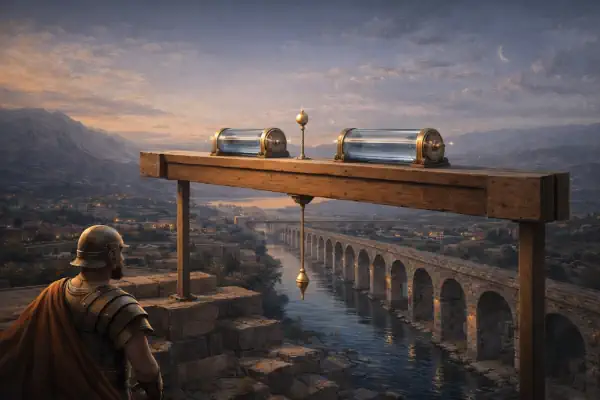
I also see in this Roman discipline something deeply relevant to the future of innovation. Our era often celebrates disruption, but durable progress still depends on proportion, calibration, and repeatability. Whether one is dealing with urban infrastructure, intelligent systems, or networked services, the challenge remains the same: how to move from brilliant concept to stable implementation. Rome excelled precisely in that passage.
Calculating Time in Order to Stabilize Collective Life
Rome did not measure space alone. It also sought to organize time. The calendar was not a secondary detail: it conditioned festivals, harvests, civic obligations, judicial activities, and the coherence of collective life. To master time, in an empire, was to synchronize highly diverse practices on a common basis.
The great reform of Julius Caesar, supported by the astronomical knowledge of Sosigenes, led to the Julian calendar. With the introduction of a year more accurately aligned with the solar cycle and the principle of the leap year, Rome stabilized an essential instrument of organization. Time ceased to be an object of opportunistic political adjustments and became a more predictable structure.
This progress was not merely scientific. It was institutional. A common calendar made the Empire more legible and more administrable. Here again, Roman mathematics appeared not as pure speculation, but as a means of fixing durable markers for social life.
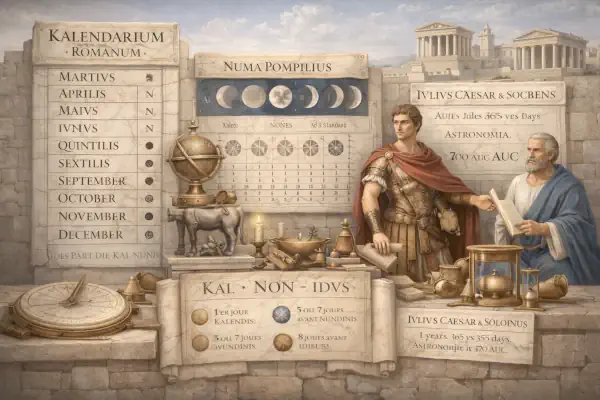
Here too, the contemporary echo is immediate. Data systems, scheduling algorithms, synchronized networks, and logistical platforms all depend on the same demand for temporal coordination. Our world is no less structured by calendars, timestamps, and protocols than Rome was by civic time. The scale is different, but the ambition is similar: to stabilize collective life by making time itself calculable.
Counting in Order to Govern: The Arithmetic of the Empire
The most decisive use of Roman mathematics may have been found in administration. To census the population, classify citizens, measure land, calculate taxes, evaluate distances, estimate water volumes, or assess the logistical needs of the legions: all of this required permanent practices of counting, measuring, and comparison.
The census was not a simple statistical survey. It constituted a central political operation. By making people, land, and resources legible, it allowed Rome to turn the immensity of the Empire into a more administrable reality. Numbers were never neutral: they served to order, distribute, rank, and decide.
This is why Roman mathematics deserve to be viewed differently. They may not have produced a theoretical revolution comparable to that of certain Greeks, but they made possible a civilization of applied calculation. Roads, cities, aqueducts, cadastres, calendars, and censuses all show the same thing: in Rome, number became a form of government over reality.
My conclusion is both analytical and resolutely forward-looking. Rome shows that technique becomes great when it serves the real. That lesson matters enormously today, at a time when data, artificial intelligence, algorithms, cartography, GPS, urban planning, logistics, and networks increasingly shape how we act. The future, in my view, will not belong to systems that merely calculate more. It will belong to those that measure well, interpret wisely, and remain anchored in the concrete realities they claim to organize. This is where Rome still speaks to us with remarkable force: not as a dead empire, but as a lasting reminder that true technical intelligence is never separated from the world it seeks to build.