From a symbolic sky to a calculable sky
For centuries, observing the stars was not solely an effort to describe the cosmos. Planets were thought of as signs capable of influencing human destiny, the seasons, disease, or political events. Astronomy and astrology thus remained closely linked, as two aspects of a single knowledge of the heavens.
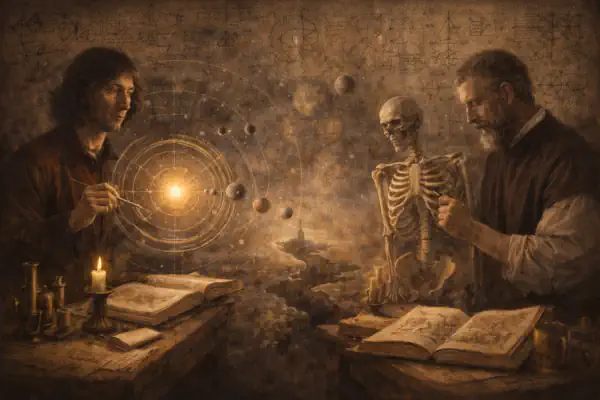
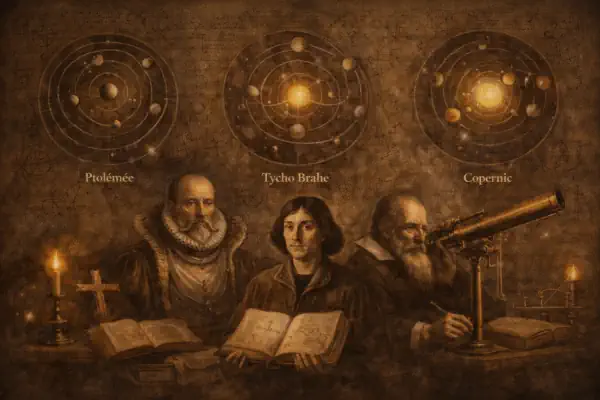
The break begins when people stop asking the stars what they mean and start asking how they actually move. In 1543, Nicolaus Copernicus proposes a heliocentric model in which the Earth ceases to occupy the center of the system. The importance of this gesture lies less in its philosophical boldness than in its methodological reach: the sky is henceforth reorganized according to geometric coherence, not symbolic hierarchy.
The question then changes in nature. No longer is it a matter of interpreting planetary positions as messages, but of establishing trajectories, speeds, and regularities. Tycho Brahe pushes this demand by accumulating observations of unprecedented precision, while Johannes Kepler crosses the decisive threshold by replacing the perfect circle with the ellipse. The heavens are no longer judged against an inherited ideal of perfection; they must answer to measurement.
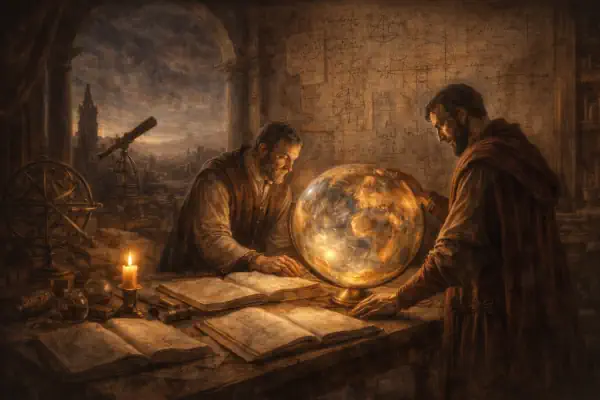
When Galileo observes the satellites of Jupiter, one major consequence imposes itself: not everything revolves around the Earth. From that point on, astronomy gradually separates itself from astrology because its object is no longer the announcement of destiny, but the establishment of physical laws. The cosmos becomes a domain of calculation, instrumentation, and proof.
The emancipation of scientific disciplines consists not only in discovering more, but in changing the very way truth is distinguished, by replacing inherited symbolic frameworks with measurement, observation, and verification.
From alchemy to chemistry: when matter becomes an object
Medieval alchemy cannot be reduced to the making of gold. It formed an intellectual universe in which transformations of matter were also invested with spiritual, cosmic, and symbolic meaning. Laboratory operations did not clearly separate themselves from a global vision of the world.
During the Renaissance, a shift occurs. Practitioners such as Paracelsus redirect the use of substances toward their concrete effects, especially in medicine. The laboratory no longer serves only to seek a hidden perfection of matter; it becomes a place of trial, preparation, and controlled transformation.
This displacement is decisive because it moves matter from the register of meaning into that of analysis. Distillation, sublimation, crystallization, and extraction gradually cease to be merely traditional gestures; they become technical procedures that make it possible to compare results and produce identifiable substances. Long before Lavoisier, the ground is already being prepared: matter begins to be thought of as something that can be isolated, modified, and described.
When modern chemistry later takes shape, it will inherit this slow transformation directly. What changes during the Renaissance is not yet the entire theoretical edifice, but the fact that matter leaves the realm of symbol and enters that of experiment.
The opened body: from Galenic authority to modern physiology
In medicine, scientific emancipation takes on a particularly visible form. For centuries, European medicine had relied heavily on the authority of Galen, whose anatomical and physiological descriptions served as reference. But this knowledge was based largely on animal dissection rather than direct examination of the human body.
With Andreas Vesalius, a threshold is crossed. By publishing De humani corporis fabrica in 1543, he founds modern anatomy on direct observation, dissection, and the precise representation of bodily structures. The body is no longer known through tradition; it is examined, compared, and corrected.
This transformation does not stop at the body’s form. With William Harvey, blood circulation becomes a phenomenon demonstrated by experiment. Blood no longer moves through a more or less speculative system of humoral balances; it follows a regular motion governed by the heart. Medicine no longer merely describes a theoretical order of life; it begins to establish observable functions.
The passage from descriptive anatomy to experimental physiology marks a fundamental rupture here. The human body becomes a dynamic system, analyzable through its structures and movements, and no longer merely a set of qualities inherited from ancient medical tradition.
The material world enters mathematical law
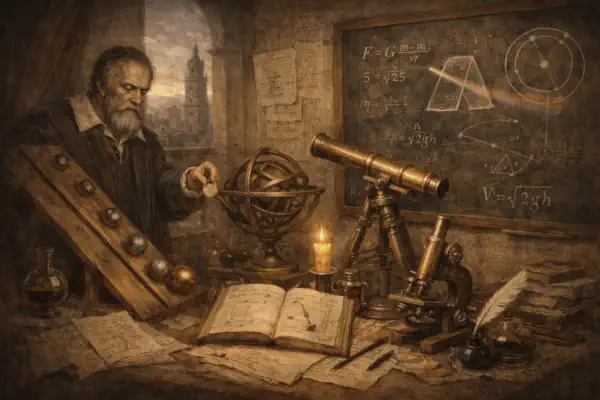
The emancipation of scientific disciplines does not concern only the stars or the body. It also concerns motion, matter, light, and the most ordinary physical phenomena. What changes during the Renaissance is that these realities cease to be described qualitatively and become objects of calculation.
Galileo plays a major role here. By studying falling bodies and motion, he shows that physical phenomena obey measurable regularities. Weight alone no longer explains falling speed, as previously believed; the behavior of objects must be grasped within a quantitative framework. This transformation turns mechanics into a science.
Optics participates in the same movement. Lenses, refraction, and instruments no longer belong merely to ingenious craftsmanship; they become means of making nature more observable and more precise. Technique, far from remaining external to science, becomes one of its necessary extensions.
From that point on, mathematics ceases to be a language separate from reality. It becomes the very form in which phenomena can be described. Nature appears increasingly intelligible through relations, trajectories, and laws.
Changing science also means changing epistemology
Behind the autonomization of disciplines lies an even deeper mutation: the transformation of the criteria by which knowledge is considered valid. What slowly collapses is not only this or that ancient theory; it is the way one believes a theory to be true.
With René Descartes, methodological doubt becomes a central principle. Truth must no longer be received solely from the authority of the Ancients, but reconstructed from an explicit rational demand. At the same time, experiment and measurement acquire unprecedented weight in the establishment of knowledge.
This transformation has been powerfully analyzed by Alexandre Koyré, who shows that the passage to modern science does not arise from a simple accumulation of discoveries. It implies a change in mental structure: the closed, hierarchical world laden with meanings gives way to a universe governed by mathematical relations, independent of older symbolic correspondences.
The emancipation of scientific disciplines thus designates a double rupture. Each field gains methodological autonomy, but all also participate in the same intellectual displacement: knowledge is no longer produced in the same way.
What this emancipation changes in the long run
- astronomy gradually separates itself from astrology and becomes a science of celestial motion
- chemistry is prepared by detaching the study of matter from its older symbolic horizon
- medicine grounds its authority in dissection, observation, and function
- mechanics brings motion into a quantitative language
- learned truth increasingly depends on proof, measurement, and verification
A silent birth, yet an irreversible one
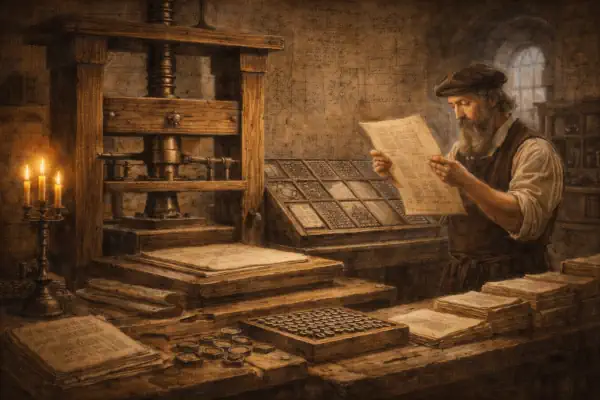
No morning of the Renaissance witnesses an official proclamation announcing the beginning of modern science. The transformation is slower, more concrete, and more profound. It unfolds in observatories, dissection rooms, glass workshops, still uncertain laboratories, annotated books, and corrected calculations.
What makes this period decisive is precisely its gradual character. Disciplines do not become modern in a single gesture, but by learning to detach themselves from frameworks that prevented them from defining their own objects, methods, and proofs.
The Renaissance does not invent all future science, but it introduces an idea whose consequences will be immense: to understand the world, one must observe it, measure it, confront it with experience, and accept that reality can correct inherited knowledge. From that moment on, knowledge is no longer only memory; it becomes inquiry.