Building Not Only to Impress, but to Endure
What is striking in Roman construction is not merely the mass of its works or the quality of its monumental finishes. It is the overall coherence. Rome built according to a logic of service, controlled repetition, and permanence. A road was not an isolated gesture, a bridge was not a passing feat, and a monument was not a pure object of prestige: each was inserted into a strategy for occupying territory and organizing collective life.
This culture of duration required a fine articulation between observation, materials, geometry, and administration. The Romans did not conceive technique as a domain separate from politics. To build was to render a space governable, passable, defensible, and legible. It was also to inscribe the Roman presence into matter itself.
Vitruvius, in De Architectura, summarized this requirement through a famous balance: firmness, utility, and beauty. In Rome, this triad was not decorative. It defined a complete program of civilization, in which architecture was never detached from its function nor from its responsibility across the long term.
To me, Rome proves something fundamental here: engineering becomes great when it organizes the real world. Technique matters most when it serves the city, the flows that move through it, and the long duration that gives collective life its stability. That lesson still feels incredibly current. With modern technologies, we should be capable of improving routes and pathways far more intelligently, increasing accessibility, strengthening public safety, and designing better lighting and more coherent urban systems. Rome reminds us that technical ambition reaches its highest level when it serves lived reality.
Roman genius lies not in building higher or faster than everyone else, but in transforming construction into a durable system serving territory, city, and power.
Materials: The Roman Intelligence of Concrete, Stone, and Brick
One of Rome's great strengths lay in its ability to choose the right materials for the right purposes. Roman concrete, the opus caementicium, played a decisive role here. Composed of lime, water, aggregates, and often pozzolana, it enabled construction that was more flexible, faster, and more ambitious than stone masonry alone. It did not replace everything, but it changed the scale of what was possible.
Stone, for its part, remained essential for visible, structural, or symbolic elements. Travertine, tuff, marble, and other regional stones carried mass, ornament, authority, and the memory of buildings. Stone gave the building its public face, while concrete often formed its deeper skeleton.
Why the Roman material system was so effective
- concrete allowed more complex volumes, forms, and construction sites
- stone ensured stability, monumental legibility, and political presence
- brick enabled standardization, speed of execution, and reproducibility
Fired brick completed this ensemble by introducing a logic of rationalization. Produced in series, calibrated, and sometimes stamped, it supported a more standardized architecture, especially in urban districts, warehouses, baths, and certain apartment buildings. Rome therefore did not merely possess good materials: it knew how to combine them within a coherent construction strategy.
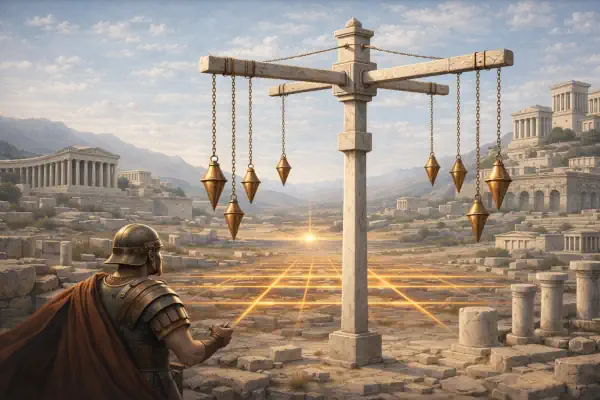
What seems especially inspiring to me is that Rome never separated material intelligence from strategic vision. Today, we speak of modeling, advanced calculation, innovative materials, and the organization of major projects. Yet the essential question remains the same: do our tools help us build more coherently, more accessibly, and more durably? Roman engineering suggests that progress is not only a matter of innovation, but of disciplined integration between materials, design, and purpose.
Roads, Bridges, Aqueducts: Building Connections
Roman architecture was not confined to monuments. It unfolded above all through infrastructure. Roman roads, beginning with the Via Appia, were designed to endure, drain, connect, and sustain continuous traffic. Their composition in successive layers, their attention to drainage, and their adaptation to relief testify to a technical thought deeply oriented toward use.
Bridges extended this logic. They were not simple crossings, but precise responses to constraints of load, current, stability, and foundation. Thanks to the arch and to concrete, the Romans knew how to transform an unstable obstacle into a reliable point of passage. The bridge thus became a form of material authority imposed upon the landscape.
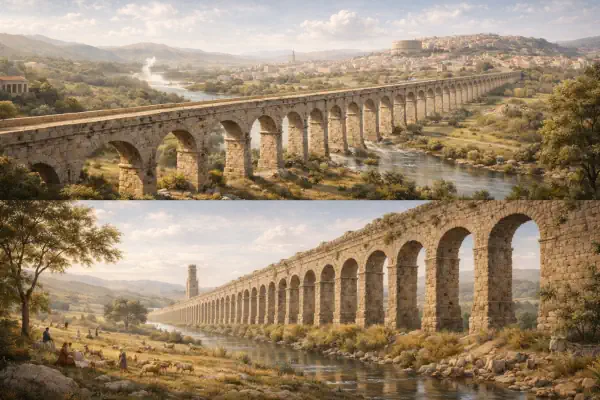
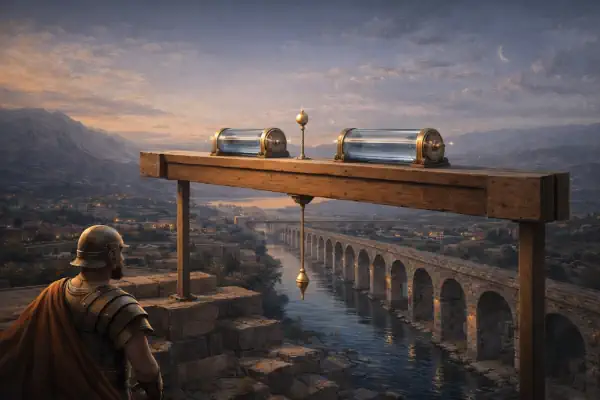
Aqueducts, finally, reveal just how closely Rome linked geometry, gravity, and urban planning. Bringing water across long distances required constant precision in gradients, conduits, crossings, and maintenance. Here again, the visible structure was only one part of a broader network. Rome did not merely build objects: it built continuities.
This is where the Roman lesson becomes intensely contemporary. Infrastructures still decide the quality of civilization. Roads, bridges, transport corridors, data centers, urban networks, and service systems shape the daily reality of millions of people. With artificial intelligence, simulation, and predictive models, we now possess tools Rome could never have imagined. That should push us not toward spectacle, but toward better organized cities, more resilient networks, and more humane access to movement, water, light, and safety.
Arches, Vaults, and Domes: Geometry in the Service of Space
The arch constitutes one of the most powerful principles in Roman architecture. It made it possible to redistribute loads, free up openings, and stabilize structures by directing forces toward supports. This logic, inherited and then perfected, became central in bridges, aqueducts, monumental gates, and many public buildings.
By extending the arch, Rome developed the vault, which made it possible to cover spaces far larger than a lintel-based architecture could allow. Baths, basilicas, warehouses, galleries, and interior circulation gained fluidity, robustness, and monumentality. Structure was no longer only what supported: it became what made another experience of space possible.
The dome, finally, brought this logic to its summit. The Pantheon, with its immense dome and central oculus, bears witness to an exceptional mastery of mass, materials, and the progressive lightening of structure. The feat was not gratuitous: it transformed interior space into a total architectural experience, in which technique also became perception, light, and order.
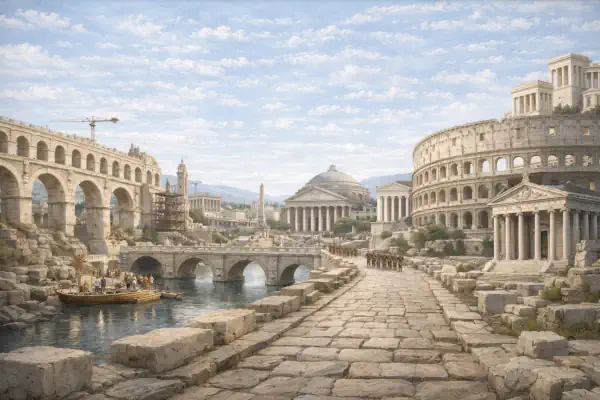
I find something deeply visionary in this mastery of form. Rome teaches that engineering is not only about solving constraints, but about opening new possibilities of space. Today, through modeling, structural calculation, and advanced design systems, we can imagine cities and buildings with extraordinary precision. But precision alone is not enough. What matters is whether these forms actually improve life, circulation, accessibility, and the long-term quality of the environments we inhabit.
Construction Sites, Standardization, and a Vision of the Long Term
Behind the great Roman works stood a rigorous organization of construction. Engineers, architects, military officers, foremen, craftsmen, free laborers, and enslaved workers all participated in a collective mechanism capable of planning, reproducing, controlling, and adapting. The Roman construction site was not improvised: it functioned as a chain of decision, measurement, and execution.
This organizational capacity explains part of Roman power. Standardization of modules, thoughtful use of materials, transmission of know-how, and adaptation to local constraints all contributed to producing works that sought more than immediate effect. Rome built to maintain territory, to sustain flows, to display the presence of power, and to endure beyond generations.
This is why Roman engineering and architecture remain a fundamental reference. They show that a civilization reaches full maturity when it knows how to make matter, calculation, space, and human organization converge within a single logic of stability. Two millennia later, Roman remains do not merely speak to us of the past: they continue to define what it means to build seriously.
My own conclusion is both analytical and resolutely forward-looking. Rome teaches that technique reaches greatness when it serves the city, the flows that sustain it, and the long duration that gives meaning to collective life. In an age shaped by artificial intelligence, modeling, advanced calculation, new materials, and the coordination of major projects, that lesson feels even more relevant. We now have the means to improve accessibility, strengthen security, rethink public lighting, and design infrastructures that are more coherent and more inclusive. The real question is whether we will use our technologies as Rome used its engineering at its best: not to produce isolated feats, but to organize the real world more intelligently, more durably, and more humanely.