When Europe takes up the challenge of the third degree
One of the great mathematical ruptures of the Renaissance begins with a problem that may seem purely technical: solving cubic equations. A first-degree equation, such as 3x + 5 = 11, can be solved by isolating the unknown. A second-degree equation, such as x² − 5x + 6 = 0, already had general tools inherited from older traditions. But once the unknown appears raised to the third power, learned Europe enters a zone of theoretical uncertainty.
At the beginning of the 16th century, the cubic equation became a prestigious challenge. Its difficulty lay not only in its apparent complexity, but in the fact that no recognized ancient method could provide a systematic solution. The problem stimulated a culture of learned competition, especially in Italy, where public challenges between mathematicians also served to establish reputation.
Scipione del Ferro discovered a method for certain forms of equations, and Niccolò Tartaglia independently found a similar procedure. The true turning point came in 1545 with Ars Magna by Gerolamo Cardano, who published a general method built on this work, while Lodovico Ferrari extended the effort to fourth-degree equations.
Behind the technical achievement lies a deeper transformation. In trying to solve increasingly abstract equations, mathematics ceased to remain within immediately intuitive forms. It began to manipulate objects that exceeded sensory evidence, especially when certain calculations brought forth negative quantities under a root. These were the first signs of a new conceptual universe, one that would later lead to a better understanding of complex numbers.
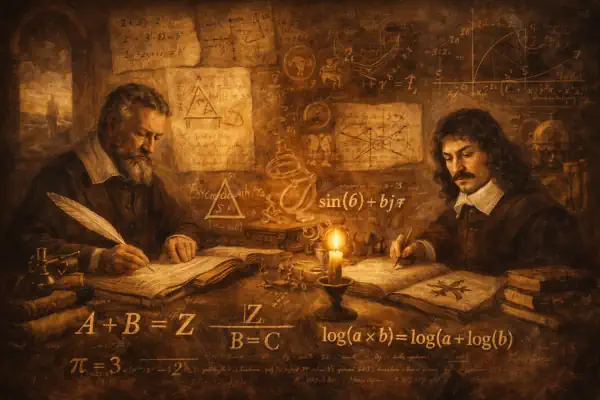
During the Renaissance, numbers no longer serve only to count: they become a way to demonstrate, predict, and write the workings of the world.
When letters replace words and make reasoning portable
Until the 16th century, much mathematical reasoning was still formulated verbally. Equations were described as sentences, which lengthened demonstrations, made comparisons heavier, and limited the operational power of calculation. True modernization came when mathematics acquired a symbolic writing system.
With François Viète at the end of the 16th century, the systematic use of letters to represent unknowns and known quantities radically changed the way people thought. This innovation was not a mere convenience of notation: it made it possible to work on general forms independently of particular numerical values. Mathematics thus gained a level of abstraction that made it far more powerful.
A few decades later, René Descartes deepened this transformation by linking algebra to geometry. With La Géométrie in 1637, curves could be described by equations, and space itself became treatable through calculation. This union of geometric form and algebraic writing was a decisive moment: it allowed scholars to move from a visual problem to a symbolic operation, and then back from the symbol to space.
In other words, mathematics became a universalizable language. It no longer merely accompanied learned thought: it now structured its inner logic. This shift was fundamental for all modern science, because it provided a common syntax to fields that had previously been separated.
What fascinates me here is not only the elegance of abstraction, but its power. Mathematics transforms science precisely because it makes thought transferable. Once reality can be written in a language that others can reuse, extend, and test, knowledge ceases to remain isolated. It becomes a framework for collective progress.
Calculating faster to understand further: the obsession with efficiency
As astronomy, engineering, and navigation advanced, a practical problem became unavoidable: calculations grew too long, too heavy, and too vulnerable to error. In a Europe that was observing more, traveling more, and measuring more, the speed of calculation became an intellectual as well as practical issue.
The use of decimal fractions, popularized by Simon Stevin in 1585, profoundly simplified the manipulation of magnitudes. What seems natural to us today represented a major gain in uniformity at the time. Numbers became easier to write, compare, and use in repeated operations. In maritime navigation, where a small computational error could have serious consequences, this standardization mattered enormously.
The next step came with John Napier’s logarithms in 1614. Their power lay in transforming long multiplications into faster additions through correspondence tables. For astronomers calculating planetary positions or navigators using celestial observations, the advantage was immediate: computation time fell while reliability increased.
With decimals, tables, and logarithms, mathematics took on a new dimension. It was no longer only a speculative or scholastic domain: it became an instrument of cognitive efficiency. To calculate more rapidly meant being able to confront more hypotheses, exploit more measurements, and widen the field of phenomena that could be treated.
This is also where my reflection turns toward engineering. Behind machines, structures, systems, and modern infrastructures, mathematics acts as a hidden language. Technology may seem visible and concrete, but what makes it reliable, scalable, and intelligible is often invisible. That invisible layer is mathematical thought.
From the observed sky to the calculated sky: astronomy becomes mathematical
It is in astronomy that the power of the new mathematics appears most clearly. For a long time, models of the heavens rested on complex geometric combinations that were often useful, yet imperfect. As the precision of observation increased, this way of representing the universe became insufficient.
Between the end of the 16th century and the beginning of the 17th, Tycho Brahe assembled the most precise observations ever obtained without a telescope. These data imposed a new demand: theories now had to fit measurements of much greater rigor. It was no longer enough to have an elegant model; it had to withstand the exactness of facts.
It was from this immense corpus that Johannes Kepler understood that the planets do not describe perfect circles, but ellipses. His work of 1609 and then 1619 showed that celestial motion could be formulated through general relations. With his third law, which links a planet’s orbital period to its average distance from the Sun, it became possible to compare all celestial bodies within a single mathematical framework.
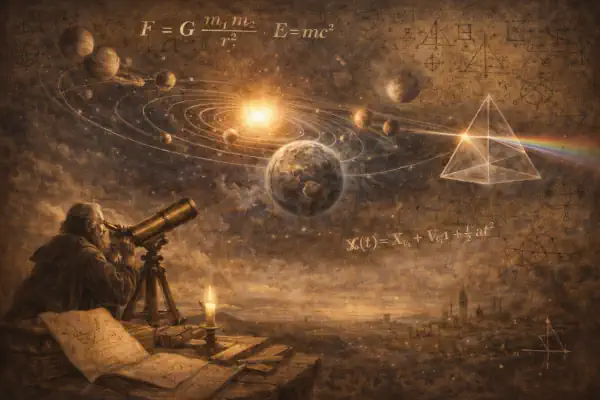
The significance of this advance is immense. For the first time, the cosmos ceased to be merely narrated, described, or schematized; it was put into equations. The sky now appeared as an intelligible system governed by quantitative laws. This mathematization directly prepared modern physics, because it showed that a natural phenomenon can be grasped as a general relation rather than merely as a singular observation.
When knowledge becomes cumulative and fuels continuous innovation
One of the most decisive effects of this mathematical transformation is less spectacular than a great isolated discovery: knowledge becomes cumulative. Viète’s work prepares Descartes’. Tycho Brahe’s observations make Kepler’s laws possible. Napier’s logarithms accelerate calculations astronomy needs. Each advance now serves as a point of support for the next.
This dynamic profoundly changes the structure of European intellectual life. Mathematics becomes a discipline capable of linking generations of scholars, providing reusable tools, and transforming isolated results into durable infrastructures of knowledge. A demonstration, a notation, or a table of calculation does not benefit only one author: it can be taken up, corrected, and extended.
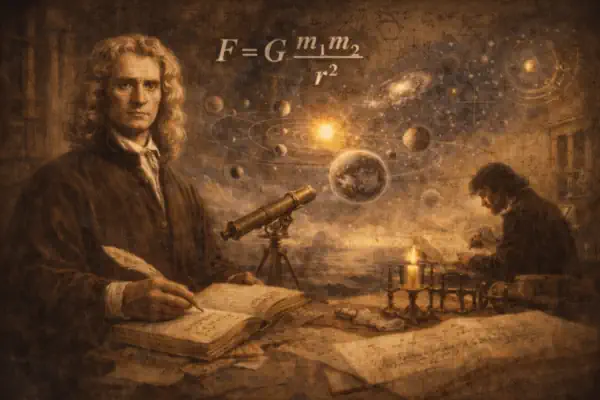
It is within this logic that Europe progressively enters a dynamic of permanent innovation. Mathematics nourishes astronomy, astronomy nourishes physics, and physics in turn prepares mechanics, engineering, and the technologies of modernity. A few decades later, Isaac Newton will be able to formulate universal gravitation within an intellectual landscape already transformed by the conceptual tools of the Renaissance.
What mathematics changes in the long run
- it makes it possible to solve algebraic problems previously beyond reach
- it renders reasoning more general through symbolic writing
- it accelerates and stabilizes the calculations required by astronomy, navigation, and engineering
- it translates natural phenomena into comparable quantitative relations
- it establishes a cumulative logic that prepares modern science and technical innovation
This is precisely why I see mathematics as one of the deepest transformations of science. It does not merely add precision; it changes the structure of what science can become. Once the world is expressible in formal relations, science gains an entirely new power: it can unify, predict, and design.
From symbol to action: when numbers transform the real
The great originality of the mathematical Renaissance is that it does not remain confined to manuscripts, schools, or learned disputes. As numbers become more manageable, more abstract, and more operational, they also gain material efficiency. They help measure trajectories, improve maps, support navigation, compare motions, and soon design more reliable machines.
The intellectual world and the material world then begin to converge. Mathematics provides a common framework for observation, calculation, and intervention. Understanding is no longer separate from acting: to describe a phenomenon in equations is already to begin rendering it transformable.
This is why the rise of modern mathematics should not be read as a mere learned specialization. It constitutes one of the foundations of European modernity. In the quiet of libraries, workshops, and observatories, a new idea asserts itself: if the world can be written, it can also be explained, compared, corrected, and changed.
That is the vision I would place here in my own name: mathematics is a hidden language behind technology. We often admire the visible result — the machine, the structure, the system, the invention — but beneath that visible layer lies an abstract order that makes action possible. That is why mathematics inspires both fascination and reflection in me: it reveals that some of the greatest forces shaping the future are silent, rigorous, and invisible at first glance.