When the World Stops Being Told and Begins to Be Understood
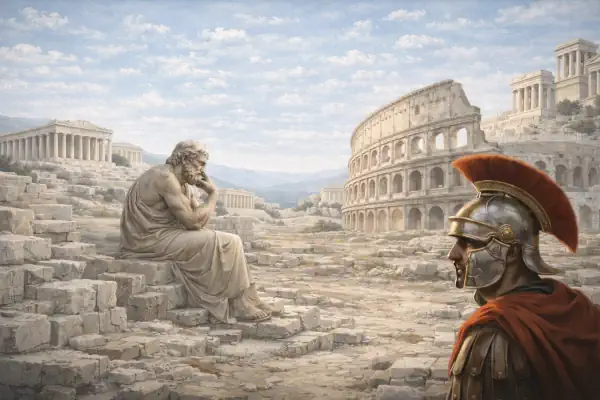
For centuries, the great civilizations of the Near East gave meaning to the world through powerful, symbolic, and sacred narratives. Lightning, earthquakes, disease, or the rhythm of the seasons were understood as expressions of divine intention. Reality possessed coherence, but that coherence still belonged to the register of myth.
Between the seventh and sixth centuries BCE, along the shores of the Aegean, a decisive rupture took place. Greek thinkers began to consider that the world might be explained without recourse to the gods. The shift was discreet, without proclamation or visible revolution, but its consequences were immense: nature became an object of inquiry.
Greek originality does not lie only in the answers it proposed. It lies in a new way of asking questions. To understand reality no longer meant merely receiving an inherited narrative; it now meant observing, comparing, discussing, and justifying. This was the birth of a culture of reasoning.
To me, this is one of the greatest thresholds in intellectual history. Greece did not merely produce a few brilliant thinkers; it established the conditions under which science, logic, and debate could become lasting civilizational practices. What changed was not only what people knew, but the very way they believed truth should be pursued.
With Greece, truth ceases to be only revealed or transmitted: it becomes argued, contestable, and demonstrable.
Thales and the First Thinkers of Nature
Tradition often places this turning point in Miletus. With Thales, reality is no longer explained by a supernatural will, but by a natural principle. When he claims that water is at the origin of all things, the hypothesis may seem naive in light of modern knowledge; yet the gesture remains revolutionary. For the first time, the origin of the world is sought within matter itself.
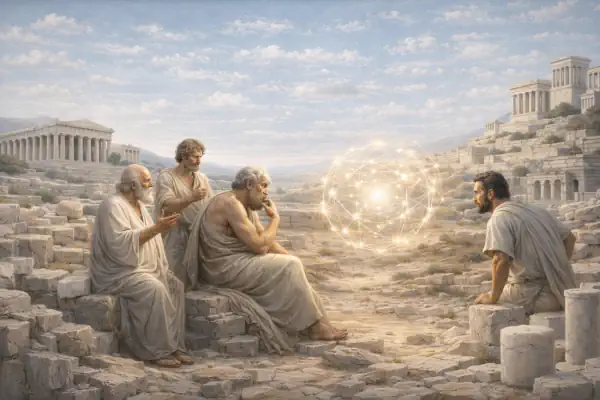
This approach opens a new intellectual space. The world becomes debatable. A proposition is no longer true because it is sacred, but because it can be defended. The importance of Thales therefore lies less in the detail of his thesis than in the new posture he inaugurates: to seek natural causes, to submit ideas to examination, to move thought from narrative toward inquiry.
From that point onward, an unprecedented attitude takes root: to observe, to reason, to argue. This transformation constitutes one of the founding moments in the history of knowledge.
Logos: When Argument Replaces the Authority of Myth
The Greek word logos does not mean speech alone. It refers to an ordered, reasoned form of speech, capable of persuading by rational force rather than by authority. With it, truth is no longer first revealed: it becomes demonstrable.
This evolution emerges within a specific political and cultural framework. Ancient Greece was not a unified empire, but a constellation of city-states where trade, alphabetic writing, and public life encouraged the circulation of ideas. In the agora, one persuaded through discourse, confronted positions, and justified one's assertions.
What logos makes possible
- explaining the world through rational arguments rather than sacred narrative
- submitting ideas to criticism, debate, and demonstration
- making knowledge a collective construction that remains discussable and improvable
This context is decisive. It gives birth to a culture in which thinking also means defending one's reasons. Speech becomes an instrument for examining reality.
I see in this Greek invention a lesson that remains vital for the present. Public debate, freedom of thought, education, and critical reason do not survive by inertia. They depend on a civilization's willingness to accept that truth must be discussed, tested, and clarified rather than imposed. Greece gave the West this discipline of argument, and that legacy still defines the dignity of intellectual life.
Anaximander, Anaximenes: The Universe Becomes a Structure
After Thales, other thinkers deepen the rupture. Anaximander seeks the origin of the world not in a visible element, but in the apeiron, an indeterminate and boundless principle accessible to reason rather than to the senses. The gesture is considerable: the foundation of reality may be abstract.
Anaximenes, for his part, proposes that everything comes from air, through rarefaction and condensation. The hypothesis remains primitive, but it already translates a scientific ambition: to think the transformations of the world in terms of physical processes rather than divine intentions.
These thinkers do not limit themselves to grand cosmological ideas. They also seek to explain winds, eclipses, earthquakes, and celestial movements. The sky itself ceases to belong exclusively to the gods: it too becomes a field of study.
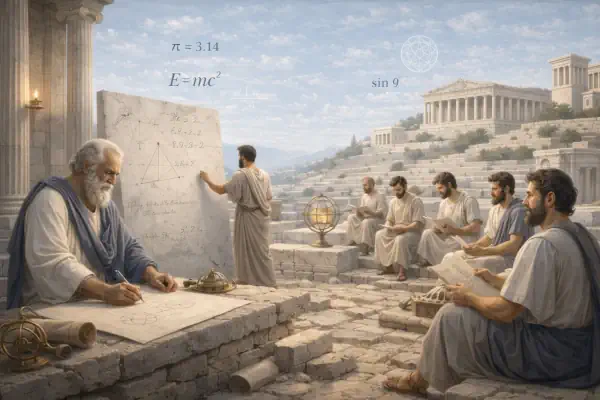
Socrates, Plato, Aristotle: Making Reason a Method
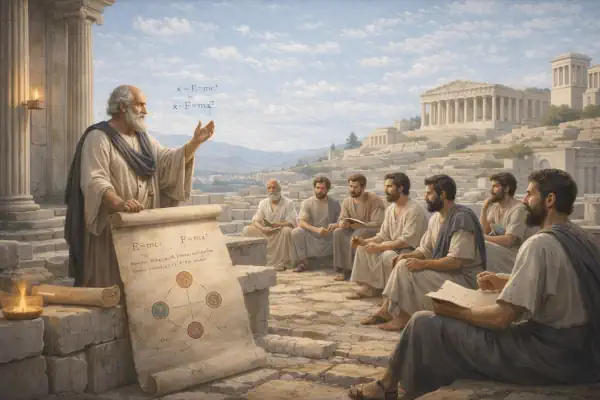
The Greek revolution concerns not only nature; it also transforms the question of knowledge itself. With Socrates, the issue becomes epistemological: how do we know what we know? His method rests on critical examination, on testing affirmations, and on revealing contradictions. An idea has value only if it can withstand rational discussion.
Plato gives this quest a new depth. The sensible world, changing and uncertain, becomes intelligible only through stable structures that the mind can grasp. In this way, he helps make reason an instrument for reading reality, rather than simply a technique of discussion.
With Aristotle, Greek thought reaches an exceptional level of systematization. He observes, classifies, describes, and compares. He formalizes logic, studies living beings, analyzes politics, reflects on causality and knowledge. In his treatises, rationality becomes a structured tool, applicable across multiple domains. Reason is no longer merely an ideal: it becomes method.
For me, this is where Greece becomes unmistakably modern. The point is not simply that these thinkers were brilliant; it is that they transformed thought into a method that could outlive them. Modern science, research culture, and the life of institutions still depend on that same conviction: observation must be organized, ideas must be tested, and intelligence must accept discipline if it wants to approach truth.
Mathematics: When Abstraction Becomes the Language of Reality
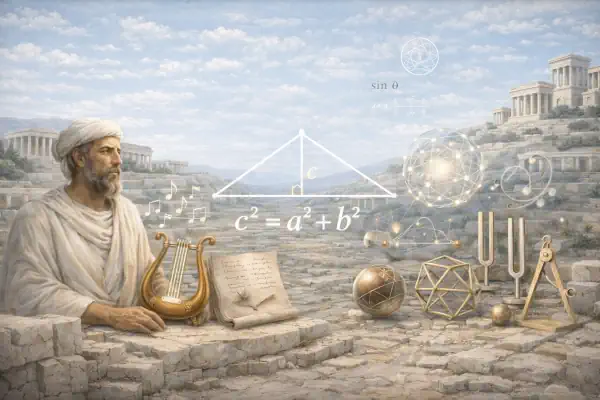
Alongside philosophy, ancient Greece also invents a new way of thinking about numbers and forms. With Pythagoras and his school, the harmony of the world seems capable of being translated into numerical relations. Even musical intervals reveal that the sensible may rest on a measurable structure.
This gesture is essential: reality is not only visible, it is also quantifiable. Numbers cease to be mere practical tools; they become keys to intelligibility.
With Euclid, this ambition reaches a monumental form. The Elements organize geometry through axioms, definitions, and demonstrations. Mathematical truth no longer depends directly on immediate experience; it proceeds from logical coherence. Abstract demonstration then enters permanently into the history of thought.
Why Greece Remains a Foundational Moment in the History of Science
In a few centuries, from Thales to Aristotle, humanity accomplishes a decisive transformation. The world ceases to be merely a theater of invisible powers; it becomes an order the human mind can interrogate. Natural phenomena call for causes, ideas require justification, and truth presupposes method.
Greece does not invent modern science in the full sense of the term. But it produces what made modern science possible: the idea that reality is intelligible, that argument is superior to authority, that doubt can be fertile, that the forms of reasoning can themselves be analyzed, and that mathematics offers a privileged language for thinking the world.
That is why its legacy extends far beyond antiquity. By making the world questionable, Greece also made possible everything that followed: method, experimentation, critique, demonstration, and more broadly a distinctively human way of seeking truth.
My own reading is both analytical and hopeful. Greece laid the foundations of science, logic, and debate, and in doing so it still speaks directly to our own age. In an era shaped by modern research, public controversy, education, and the permanent circulation of information, critical reason is not a luxury; it is a civil necessity. Greece reminds us that freedom of thought is not opposed to rigor, but fulfilled by it. The future belongs to societies capable of protecting both inquiry and debate, both reason and intellectual courage. That, to me, is the enduring premium lesson of the Greek moment.