
When Greece begins to think the world
One of the great turning points in human history takes place when the world ceases to be explained solely through myth. Jean-Pierre Vernant showed it clearly: ancient Greece does not merely provide new answers; above all, it invents a new way of framing questions. Sacred narrative does not vanish at once, but reason begins to trace its own path.
Tradition attributes to Thales of Miletus, around 585 BCE, the prediction of a solar eclipse. Whether the episode is perfectly accurate or partly reconstructed matters less than its symbolic force: the sky is no longer only a divine stage, but an intelligible phenomenon. With the Ionian thinkers, the world can be interpreted through natural causes.
Thales, Anaximander, and Anaximenes search for a first principle, an archè, capable of explaining the diversity of reality. In Anaximander, the apeiron, the boundless, already replaces divine intervention with an abstract hypothesis. It is a decisive mutation: the universe becomes debatable, interpretable, and arguable.
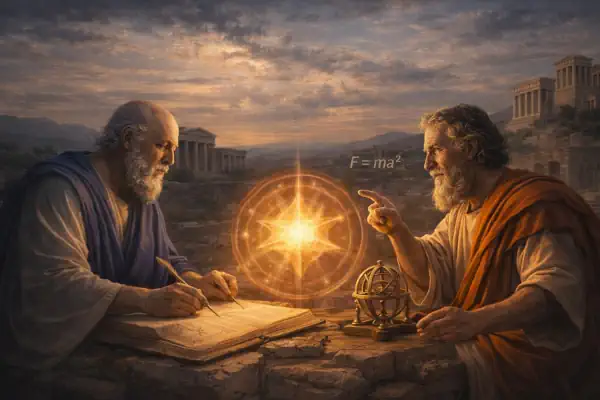
With Greece, knowledge ceases to be only transmitted or revealed: it becomes a public discussion about causes, forms, and proofs.
Reason, numbers, and public debate
Greek power lies not only in a few famous names, but in a new way of producing knowledge. In the fifth century BCE, Pythagoras and his school discovered that numerical relationships could describe real harmonies. Sounds, proportions, figures: everything seemed capable of being grasped through number. This intuition already anticipates the later idea that reality can be written in mathematical language.
With Socrates, inquiry also shifts toward critical examination, the coherence of arguments, and the rigor of dialogue. Plato institutionalizes this ambition by founding the Academy, while Aristotle systematizes logic in the Organon. Thought is no longer merely inspiration: it becomes method.
What ancient Greece puts in place
- the search for natural explanations rather than strictly mythical ones
- demonstration, argumentation, and logic as forms of validation
- the possibility of knowledge debated publicly within civic space
With Euclid, geometry is organized into rigorous demonstrations in the Elements. With Archimedes, mechanics and hydrostatics take on a mathematical form of exceptional depth. Greece does not yet build the industrial world, but it invents the mental architecture that will one day make that world calculable.
Rome: building and organizing the real
When Rome establishes itself across the Mediterranean world, it inherits a significant part of the Greek intellectual universe. Yet it redirects that legacy according to a different logic: less speculative, more practical, more administrative, more constructive. Where Greece seeks principles, Rome seeks durable systems.
The Aqua Appia, as early as 312 BCE, shows this desire to organize the city through engineering. Aqueducts, bridges, roads, sewers, baths, and forums are not merely isolated feats: they form a coherent system intended to sustain collective life. The Roman city becomes a political, social, and technical machine.
Roman concrete, the opus caementicium, testifies to this constructive intelligence. The Pantheon, with its monumental dome, embodies Rome's ability to transform technical knowledge into durable architecture. Likewise, the empire-wide road network enables not only the movement of armies, but also the circulation of trade, administration, and information.
The Roman genius: urban planning, law, and infrastructure
Rome's greatness lies in the fact that it thinks technique on the scale of a civilization. Roads connect, aqueducts supply, forums structure, baths gather, and public works organize daily experience. Roman urbanism is not a backdrop: it is a strategy of order.
This logic extends to law. Legal standardization, from the Lex Duodecim Tabularum to the great late compilations, reveals the same gesture: making society administrable, predictable, and transmissible. Rome does not build only in stone; it also constructs frameworks of operation.
That is why the Roman city must be understood as a system of controlled flows: water, people, goods, decisions, power. Where Greek thought learned to problematize reality, Rome learns to order it in space, in time, and within institutions.
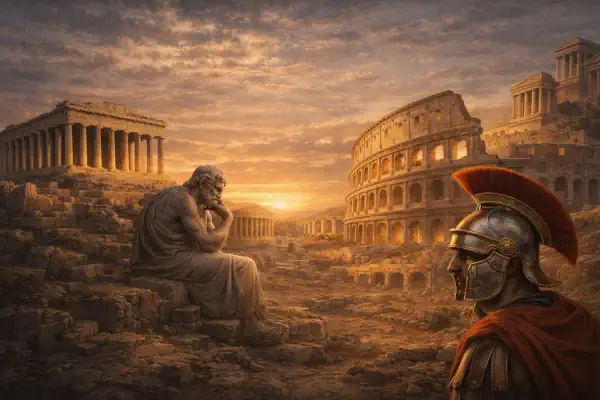
Two founding gestures, one civilization
The Greco-Roman legacy is best understood if we read it as a fruitful tension. Greece questions: it invents debate, demonstration, logic, and the mathematization of the world. Rome structures: it transforms these achievements into technical systems, infrastructures, institutions, and durable forms of power.
Without Greece, Rome would not have possessed the same conceptual depth. Without Rome, part of Greek thought would have remained confined to the horizon of schools, libraries, and learned circles. Together, they make possible a capital idea: the world can be understood through reason and transformed through technique.
It is in this articulation that a large part of Western science, engineering, law, urbanism, and political culture takes root. Greco-Roman civilization cannot therefore be reduced to monumental or literary heritage: it corresponds to a new way of inhabiting the world by thinking it, debating it, and building it.
