
Leonardo da Vinci and the intelligence of convergence
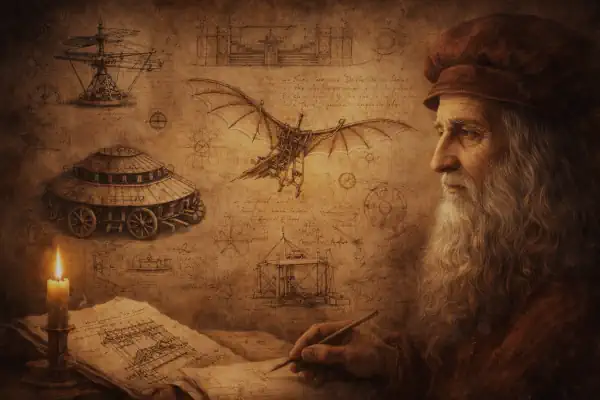
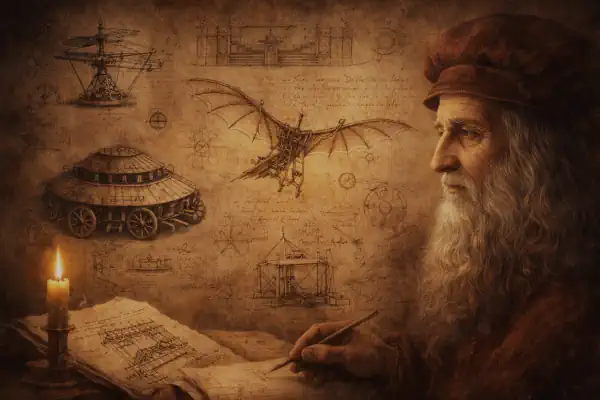
The singular power of Leonardo da Vinci lies not only in the variety of his talents, but in the way he connects fields that are often treated separately. For him, painting does not simply mean producing an image; it means understanding light, proportions, perception and the internal structure of forms. In the same way, designing a machine is not a matter of an isolated invention, but of a broader reading of the forces, movements and balances at work in nature.
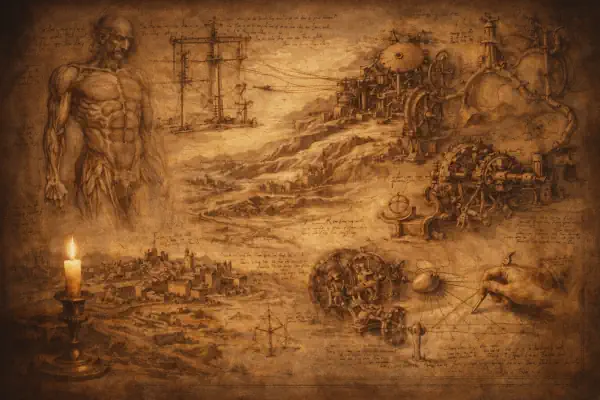
His notebooks reveal a way of thinking that constantly moves between scales and disciplines. An anatomical study may appear beside a gear mechanism, a hydraulic sketch or an observation of the flight of birds. This continuity is no accident: Leonardo is looking for transferable principles. He observes that living beings, matter, water, light and machines often obey comparable logics of tension, flow, rotation and transmission.
That is why he appears today as an early figure of technological convergence. Long before the industrial age, he sensed that real progress arises less from narrow specialization than from the ability to connect different bodies of knowledge in order to understand reality more deeply.
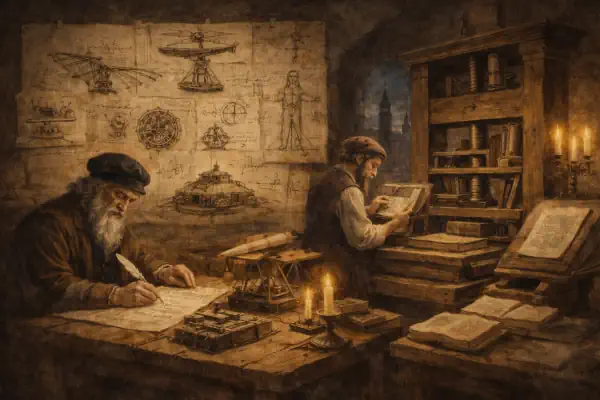
In Leonardo da Vinci, innovation does not emerge from a single domain: it is born from the meeting of observation of life, analysis of forces, geometry of forms and technical invention.
When the workshop becomes a laboratory of the future
The Italian Renaissance provided Leonardo with an exceptional environment. In cities such as Florence, Milan and Venice, workshops, urban building sites and princely courts were spaces where people built, measured, dissected, drew and experimented. Rediscovered ancient texts circulated alongside practical know-how. Technique had not yet been separated from art; both developed within the same material world.
Leonardo fully belongs to that world, but he pushes its logic further. He does not merely execute or illustrate: he interrogates mechanisms. When he observes an arm, he sees a system of levers; when he studies a flow of water, he identifies a dynamic of pressure and turbulence; when he draws a machine, he already seeks to understand its resistance, its transmission of energy and its breaking points.
This way of working anticipates a decisive shift: useful knowledge no longer depends only on tradition or manual dexterity, but on a combination of observation, precise representation and structural reasoning. The workshop thus becomes a place of thought as much as a place of fabrication.
Military engineering: thinking forces, masses and terrain
When he addressed Ludovico Sforza, Leonardo presented himself above all as an engineer. That detail is revealing. In late-15th-century Europe, war posed concrete problems: crossing a river quickly, moving troops, protecting positions, improving the range and efficiency of weapons. To answer them, Leonardo proposed detachable bridges, artillery devices, siege mechanisms and armored vehicles.
What matters here is not only the inventiveness of the forms, but the rigor of the method. His sketches show gears, screws, transmissions, inclined plates and distributions of load. In other words, he thinks of the machine as an organization of forces. Every detail implies an implicit calculation about weight, thrust, material resistance and efficiency of motion.
Military engineering thus serves him as a field of intense experimentation. The constraints are not abstract: they are immediate, measurable and sometimes vital. In that sense, war becomes a place where mechanics confronts reality. Leonardo is already applying one of the central principles of modern technology: the idea that an invention has value only if it answers a real physical problem within a given environment.
Flying machines: understanding air before trying to cross it
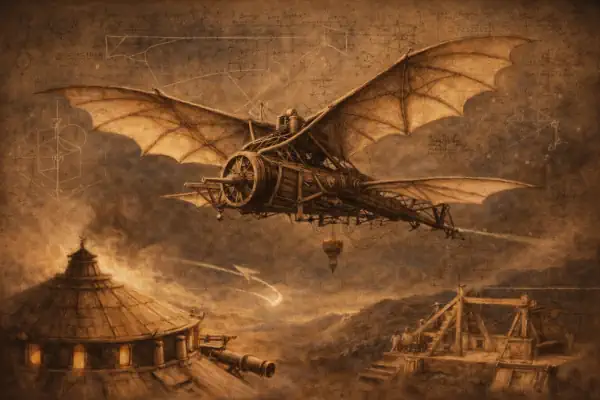
One of the most fascinating aspects of Leonardo’s thinking concerns flight. Where older traditions often treated this ambition in mythical or symbolic form, he reformulated it as a problem of observation and mechanics. Between the end of the 15th century and the beginning of the 16th, he studied the flight of birds with remarkable attention: wing inclination, feather curvature, the role of rising currents, and the relationship between mass and lifting surface.
His drawings of ornithopters and aerial devices translate this attempt at analysis. The body of the bird is no longer a marvelous model to imitate naïvely; it becomes a structure to decompose. Wings are thought of as lever arms, muscles as systems of traction, air as a medium with specific properties. Leonardo gradually understands that flight depends not only on muscular power, but on mastering an equilibrium between weight, surface and flow.
His method already follows a strikingly modern logic
- observe a natural phenomenon in meticulous detail
- identify the forces and proportional relationships involved
- design prototypes or models on the basis of that analysis
Even though the available materials and engines still did not allow these projects to be realized effectively, the underlying reasoning was already there: before inventing a vehicle, one must understand the medium in which it moves. In that sense, Leonardo anticipates a fundamental intuition of later aeronautics.
Hydraulics: reading the invisible forces of water
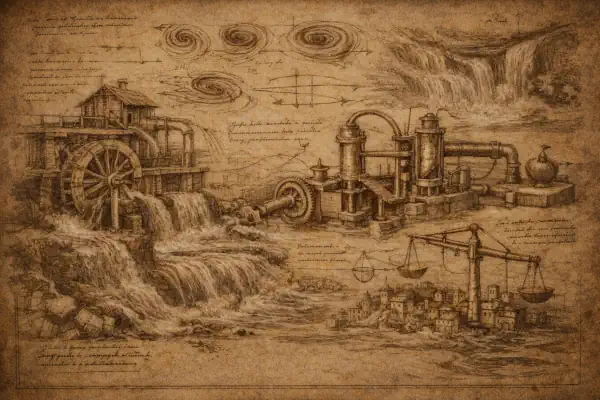
Water occupies a central place in Leonardo’s research. He does not treat it as a simple natural backdrop, but as an active force that shapes landscapes, transports matter, threatens cities and conditions exchanges. His work on canals, dams, diverted watercourses and irrigation systems shows a mind attentive to circulation, pressure and the effects of obstacles on flow.
What is impressive is the subtlety of his gaze on dynamic phenomena. He observes the acceleration of water in narrow passages, the formation of eddies behind an obstacle, and the way sediments are deposited when speed decreases. His vortices and spirals are not simple graphic motifs: they are attempts to represent transfers of energy and structures of flow.
In other words, Leonardo transforms drawing into a tool of analysis. Where modern fluid mechanics would later use equations, he proceeds through comparative observation, schematization and reasoning about effects. His method remains empirical, but it is already profoundly scientific in its intention: to understand in order to predict, and then to control.
Optics and mechanics: seeing in order to understand
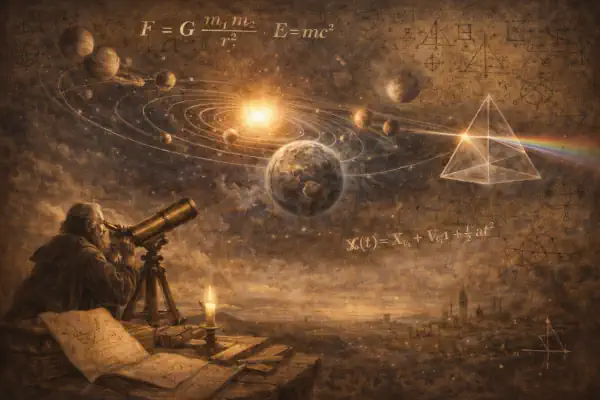
For Leonardo, vision is never a passive act. To see means to analyze how light propagates, how shadows are formed, how distance alters perception and how the eye transforms the visible world into an image. That is why his research on optics goes far beyond painting: it touches the very functioning of knowledge itself.
By studying light, atmospheric perspective and the camera obscura, he seeks to understand the material conditions of representation. The image is no longer merely a matter of style; it depends on vanishing lines, angles, contrasts and luminous trajectories. In the same way, when he dissects eyes or analyzes the structure of the human body, he attempts to connect perception, anatomy and geometry.
This continuity between optics and mechanics reveals a deep conviction: reality possesses an intelligible organization, and art can help reveal it, provided it relies on measurable principles. In that sense, painting becomes for Leonardo a form of inquiry into the laws that structure the visible.
A systems way of thinking about life, matter and form
What truly distinguishes Leonardo from many scholars or artists of his time is that he does not compartmentalize his research. Muscles remind him of ropes and pulleys; rivers evoke circulatory networks; cities can be thought of as organisms in which air and water must circulate properly; machines, in turn, imitate natural structures in order to transmit forces more effectively.
This way of comparing phenomena that seem far apart rests on a powerful idea: behind the diversity of forms, there are common structures. A whirlpool in water, an organic spiral, a rotation of gears or a muscular transmission may be understood according to analogous logics. Leonardo is therefore seeking not isolated objects, but models of functioning.
Today we would readily speak of systems thinking or interdisciplinarity. In the Renaissance, such an intuition was remarkably powerful. It already anticipates the modern sciences when they model complex wholes instead of merely adding together dispersed observations.
The golden ratio: when geometry becomes a language of the visible
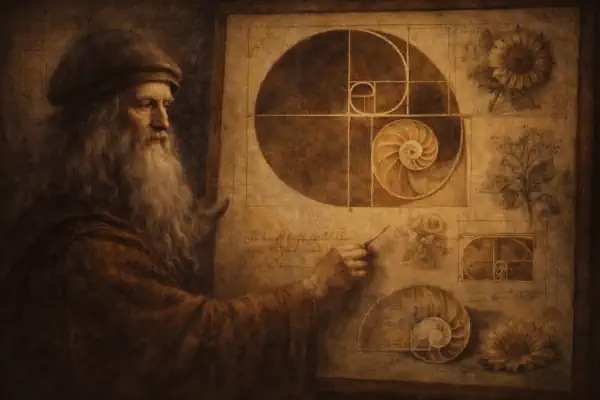
The question of the golden ratio helps us understand another essential aspect of Leonardo’s role. He was neither its inventor nor its main theorist, since this proportion was inherited from antiquity and taken up during the Renaissance by Luca Pacioli. However, Leonardo played a decisive role as a visual mediator. Through his drawings of polyhedra and his research on proportion, he transformed an abstract mathematical relationship into a form intelligible to the eye.
His illustrations for De divina proportione make the geometric structure of solids perceptible. They show that beauty is not merely a matter of ornament, but can be linked to proportional order and to an internal logic of forms. This gesture has major importance: it connects mathematics, perspective, architecture and perception.
In this, Leonardo acts less as a “discoverer” than as a translator between several worlds. He carries a numerical relationship into the field of drawing, space and visual experience. It is yet another way of making branches of knowledge converge.
Toward a modern technological way of thinking
Leonardo da Vinci’s legacy therefore cannot be reduced either to a few famous machines or to the romantic figure of the solitary genius. What he contributes most durably is a way of thinking about the world: to observe, compare, model, represent, correct and connect. His work rests on the idea that no domain of reality can be understood in isolation as soon as it participates in the same play of forces, proportions and movements.
That is why Leonardo may be read as a major early figure of technological convergence. For him, technology is valuable not only as a tool; it is also a mode of knowledge. Drawing becomes visual calculation, anatomy becomes mechanics, hydraulics becomes the study of flows, optics becomes a theory of perception, and art itself becomes a way of accessing the structure of reality.
Through this synthesis, the Renaissance reveals a new horizon: that of an intelligence capable of linking disciplines rather than opposing them. It is in that gesture, more than in any particular invention, that the modernity of Leonardo da Vinci truly lies.
