Rome Did Not Merely Conquer: It Learned to Organize
Many empires expand rapidly and then fragment for lack of structure. Rome stands apart because it turned conquest into order. As its territory grew, it put into place frameworks capable of surviving individuals, generations, and even political crises. This structuring capacity explains a large part of its longevity.
This system rested on several complementary dimensions: written law, legal statuses, the hierarchy of magistracies, provincial management, censuses, planned cities, and communication networks. None of these elements acted alone. It was their articulation that gave Roman power its force.
Rome thus invented a rare form of imperial coherence for Antiquity. It did not rule through military presence alone, but through its ability to classify, record, standardize, and circulate decisions across a vast space. Power became structure.
To me, this is one of the clearest bridges between Rome and the modern world. We still live through systems, rules, and layers of organization, just as Rome did. But unlike Rome alone, our world also carries part of the Greek inheritance: reflection, philosophy, debate, and the freedom to imagine differently. The internet and the spread of social networks have amplified that movement by turning knowledge-sharing into a global dynamic. In that sense, our era is not simply Roman or Greek: it is a civilization trying to combine Roman structure with Greek openness.
Roman greatness does not lie only in the scale of the Empire, but in this unique ability to transform domination into durable organization.
Roman Law: Writing the Rule in Order to Make It Last
One of Rome's founding gestures was to make the law visible. With the Law of the Twelve Tables, the rule ceased to be knowledge reserved to a few and became a public, opposable, and durable framework. This codification marked a decisive turning point: the city could now rely on a legal order more stable than human memory alone or the arbitrariness of the powerful.
Roman law then evolved alongside the expansion of the city. Alongside the ius civile, proper to citizens, a broader law developed, the ius gentium, allowing Rome to integrate relations with foreigners and the provinces. This adaptive capacity was essential: Rome did not freeze its legal order; it expanded it as the Empire changed scale.
What Roman law made possible in concrete terms
- making rules legible and less dependent on individual persons
- integrating diverse populations into a common legal framework
- turning law into an instrument of political and administrative continuity
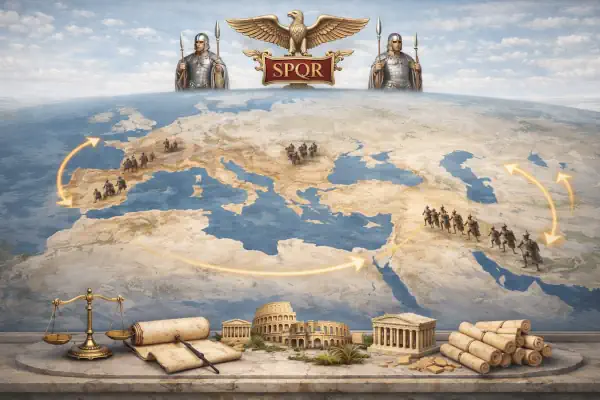
This movement culminated in the progressive extension of citizenship, up to the Constitutio Antoniniana of 212 CE, which extended Roman citizenship to almost all free men of the Empire. Roman law then ceased to be merely the law of a dominant city: it became the common language of an imperial whole.
Personally, I do not see this density of rules as a weakness in itself. On the contrary, I believe it is necessary to build something durable. A civilization that wants to last cannot rely only on improvisation, charisma, or momentum. It needs frames, written rules, and institutions capable of outliving those who created them. Rome understood that early. The real challenge is not the existence of structure, but whether that structure remains intelligent enough to support a living society instead of suffocating it.
Urban Planning: Organizing Space in Order to Organize Life
The Roman city was not a simple grouping of buildings. It was conceived as a system. The crossing of the cardo and the decumanus, the place of the forum, the street networks, hydraulic equipment, centers of power, and circulation spaces all composed an overall logic that made the city more legible and more governable.
This urban planning responded to concrete needs: circulation, administration, sanitation, the hierarchy of functions, and the visibility of power. Roman cities were often designed to be understood quickly by inhabitants as well as by administrators. The plan was not merely aesthetic: it was political.
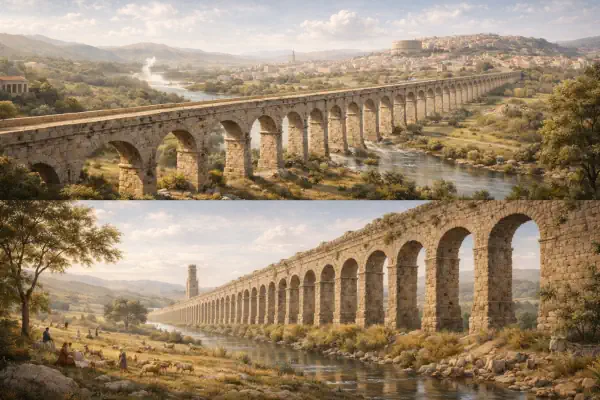
Infrastructure extended this same logic. Sewers, water supply systems, aqueducts, streets, and public buildings all participated in a common rationality. The Roman city became an organism maintained by flows, rules, and equipment. Built space was thus the material extension of Roman order.
What fascinates me here is that Rome was already building more than cities: it was building readable systems. That remains one of the great lessons for the future. Whether we are speaking about urban life, digital platforms, artificial intelligence, or public services, the central question is still the same: can we build environments that are both functional and intelligible? To build the future is not only to add innovation. It is to create forms that make collective life more coherent.
Governing Distance: Roads, Writing, and Administrative Hierarchy
Governing a vast empire without modern means of communication required exceptional logistical intelligence. Rome answered through networks. Roads ensured the circulation of armies, goods, dispatches, and administrators. They reduced political distance by making territories more accessible, more surveillable, and more tightly connected to the center.
The cursus publicus, the imperial postal service, played a fundamental role here. Thanks to relay stations, controlled routes, and regular organization, orders, reports, and information circulated across the Empire with remarkable speed for the time. Roman power was not merely centralized: it was relayed.
This logic also relied on writing. Administrative reports, archives, tablets, military orders, fiscal documents, and provincial correspondence made the Empire more legible. Rome governed as much through texts, registers, and procedures as through force. In such a system, writing, counting, and transmitting became acts of government.
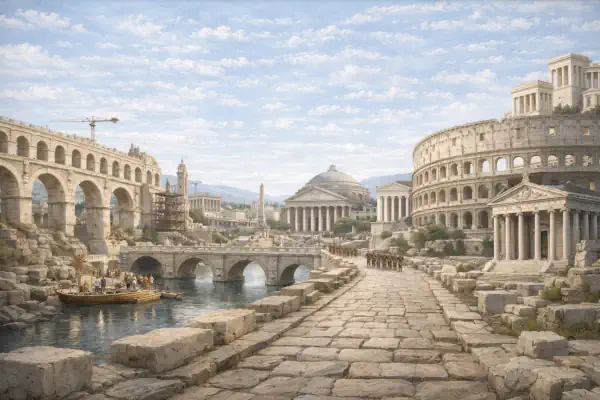
This is also why our world still feels Roman at its core. We live through administrative flows, data circulation, logistical chains, information systems, and platforms that relay decisions across distance. What changes is the speed and scale. What remains is the principle. And yet our era adds something else: knowledge no longer circulates only from the center outward. Through the internet and social networks, sharing also rises from below, from individuals, communities, and distributed intelligence. That is one of the major differences between our world and Rome.
Census, Classify, Integrate: The Roman Rationality of Government
The functioning of the Empire also rested on acts of classification. Censuses made it possible to evaluate populations, statuses, fiscal obligations, and sometimes available resources. Provinces were administered by governors, surrounded by apparatuses that were more or less dense depending on periods and circumstances. The Empire thus became a hierarchical, documented, and more predictable whole.
This rationality did not eliminate tensions or inequalities, but it gave Rome a decisive advantage: the capacity to process complexity. An empire of such scale could only last by turning the diversity of local situations into categories, procedures, and levels of decision. This is one of Rome's great contributions to political history.
The legacy of this system extends far beyond Antiquity. Roman law, taken up, compiled, and later rediscovered, durably nourished European legal traditions. The idea of a state supported by written rules, archives, territorial frameworks, and a hierarchical administration owes much to Rome. Its roads may have cracked and its monuments may have fallen into ruin, but its way of organizing the world still accompanies us.
My own conclusion is clear: one of the most important lessons Rome leaves us for the future is that to build, to imagine, and to shape tomorrow, we need more than isolated ideas. We need structures capable of carrying them. The future will not be built by inspiration alone, nor by rigid systems alone. It will be built when creative imagination can meet durable organization. In that sense, Rome still teaches us something essential: if we truly want to imagine the future, we must also learn how to build it.