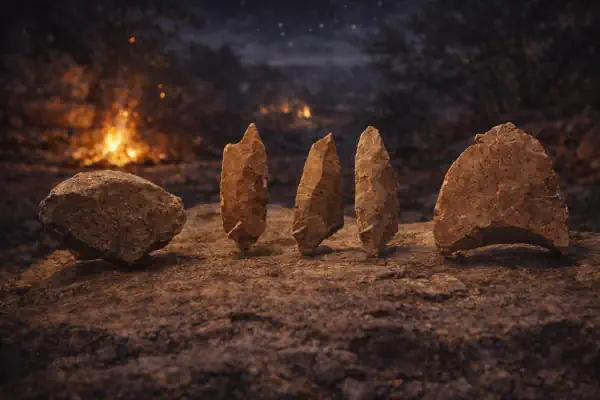
Simple stones, yet a profound intellectual revolution
Prehistoric tools are the earliest material witnesses of a human mind capable of transforming matter to achieve a precise goal. Behind a flaked pebble or a flint blade, there is already intention, anticipation of action, learning and often collective transmission. That is what gives these objects such immense value: they allow us to trace the gradual rise of human ingenuity over several million years.
The evolution of tools is not merely a history of technical forms. It also sheds light on the evolution of the brain, social behavior, hunting strategies, territorial occupation and, later, sedentary life. As tools become more specialized, human societies become more organized, more adaptable and better able to act durably upon their environment.
Prehistory can therefore be read as a long chain of concrete innovations. Every advance, however modest, opens a new possibility: to cut better, hunt better, build better, store better. In that sense, the first tools do not simply tell the story of survival; they already tell the origins of human technology.
The first tool is not merely a useful stone: it is the sign that a human mind has begun to imagine the world as something that can be transformed.
A technical chronology of human prehistory
From the earliest Oldowan choppers to the polished axes and pottery of the Neolithic, the history of prehistoric tools follows a clear progression: materials are chosen more carefully, forms are controlled more precisely, and uses become increasingly specialized. This evolution is neither instantaneous nor uniform, yet it reveals a deep tendency: technique gradually becomes a field of knowledge in its own right.
At first, a cutting edge is enough. Then come symmetrical hand axes, more complex chaînes opératoires, composite tools, specialized hunting weapons, bone objects and finally the implements linked to agriculture and settled life. At each stage, the tool becomes less improvised and more deliberately conceived, learned and refined.
The major stages to remember
- Oldowan: the first choppers and cutting flakes
- Acheulean: symmetrical, versatile hand axes
- Mousterian: prepared-core technology and the Levallois method
- Upper Paleolithic: blades, burins, harpoons and specialization
- Neolithic: polished axes, sickles, pottery and farming tools
Oldowan: the first choppers in history
The Oldowan industry represents one of the earliest beginnings of human technique. Appearing more than 3 million years ago, these very simple tools were often made from pebbles struck to produce a cutting edge. They may seem rudimentary, but they already express a fundamental break: nature is no longer merely used as it is, but modified to answer a need.
That flaked edge makes it possible to cut meat, scrape surfaces, crack bones or work plant materials. The efficiency of these tools lies not in their appearance, but in their immediate functionality. Even so, such simplicity already implies choices: selecting the right stone, understanding how it fractures, repeating an effective gesture.
The Oldowan therefore reveals more than a survival technique. It marks the emergence of operational reasoning, technical intelligence and a first material culture. With these tools, humanity enters a history in which thinking and making become inseparable.
Acheulean: the age of hand axes and symmetry
With the Acheulean, a new technical threshold is crossed. The hand axe becomes the emblematic tool of this long period, especially associated with Homo erectus. Unlike the Oldowan chopper, the hand axe is worked on both faces to produce a stable, balanced and often symmetrical form. This evolution indicates a new ability to foresee the final result before the shaping process is complete.
The hand axe is robust, versatile and durable. It can cut, scrape, dig, break or work wood. Yet its importance goes beyond mere efficiency: it reflects a more advanced technical thought, capable of sequence, regularity and standardization. People no longer flake stone simply to obtain a useful edge; they conceive a tool with an overall architecture.
The symmetry of many hand axes also shows that the human mind begins to integrate principles of form, control and perhaps even a visual or cultural dimension. The hand axe is therefore not merely an effective implement: it is also the sign of a more structured intelligence in its relationship to matter.
Mousterian and Levallois: preparing the tool before detaching it from stone
The Mousterian, often associated with Neanderthals, marks a major refinement in the art of stone knapping. The Levallois technique is its most famous expression. Its principle is remarkable: instead of detaching flakes at random until a useful shape appears, the knapper carefully prepares a core so that the future flake already has the desired size, thickness and form.
This method requires far more complex planning. The knapper must organize the core surface, anticipate the convexities, prepare a striking platform and act only at the right moment. The tool is therefore no longer simply shaped after extraction: it is mentally conceived before it exists. This is a decisive step in the history of technical cognition.
The flakes obtained are then used to produce scrapers, points and other specialized tools. Levallois improves efficiency, regularity and functional adaptation. It shows that prehistoric societies already mastered complex operational sequences, far removed from the simplistic image of a humanity improvising its techniques.
Upper Paleolithic: blades, burins, harpoons and growing specialization
The Upper Paleolithic corresponds to a period of spectacular technical diversification. Tools become more numerous, finer, more specialized and are produced from varied materials. Flint blades, long and regular, serve as the basis for a whole series of secondary tools. This logic already shows a form of rational production in which a single blank can support several uses.
Burins make it possible to work bone, antler and ivory with precision. Bone harpoons, meanwhile, illustrate a more refined adaptation to fishing and specialized hunting. At this stage, toolmaking no longer serves only essential tasks: it accompanies a society that is more complex, more mobile, more inventive and capable of exploiting different environments with remarkable flexibility.
This period also shows that technique advances alongside culture. Material innovations go hand in hand with the transmission of knowledge, social organization, portable art and symbolic behavior. Tools thus become one of the surest indicators of the growing power of human intelligence.
Neolithic: polished axes, sickles and pottery to transform the world
The Neolithic profoundly changes the function of tools. With agriculture, herding and sedentary life, technical needs are transformed. It is no longer only a matter of hunting, cutting or scraping, but also of clearing land, harvesting, storing and durably shaping a territory. Tools become the instruments of a new relationship to time, space and production.
Polished axes make it possible to fell trees and prepare arable land. Sickles are used to harvest cereals. Pottery makes it possible to store water, grains and processed foodstuffs. Each of these objects bears witness to a material revolution: humanity is no longer organizing only its immediate survival, but planning, conserving and structuring its collective life.
The Neolithic therefore shows that the evolution of tools directly accompanies the birth of villages, the accumulation of resources and the emergence of more complex societies. The tool is no longer only tied to the individual in action; it becomes part of the functioning of a community settled over time.
What Neolithic toolkits concretely change
- clearing and organizing agricultural land
- harvesting and then preserving plant production
- stabilizing domestic life and permanent villages
From immediate survival to durable human innovation
The evolution of the first prehistoric tools shows that human technique does not emerge all at once. It progresses through stages, adjustments, learning and transmission. A flaked pebble may seem modest, yet it opens an immense path: that of a species that no longer merely uses the world, but begins to modify it consciously.
Hand axes, Levallois points, specialized blades, harpoons, polished axes and pottery form a coherent chain. Each of these objects corresponds to a higher level of technical complexity, but also to a broader transformation of human behavior: hunting better, organizing space better, planning better, transmitting better.
In that sense, the first tools are not merely the remains of an ancient humanity. They are already the foundations of all future technologies. They remind us that innovation is not a modern phenomenon: it is rooted in the earliest technical gestures of our ancestors, at the precise moment when hand, brain and collective experience began to work together.