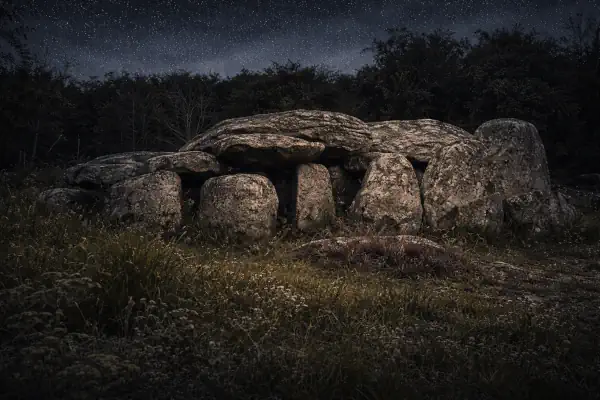
Why fire marks a major rupture in human evolution
Fire is not merely a useful discovery: it is a transformative technology. Where many tools improve one precise gesture, fire acts on several dimensions at once. It heats, illuminates, protects, alters matter, transforms food and reorganizes social interactions. From the moment human groups learned to preserve it and later to produce it, their relationship to the environment changed profoundly.
This rupture is decisive because it gives humans a means of acting upon their surroundings instead of only adapting passively to them. Fire makes certain territories more habitable, extends activity beyond nightfall and improves security within the camp. It becomes a pivot around which technical practices and collective life are organized.
To understand the invention of fire is therefore to understand one of the first great moments when humanity truly began to transform its world in an intentional and lasting way.
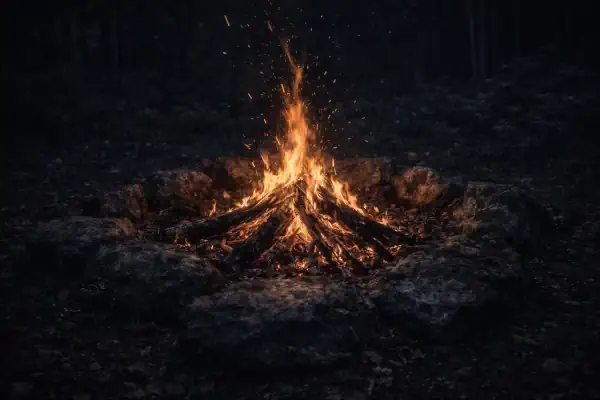
Mastering fire does not merely mean producing a flame: it means learning to create around it a space of safety, cooking, light and social life.
Before intentional ignition: the encounter with natural fires
The first humans did not invent fire out of nothing. They first encountered it in nature, in the form of wildfires caused by lightning, burning vegetation, or more rarely volcanic phenomena. This first stage is essential: it exposed human groups to a force that was at once dangerous and extraordinarily useful.
Natural fire was likely first observed, feared and then gradually exploited. Once a wildfire had passed, it became possible to recover glowing branches or still-active embers. The ability to transport and above all maintain this borrowed fire must have been a crucial skill. At this stage, the challenge was not yet to produce the flame, but to preserve it long enough for it to remain available at the camp.
This phase of appropriation passed through observation. Humans discovered that fire provides heat, repels certain animals, alters materials and transforms food. In other words, long before full mastery, natural fires had already opened a field of technical experimentation.
Mastering fire: from a rare resource to a stable tool
Between around 700,000 and 400,000 years ago, several archaeological clues suggest that certain human groups were no longer content to use occasional fires. They appear by then to have been capable of maintaining hearths over time, protecting them and reviving them. This gradual mastery was a turning point of enormous significance.
The remains of prepared hearths — reddened soils, charcoal, burned bones and stones altered by heat — do not merely testify to the presence of fire. They reveal repeated, organized use integrated into habitation. Fire was no longer an exceptional event: it entered the daily life of the group.
This stabilization required new forms of knowledge. It was necessary to choose the hearth’s location, manage its intensity, feed the flame, preserve the embers and protect the whole from wind and moisture. Such management implies vigilance, the transmission of know-how and probably a form of collective responsibility organized around the flame.
What mastering fire changes in concrete terms
- it secures lasting warmth and light
- it makes regular cooking possible
- it turns the camp into a more stable and better protected space
Producing fire: mineral percussion and wood friction
Once fire had been preserved and controlled, another decisive step was to produce it intentionally. This energy autonomy changed everything: the group no longer depended solely on the chance of a natural wildfire or on the fragile survival of a transported ember. It could light a hearth whenever conditions required it.
Among the best-known techniques is percussion between minerals, notably striking flint against an iron-rich stone such as pyrite or marcasite. The impact produces sparks capable of igniting a very dry material similar to tinder. This method requires precision, the right materials and careful preparation of the combustible support.
The other great family of methods relies on wood friction. By rapidly rubbing a hard element against a softer support, a heated dust is produced that eventually catches fire. Whether through a hand drill, a bow drill or other variants, these techniques reveal a practical understanding of materials, rhythm of motion and the conversion of mechanical energy into heat.
Producing fire was therefore not an instinctive gesture but a sophisticated skill. These techniques imply experimentation, learning and cultural transmission, which also makes them markers of the technical intelligence of prehistoric groups.
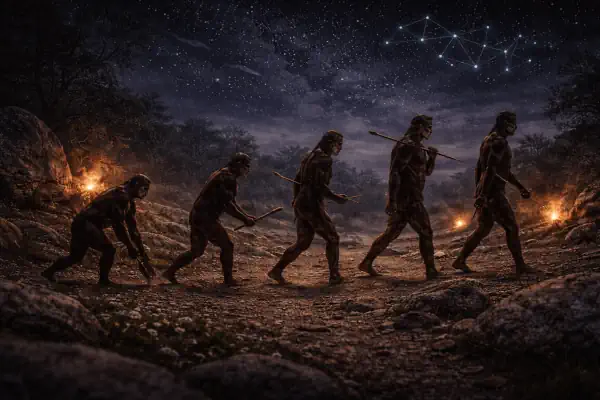
Cooking, protection, light and hunting: the major uses of the hearth
The use most often highlighted is cooking food, and for good reason. Cooking meat and certain plants makes them more digestible, safer and energetically more efficient. Fire thus transformed the human relationship to food: humans no longer merely consumed what nature provided, they modified it to gain greater benefits from it.
Fire also provided decisive protection. Its light and warmth drove away some predators, while smoke kept away certain insects. This increased security within the camp expanded the possibilities of settling in harsher environments and reduced part of the risks associated with the night.
By bringing light, fire also extended the day. Around the hearth, it became possible to maintain tools, prepare resources, exchange ideas, learn and perhaps tell stories. It structured a new nocturnal social space whose importance went far beyond pure practicality.
Finally, fire also played a role in hunting and in the organization of camps. It could be used to frighten or drive animals, to explore dark areas, to delimit inhabited space and to centralize daily life around a fixed point. The hearth thus became as much an infrastructure as a symbol of collective organization.
Why these uses deeply changed human societies
- they improved food quality and sanitary safety
- they strengthened protection and the stability of camps
- they created a shared space favorable to transmission and social cohesion
The consequences of fire: physiological change and social reorganization
The effects of fire extend far beyond immediate use. On the physiological level, cooking transforms access to energy. Softer, more digestible foods reduce chewing effort and optimize assimilation. Some researchers consider that, over the long term, this evolution may have contributed to major metabolic and anatomical changes within the human lineage.
On the social level, fire introduced a new center of gravity into collective life. The hearth stabilized the space of the camp, organized proximity between individuals, encouraged shared activities and extended exchanges beyond nightfall. It became a focal point around which protection, food, learning and sociability were articulated.
This centrality of fire likely reinforced the transmission of know-how and the coordination of the group. Keeping the flame alive, choosing fuel, igniting, maintaining and distributing its uses all required memory, cooperation and discipline. In this sense, fire did not only transform the material environment; it also reconfigured human relationships.
The invention of fire therefore represents a major threshold at which biology, technology and social life influence one another. A simple flame became, on the scale of evolution, an organizing force of the human condition.