
When knowledge changes speed
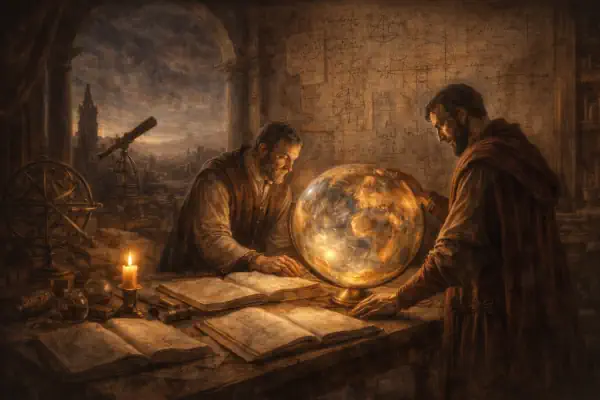
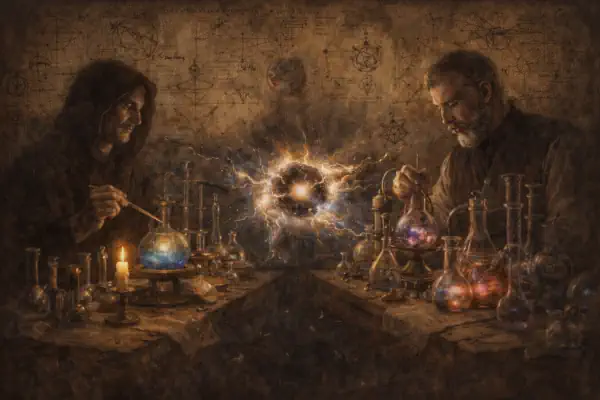
The explosion of knowledge in the Renaissance did not come from the sudden appearance of entirely new ideas. It rested first on a deeper transformation: knowledge changed its mode of circulation. What had been slow, rare, local, and often confined within specific institutions began to become more mobile, more comparative, and more cumulative.
At the threshold between the Middle Ages and the Renaissance, Europe was not an intellectual desert. It already had universities, masters, traditions of argumentation, and a shared scholarly language: Latin. Yet from the fourteenth century onward, several forces converged: the rediscovery of classical texts, renewed ways of reading, greater confidence in human powers of analysis, and, soon, the material amplification of diffusion through printing.
That shift produced a decisive effect. Knowledge no longer merely passed from one generation to the next; it began to be compared, corrected, disseminated more rapidly, and accumulated in a more visible way. More than a single event, it was this dynamic that gave meaning to the very idea of an “explosion.”
In my view, the Renaissance matters above all because it marks the moment when Europe learns to structure, transmit, and correct knowledge faster. That is what makes this period so modern in spirit: not simply the brilliance of a few masterpieces, but the emergence of a new rhythm of intelligence.
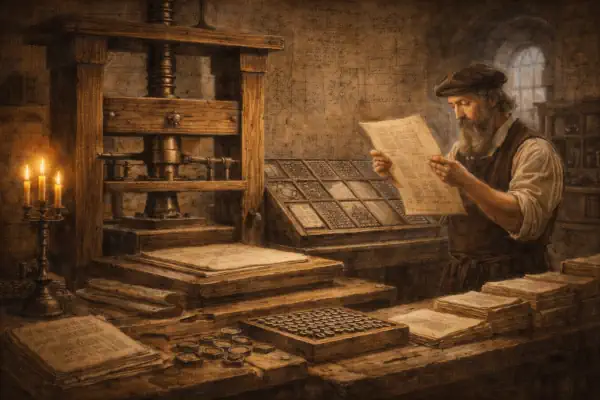
The Renaissance did not create thought out of nothing; it transformed the way ideas circulate, are tested, confront one another, and become a shared intellectual heritage.
Medieval universities: the intellectual framework before the turning point
To understand the Renaissance, one must first correct a common misconception: the late Middle Ages were not simply an age of darkness. Long before humanism, Europe had already established institutions capable of organizing learned transmission. The universities of Paris, Bologna, and Oxford structured an intellectual space in which teaching, debate, and the training of elites took on a durable form.
Their importance went beyond the accumulation of knowledge alone. They invented a way of working intellectually. The disputatio, with its arguments, objections, distinctions, and syntheses, trained minds to analyze and rank problems. Scholasticism did not yet produce the humanist spirit, but it gave Europe a powerful logical toolkit.
This point is essential: the Renaissance did not destroy the medieval inheritance; it displaced it. The conceptual rigor forged in universities made possible a more critical reading of texts, a greater capacity for comparison, and later an opening toward other objects of study such as nature, the body, philology, or history.
In that sense, the medieval centuries prepared the coming intellectual expansion in depth. They offered Europe institutions, methods of reasoning, and a common horizon without which the faster circulation of ideas would have lacked structure.
The return of the Ancients: manuscripts, exile, and a new critical spirit
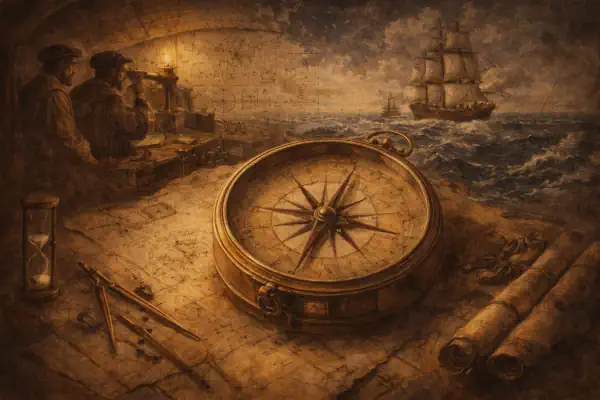
One of the great engines of the Renaissance was the reappearance of classical texts that had been forgotten or insufficiently known in the Latin West. This phenomenon unfolded over time, but it accelerated through exchanges between Italy and the Byzantine world, and later through the movement of Greek scholars after the fall of Constantinople.
These circulations did more than bring new books; they changed Europe’s relationship to the past. Plato’s texts, Greek mathematical treatises, philosophical works, and learned writings returned to an intellectual space now capable of comparing, translating, and debating them. Antiquity was no longer merely an abstract authority; it became a field of work.
Figures such as Bessarion played a decisive role here. By transporting and preserving Greek manuscripts, then entrusting them to major centers such as Venice, they helped shift the center of gravity of Europe’s learned culture. The library became a strategic site of intellectual transformation.
Yet this rediscovery did not lead to simple admiration. It gave rise to a new critical spirit. Comparing versions, translating carefully, contextualizing sources, and analyzing variants gradually imposed a culture of textual precision. Reading became a form of investigation.
Petrarch, Erasmus, Pico: the birth of a humanism centered on the human being
The rediscovery of classical texts would not by itself have transformed Europe without a new way of reading them. That is precisely what we call humanism. With it, ancient works ceased to be consulted merely to confirm tradition; they became partners in thought.
Petrarch embodies this first moment. By seeking out forgotten Latin texts and rereading Cicero as a living voice rather than as a frozen authority, he opened a more personal and inward relationship to knowledge. Antiquity ceased to be a reservoir of quotations; it became a conversation.
This movement deepened with Erasmus, who placed the return to sources, ad fontes, at the center of his work. To read better, compare more, correct errors, and understand before repeating: this philological demand renewed the study of sacred texts as well as ancient authors. Knowledge thus gained both precision and critical freedom.
With Pico della Mirandola, humanism took on an even more ambitious tone. Human beings were no longer merely readers shaped by tradition; they became beings capable of shaping themselves, elevating themselves through study, judgment, and the exercise of freedom. This affirmation of human intelligence was not only a moral shift; it also prepared a new confidence in the capacity to observe, understand, and act upon the world.
What humanism changed in the long run
- it turned the return to sources into a demanding intellectual method
- it valued critical reading over passive repetition
- it refocused attention on the dignity, responsibility, and creative power of the human being
- it prepared a more open intellectual culture, one more receptive to inquiry, comparison, and the reform of knowledge
My own reading of this moment is that humanism remains powerful because it combines rigor and confidence. It does not glorify the human mind in a naïve way; it asks it to become more exacting. That balance still matters today, especially in an age where access to information is immediate but depth of judgment is not.
Gutenberg: when knowledge changes scale
Humanism renewed the contents and methods of reading; printing, for its part, radically transformed the material infrastructure of knowledge. With movable type, Johannes Gutenberg did not merely produce a faster technical tool: he altered the very conditions of intellectual diffusion.
Before printing, manuscript copying made texts expensive, slow to reproduce, and vulnerable to significant variation. With print, more numerous, more uniform, and more easily comparable copies circulated on a new scale. Knowledge became more stable in form, yet more dynamic in diffusion.
This change had several major effects. Ideas crossed borders more easily. Errors could be spotted through comparison. Annotations, corrections, and commentary entered an intellectual space that had now widened. The authority of a text no longer depended solely on rarity or antiquity; it also depended on circulation, critical reading, and the capacity to be taken up again.
Printing thus gave knowledge a new technical memory. What had been produced could now be taken up, corrected, enriched, and reissued more quickly. It was one of the essential conditions for the cumulative knowledge that would define modernity.
This is also where the parallel with our own time becomes unavoidable. The speed of knowledge circulation today is vastly greater still, but the lesson of the Renaissance remains intact: acceleration alone is not enough. A civilization progresses when it learns not only to publish faster, but also to verify better, compare more carefully, and correct itself without delay.
Comparing, correcting, contextualizing: philology as an instrument of truth
The explosion of knowledge in the Renaissance did not depend only on the number of texts available. It also relied on a new demand for method. Reading an ancient document no longer meant simply accepting it; one had to situate it, compare it, examine its language, and assess its historical coherence.
Lorenzo Valla illustrates this turn brilliantly. By demonstrating that the Donation of Constantine was a forgery through linguistic and contextual analysis, he showed that a text could be unmasked not by a higher authority, but by the rigor of examination. Language itself became a critical instrument.
This evolution was decisive for European intellectual history. It established the idea that the truth of a document, source, or testimony depends on procedures of verification. Knowledge was no longer merely received; it was controlled. This culture of textual control already announced, in another register, the spirit of future scientific methods.
When ideas become a European network
Once brought together, recovered texts, universities, humanism, and printing produced a systemic effect. Knowledge was no longer inscribed only in fixed places; it became circulation. Venice, Florence, Paris, Basel, Leuven, Oxford, Bologna, and Rome all participated in a denser intellectual space in which works, translations, controversies, and commentaries answered one another.
This phenomenon profoundly changed the status of knowledge. An idea was no longer condemned to remain local. It could be read elsewhere, taken up again, contradicted, amplified. Learned Europe began to function as a more interconnected whole. The library, the university, the printing workshop, and the humanist circle now formed the nodes of one and the same network.
This accelerated circulation also had a methodological consequence: it imposed comparison more strongly. When a text traveled, it encountered other texts. When a thesis was published, it could be debated far away. When an error circulated, it could also be corrected more quickly. Knowledge then began to live through exchanges, revisions, and successive reworkings.
Every era, I believe, has its own revolution in the circulation of ideas. The Renaissance had manuscripts, workshops, translators, and letters; we have digital infrastructures, platforms, and intelligent systems. The tools change, but the decisive question remains the same: can a society turn speed into clarity rather than confusion?
The intellectual root of modernity
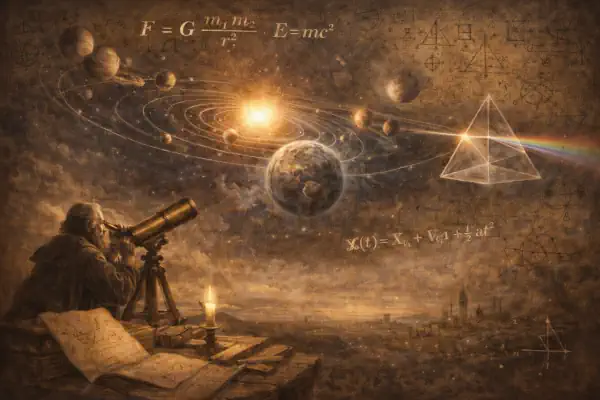
The explosion of knowledge in the Renaissance was not simply a cultural brightening. It prepared a lasting change in the way truth would be produced. By strengthening critical reading, comparison of sources, circulation of texts, and confidence in human intelligence, it created the conditions for a future science that would be more experimental and more cumulative.
The shift is essential: knowledge began to be conceived as an expanding flow, not as a closed inheritance. That idea alone profoundly changed European history. It opened the possibility of a world in which one could learn from the ancients without being submitted to them, correct errors without destroying tradition, and advance knowledge through reflective accumulation.
This is why the Renaissance must be understood as a hinge moment. It did not invent everything that followed, but it provided the mental, textual, and material infrastructure that made later transformations possible, from modern scientific method to the rise of specialized disciplines and the growing technologization of societies.
In that sense, the true explosion was not only that of books. It was the rise of a new conviction: that knowledge can grow, circulate faster, be corrected, accumulate, and permanently transform humanity’s relationship to the world.
To me, that is the lasting lesson of this period. A civilization becomes stronger when it understands that knowledge is not a static treasure to be guarded in silence, but a living force that must be organized, transmitted, questioned, and improved. The Renaissance shows us that each age invents its own channels for ideas; our responsibility is to ensure that those channels elevate understanding rather than merely multiplying noise.
