Before institutions, letters: Europe connected through ink
Before academies, laboratories, or regular scientific journals, it was scholarly correspondence that provided Europe with its first true intellectual network. Thousands of letters circulated between astronomers, physicians, mathematicians, naturalists, philosophers, and learned men. They carried observations, objections, hypotheses, but also something essential: trust.
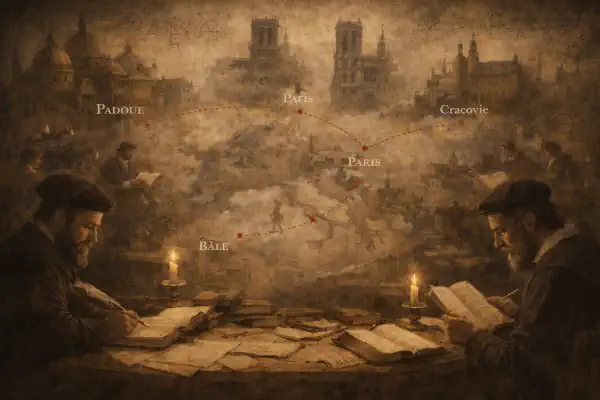
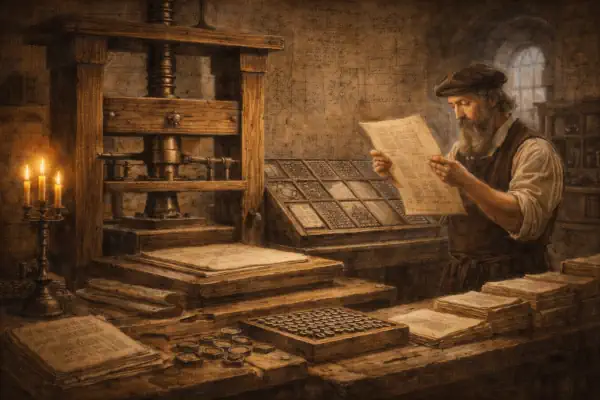
Printing, born from Gutenberg’s innovation, profoundly changed the circulation of texts, yet the handwritten letter retained a central role. It allowed exchanges that were faster, more targeted, and more personal. A scholar in Padua could debate with a colleague in Paris, a physician in Basel could comment on the work of a Flemish anatomist, and an Italian astronomer could make his observations known throughout Europe.
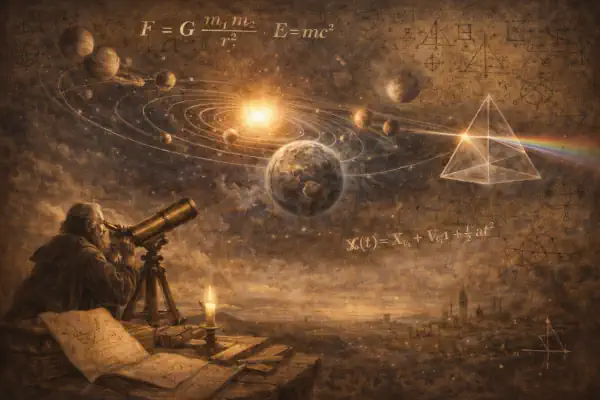
When Galileo Galilei revealed in 1610 his observations of Jupiter’s satellites, the news spread precisely through this intertwined system of letters, copies, and printed material. Knowledge became mobile. It no longer depended exclusively on the place where it had been produced. It entered a space of discussion that exceeded political and confessional borders.
This written infrastructure had decisive importance. It did not merely transmit results; it created the conditions for collective validation. Little by little, scientific truth ceased to be purely local. To be recognized, it had to circulate, be read, discussed, challenged, and confirmed by others.
What strikes me most here is the circulation of knowledge itself. For me, that is the real turning point. A discovery matters, of course, but it changes history only when it can leave the hands of one individual and enter a wider human conversation. In many ways, this early scientific Europe already foreshadows what Internet culture, open source communities, and platforms like GitHub would later make visible on a much larger scale.
A scientific community does not appear only when scholars discover; it is born when they can read one another, answer one another, criticize one another, and build a shared memory.
From circles to academies: science becomes an organized practice
In the 17th century, informal exchanges began to take on a more structured form. Groups of scholars met regularly to compare observations, examine experiments, and discuss methods. This passage from diffuse circulation to more stable organization marked a major rupture: science gradually became an institutional collective activity.
The creation of the Royal Society in London, officially recognized in 1662, symbolizes this transformation. Its motto, Nullius in verba, affirms that authority should no longer rest on the mere word of the Ancients or on the prestige of a name, but on facts that can be debated and reproduced. A few years later, the French Academy of Sciences in Paris followed a comparable logic by giving research a more regular and visible framework.
These institutions did not merely gather scholars together; they established new intellectual habits. Memoirs were exchanged, procedures described, and results compared. Experiment ceased to be an isolated act and became an object of communication and collective control.
In this sense, academies were far more than showcases of monarchic or urban prestige. They were social laboratories of scientific thought. They helped bring forth a common culture of evidence, disciplined discussion, and learned cooperation.
I also think this is where a useful criticism of the present begins. Science today is often more powerful than ever, yet it can also feel too closed, too difficult to access, and too confined within institutional walls. The Renaissance reminds us that the strength of knowledge lies not only in rigor, but in the ability to create spaces where rigor can actually circulate.
The Republic of Letters: a learned nation without borders
As exchanges multiplied, European scholars began to see themselves as members of a common intellectual space. This space gradually acquired a name: the Republic of Letters. It was not a state nor a centralized institution, but an ideal community grounded in the circulation of knowledge.
In this symbolic republic, citizenship depended neither on birth nor territory, but on participation in research, reading, discussion, and writing. Latin played a fundamental role here: it served as a shared language and allowed texts to be read from Lisbon to Kraków, from Padua to Paris, from Leiden to London.
Figures such as Marin Mersenne perfectly embody this networked world. Through his correspondence, he connected thinkers, transmitted problems, circulated answers, and linked circles that without him would have remained separate. The Republic of Letters thus functioned as an infrastructure of mediation: it connected, filtered, transmitted, and organized.
Its importance went beyond scholarship alone. By making knowledge something shareable and discussable beyond borders, it introduced one of the essential ideas of scientific modernity: knowledge does not belong exclusively to a city, a university, a Church, or a prince. It belongs to a wider horizon, potentially universal.
That idea still speaks to me today. Helping people think means, in part, helping them enter that wider horizon. Knowledge becomes truly fertile when it is not locked inside a closed circle, but offered to others in a way that may awaken reflection, vocation, or even genius where no one expected it.
From authoritative text to observation: a revolution in the source of truth
The emergence of a European scientific community cannot be understood only through the networks that connected scholars. It also presupposed a deeper transformation: the displacement of the authority of knowledge. For centuries, ancient texts and their interpretation had largely dominated intellectual life. The Renaissance and then the 17th century did not abolish that inheritance, but they changed its hierarchy.
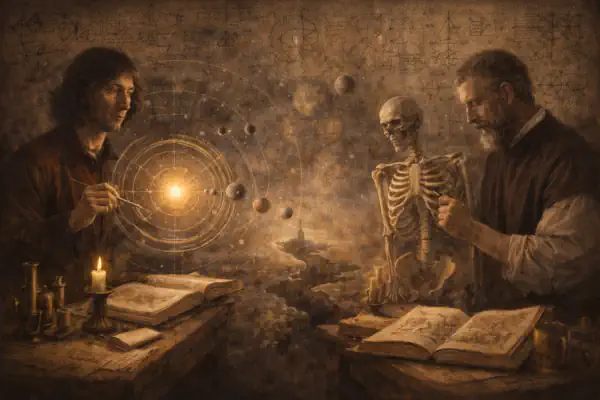
The year 1543 is emblematic in this regard. Copernicus published De revolutionibus orbium coelestium, reformulating the cosmological order. That same year, Vesalius published De humani corporis fabrica, grounded in direct observation of the human body. Two domains, one common logic: it was no longer enough merely to comment on tradition; one had to look, measure, and verify.
At the beginning of the 17th century, Francis Bacon formalized the importance of methodical observation and experiment, while René Descartes advanced methodological doubt as a principle of rigor. In both cases, truth was built less through fidelity to authority than through an effort of testing.
This transformation changed the very nature of the learned community. If knowledge must be observed, experimented upon, and discussed, then it requires a collective capable of examining it. Modern science was born not only from new ideas, but from a new regime of validation in which experiment, confrontation, and the publicity of results took on a central role.
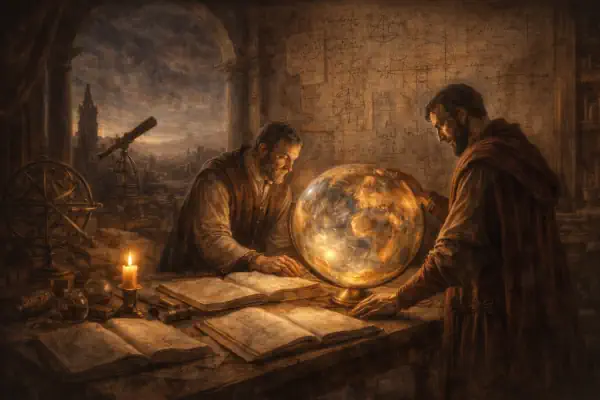
A collective intelligence on a European scale: the foundation of modern science
Between the 16th and 17th centuries, what took shape was not merely a series of technical or theoretical discoveries. It was a new way of producing truth. A truth more collective, more discussed, more verifiable, and more circulating. Letters, academies, debates, translations, and printed works together formed an environment in which ideas no longer remained enclosed within their place of origin.
This turning point had lasting consequences. It allowed knowledge to become cumulative, because results could be preserved, revisited, criticized, and extended. It also allowed science to become European before it became fully international: a scholar no longer wrote only for his students or his prince, but for a wider space of competent readers.
That is why the European scientific community constitutes one of the invisible foundations of the contemporary world. International collaborations, scientific journals, critical peer review, and major research networks all extend, under new forms, the logic born in the Renaissance. Europe did not merely rediscover antiquity; it invented a durable form of organized collective intelligence.
What this scientific community changed in the long run
- it connected scholars beyond political and religious borders
- it transformed the letter, the book, and the academy into infrastructures of knowledge
- it made critical discussion a condition of scientific validation
- it shifted authority away from inherited texts toward observation and experiment
- it prepared modern science by making discoveries cumulative, comparable, and shareable
This is where I would place my own signature on the subject: scientific revolution is not only about discovery, but also about the capacity to share. If knowledge remains in the hands of one specific person among billions of human beings, then humanity loses a part of its future. A single idea, once shared, may open the door for a future genius.
A living legacy in the way we search, publish, and cooperate
The European scientific community born during the Renaissance left behind a methodological legacy as important as its discoveries. It established the idea that no serious knowledge can suffice unto itself if it is not exposed to the reading of others, to criticism, and to confrontation with other forms of evidence.
This principle remains at the heart of contemporary research. The forms have changed, the scale has become global, the tools are digital, but the logic remains the same. A scientific discovery fully exists only when it can enter a common space of examination, memory, and transmission.
In this sense, the history of the European scientific community is also the history of a civilization learning how to organize disagreement, institutionalize proof, and turn the circulation of ideas into a lever of progress. It is one of the great intellectual inventions of modernity.
That is also why this subject matters to me beyond historical interest alone. It helps foster reflection. It reminds us that knowledge is not only something to possess, but something to pass on. A civilization advances when it creates the conditions for minds to meet, challenge one another, and continue what others began.