The origins: the promise of a mechanical mind
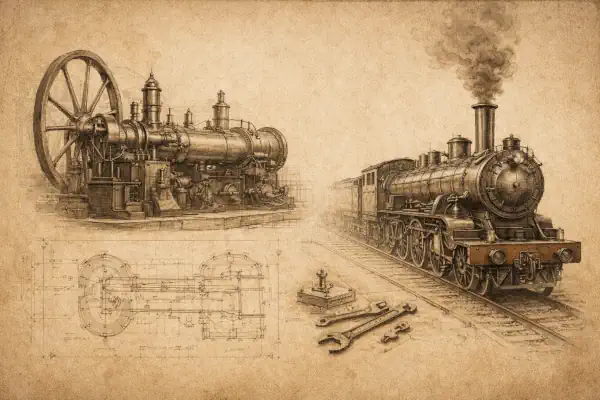
The history of artificial intelligence begins less with robots than with a foundational idea: can a machine manipulate information in a sufficiently complex way to reproduce certain functions of human intelligence? After the Second World War, that question became technically credible with the emergence of the first electronic computers and logical architectures capable of processing instructions in sequence.
In 1945, John von Neumann formalized an architecture that would permanently shape modern computing. A few years later, the 1956 Dartmouth conference gave intellectual form to a new field: artificial intelligence. The challenge was no longer simply to calculate quickly, but to represent problems, reason, learn, and automate tasks that had previously been associated with the human mind.
This first phase established a decisive horizon: if reasoning can be modeled, then part of intelligence becomes technically programmable. AI was born from that ambition, at once scientific and philosophical, to transform thought into a formal process.

Artificial intelligence was not born from a single algorithm, but from a major historical shift: moving certain functions of the human mind into the domain of computation, modeling, and automation.
Neural networks and learning: when machines begin to see
As early as 1958, Frank Rosenblatt introduced the perceptron, one of the first artificial neural network models. The idea seemed simple, yet its implications were profound: instead of imposing every rule on the machine, researchers sought to let it adjust certain parameters from examples. The machine no longer merely executed; it began to learn.
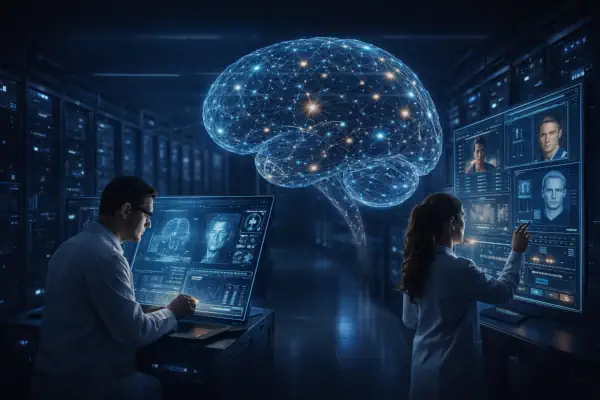
Long constrained by limited computing power and insufficient data, these approaches gained new momentum from the 1980s onward, and even more so in the 1990s. The work of Geoffrey Hinton, Yann LeCun, and other researchers advanced neural architectures capable of recognizing shapes, faces, characters, and then increasingly complex objects in digital environments.
What machine learning changed
- the machine can extract patterns from examples rather than rely only on rules written entirely in advance
- visual, audio, and language recognition gain in precision and scale
- AI becomes operational in concrete fields such as medicine, finance, and logistics
At this stage, AI changes in nature. It is no longer only symbolic or theoretical: it becomes statistical, experimental, and massively dependent on data. That transition is one of the major turning points in its contemporary history.
Autonomous robots and assisted medicine: intelligence moves beyond the screen
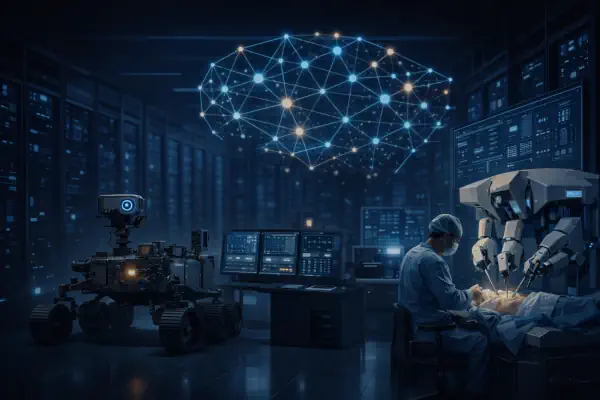
One of the most important transformations in contemporary AI is its passage from the purely software world into the physical one. When integrated with sensors, navigation systems, or precision instruments, artificial intelligence ceases to be a computational abstraction: it becomes a capacity for action.
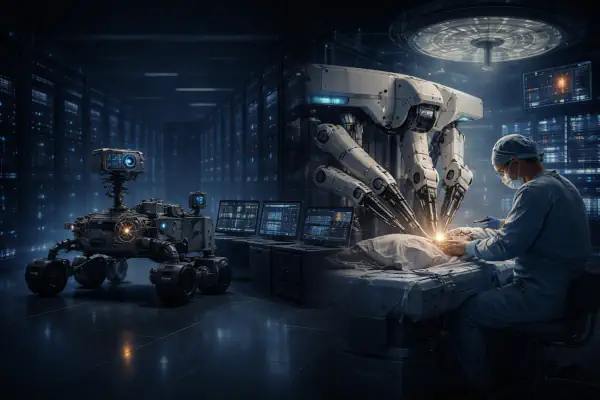
Autonomous robots are a striking expression of that shift. In hostile or distant environments, such as space exploration, a machine capable of perceiving, assessing its surroundings, and adjusting its trajectory represents a valuable form of technical autonomy. The Curiosity rover symbolizes that ability to observe, decide locally, and produce knowledge without permanent step-by-step human control.
In hospitals, computer-assisted surgical systems reveal another dimension of this evolution. With platforms such as the Da Vinci Surgical System, AI enters domains where precision, repeatability, and instrument-based assistance become decisive. Here, the machine does not replace the physician; it amplifies certain capacities of execution and control.
AI in our lives: invisible, diffuse, and already structuring
Artificial intelligence does not appear only in laboratories, robots, or operating rooms. It also acts through ordinary gestures of digital life. Content recommendations, anomaly detection, search engines, filtering, translation, behavioral analysis, software assistance: an ever larger share of contemporary experience is mediated by systems of inference and prediction.
This presence is often discreet, even imperceptible. Yet it profoundly reshapes decision circuits. What we see, buy, listen to, read, or prioritize increasingly passes through models that rank information on our behalf. AI is becoming an everyday cognitive infrastructure.
That shift has major economic and social implications. When an algorithmic system influences work, consumption, access to information, or the evaluation of complex situations, it is no longer merely a matter of technical innovation. It becomes a new layer of world organization, with its performance gains but also its effects of dependency, bias, and opacity.
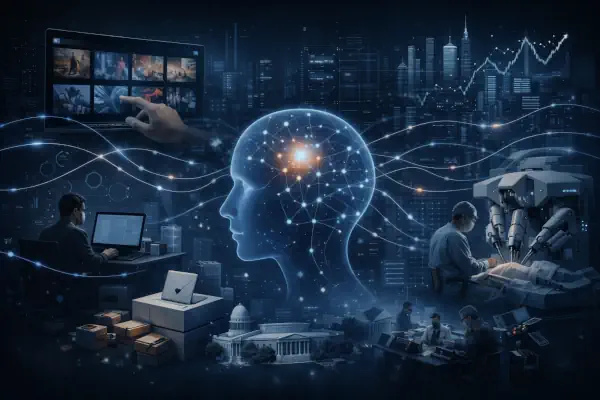
A reflection on the future: power, responsibility, and the mirror of our ambitions
What makes artificial intelligence historically decisive is not only its growing sophistication. It is the fact that it forces us to rethink how roles are shared between the human, the machine, and decision-making. As systems become able to learn, recommend, anticipate, or act, the question is no longer only technical: it becomes political, ethical, and civilizational.
AI acts as a mirror. It reflects our ambitions for mastery, our desire for optimization, our fascination with machine autonomy, but also our anxieties in the face of error, excessive delegation, and the loss of readability in the decision-making world. It is not external to our societies: it condenses their priorities, their economic choices, and their limits.
Understanding the history of AI is precisely what allows us to move beyond fantasy. Behind spectacular narratives lies a trajectory built in successive layers: calculation, modeling, learning, perception, action, integration. That continuity is what gives artificial intelligence its real depth: not technological magic, but a progressive power of organization, simulation, and intervention in the real world.