Why divide prehistory into major periods?
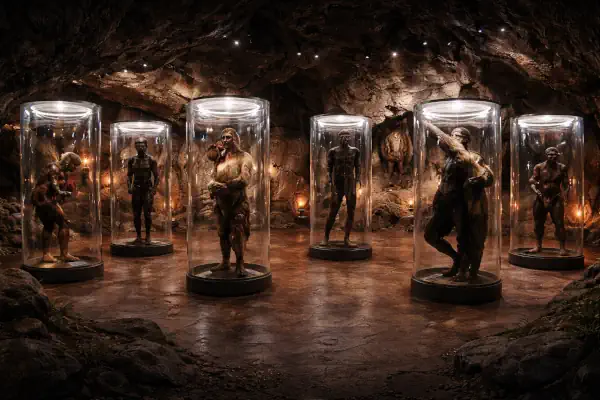
Prehistory spans several million years. Such an immense duration can only be understood by distinguishing major phases corresponding to technical, ecological and social changes. Dividing it into the Paleolithic, Mesolithic and Neolithic is therefore not an artificial simplification of the past: it makes it possible to identify the great thresholds that transformed the human condition.
Each of these periods reflects a different relationship to territory, resources, tools and collective organization. The Paleolithic corresponds to the very long dominance of ways of life based on hunting, gathering and mobility. The Mesolithic marks an important phase of adjustment after the end of the Ice Ages. The Neolithic, by contrast, opens onto food production, lasting sedentism and the structuring of more complex communities.
Reading prehistory through these major sequences makes it possible to understand that human evolution was neither a matter of instant progress nor a simple accumulation of objects, but a succession of intelligent responses to changing environments and new collective needs.

The major periods of prehistory are not simple chronological markers: they reveal three successive ways of inhabiting the world, producing resources and organizing human life.
The Paleolithic: the very long matrix of technical humanity
The Paleolithic, or “Old Stone Age,” is by far the longest phase of prehistory. It begins with the earliest known lithic industries and extends until the end of the last great glacial period, around 10,000 BCE. This immense duration is enough to remind us of an essential fact: humanity lived the vast majority of its history in mobile societies, without agriculture, yet already capable of constant innovation.
It is during this period that the first great technical foundations were established: stone knapping, the gradual improvement of tools, the controlled use of fire, more organized hunting, and the diversified exploitation of environments. Human groups adapted to extremely varied settings, from African savannas to the cold regions of Eurasia. Toolkits, initially simple, became more specialized over time, revealing an increasingly sophisticated operational intelligence.
The Paleolithic should not, however, be reduced to material survival alone. It also witnessed the emergence of symbolic behavior, funerary practices, forms of art and denser networks of cooperation. In that sense, it constitutes the technical, social and cultural matrix of humanity.
What the Paleolithic established for the long term
- the use and diversification of stone tools
- the gradual mastery of fire and environments
- the first forms of art, symbolism and durable social organization
At the origins of the Paleolithic: the first hominins
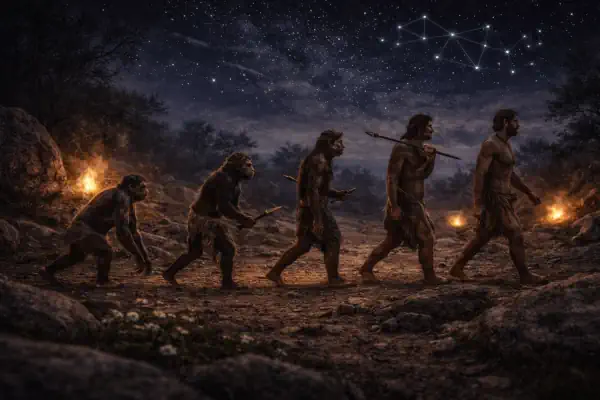
The earliest history of prehistory is rooted in the appearance of the first hominins in Africa. Long before Homo sapiens, several species experimented with decisive traits: more regular bipedalism, changes in the pelvis, the partial freeing of the hands, a growing capacity to manipulate objects and, over the long term, an increase in brain volume.
These first representatives of the human lineage were not yet modern humans, but they opened the way to a major transformation in the relationship to the environment. Bipedalism made long-distance movement easier, changed the observation of surroundings and made the hands available for other uses. With the earliest technical gestures, however rudimentary, a new logic appeared: the environment was no longer merely endured, it began to be transformed.
Studying these first hominins means understanding that prehistory does not begin with an already completed humanity. It begins with a long biological and behavioral evolution in which every innovation prepares another threshold.
Within the Paleolithic: a slow but decisive progression
The Paleolithic itself is not homogeneous. It is generally divided into the Lower, Middle and Upper Paleolithic. These subdivisions make it possible to follow the evolution of human species, tools and collective behaviors across the long term.
The Lower Paleolithic corresponds to the earliest lithic industries and ancient hominins. The Middle Paleolithic saw the development of more standardized techniques, better resource management and more complex social behaviors, notably among Neanderthals and the first Homo sapiens. The Upper Paleolithic marks the affirmation of modern Homo sapiens, with a strong specialization of tools, broader exchange networks and a clear intensification of symbolic production.
This internal chronology shows that prehistoric evolution did not proceed only through abrupt breaks. It also advanced through accumulation, refinement, transmission and local adaptation. This long timescale partly explains the solidity of the gains that prepared later transformations.
The Mesolithic: a period of transition under the impact of climatic change
The Mesolithic opens after the end of the great glaciations. Climate warming profoundly altered landscapes, fauna, flora and the availability of resources. Vast cold open spaces increasingly gave way to forests, wetlands, lakes and river systems. This reconfiguration of the environment forced human groups to develop new strategies.
Mesolithic societies did not completely break with the Paleolithic heritage, but they adjusted their practices. They exploited local resources more finely, developed tools adapted to smaller prey, strengthened fishing, gathering and seasonal management of territories. Microliths, small stone elements integrated into weapons or composite tools, clearly illustrate this new technical precision.
The Mesolithic is therefore less a marginal period than a genuine laboratory of adaptation. It shows how human groups reorganized their economy and mobility when the world changed around them.
Why the Mesolithic matters so much
- it accompanies the transition out of glacial worlds
- it develops more diversified subsistence systems
- it prepares the technical and social conditions of sedentism
Between mobility and local anchoring: more hybrid ways of life
One of the distinctive features of the Mesolithic is the coexistence of mobility and partial settlement. Groups often remained mobile, but they could stay longer in certain areas particularly rich in resources. Semi-durable camps appeared in favorable zones, especially near water.
This relative stabilization of settlements changed the organization of daily life. Longer stays facilitated the transmission of know-how, collective resource management, the specialization of certain gestures and a stronger appropriation of territories. Mobility did not disappear, but it became more strategic and less systematically dictated by the pursuit of large herds alone.
In this sense, the Mesolithic functions as a bridge: it no longer belongs entirely to the very large-scale nomadisms of the Paleolithic, while not yet being the world of permanent farming villages that define the Neolithic.
The Neolithic: producing food and durably transforming territory
The Neolithic marks one of the most decisive turning points in human history. Instead of relying exclusively on hunting, fishing and gathering, some communities began to cultivate plants and domesticate animals. This agricultural revolution changed the very basis of subsistence: food was no longer only collected, it was produced.
This change triggered a cascade of transformations. Groups settled more permanently, built fixed dwellings, organized villages, accumulated reserves and reshaped landscapes through clearing, enclosures, fields and the first forms of agricultural management. Toolkits also evolved, with polished axes, sickles, grinding stones and other instruments suited to working the land and processing harvests.
The Neolithic revolution should not be understood as a simple technical advance. It reconfigured social relations, the rhythms of time, forms of cooperation, the management of surpluses and the relationship to territory. It is at this point that sedentism became structural and the foundations of more complex societies were consolidated.
Agriculture, herding, villages: the rise of sedentary societies
With the Neolithic, human communities no longer occupied space in the same way. Permanent villages appeared, dwellings became more solid, and collective organization gained density. Agricultural production and livestock rearing made surpluses possible, profoundly altering economic and social balances.
This new stability also encouraged other developments: demographic growth, intensified exchange, the specialization of certain forms of know-how and the assertion of territories exploited in a more clearly defined way. The Neolithic thus brought forth another relationship to time and labor: it became necessary to sow, wait, harvest, store, protect and transmit.
This more stable framework also prepared later developments toward metallurgy, more hierarchical forms of organization and, eventually, entry into protohistoric and then ancient worlds. Prehistory did not end abruptly: it gradually led into societies capable of profoundly transforming their environment and their own internal organization.
Toward metals and Antiquity: prehistory as the foundation of the historical world
At the end of this long sequence, the major periods of prehistory appear as a continuum. The Paleolithic established the technical and symbolic foundations of humanity; the Mesolithic reorganized strategies of life in a changing world; the Neolithic deeply transformed the economy, settlement and the relationship to territory.
This long progression gradually led to thresholds that announce historical worlds: the first metals, more structured exchanges, denser communities and greater mastery of resources. Antiquity did not emerge from a void; it extended a very ancient history of techniques, organizations and human experimentation.
Understanding the major periods of prehistory therefore means understanding how humanity slowly built the material, social and cultural conditions of civilization. Far from being a simple “before,” prehistory is the deep foundation of our world.