When Numbers Cease to Be Merely Useful and Become Intelligible
In many ancient civilizations, counting, measuring, or drawing figures first answered concrete needs: trade, architecture, surveying, calendars, astronomy. Ancient Greece inherited these practices, but gave them a new direction. Numbers and forms no longer served only to act upon the world; they became objects of thought capable of revealing a hidden structure of reality.
This shift is decisive. The Greeks no longer contented themselves with observing that a procedure worked; they wanted to understand why it worked necessarily. Mathematics thus ceased to be merely operational and became demonstrative. That demand opened an unprecedented space in the history of knowledge: one of abstract, universal knowledge founded on proof.
It is in this framework that a major intuition appears: the world can be read through relations, proportions, forms, and logical sequences. Mathematics becomes a language of reality, not because it imitates the visible world, but because it makes it possible to think the world's order with a rigor greater than immediate experience can offer.
With ancient Greece, mathematical truth no longer rests only on what one observes, but on what one can demonstrate.
Geometry: When Form Becomes a Science
The word geometry, from geômetria, originally means "measurement of the earth." Its origin is practical, concrete, almost administrative. Yet the Greeks transformed this art of measurement into a science of pure form. A line, an angle, a circle, or a triangle no longer mattered only as tools for solving a material problem; they became ideal objects studied for their necessary properties.
This transformation is essential because it progressively detaches geometric thought from the sensible world. A perfect geometric figure does not fully exist in nature, yet it can be grasped by the mind. Greek geometry thus inaugurates a new relation between thought and reality: abstraction does not distance us from truth, but may allow us to reach it more securely.
From that point onward, forms cease merely to be seen; they are thought. And to think a form is already to enter a universe in which order can be constructed, verified, and demonstrated.
Pythagoras: The Universe as a Network of Relations
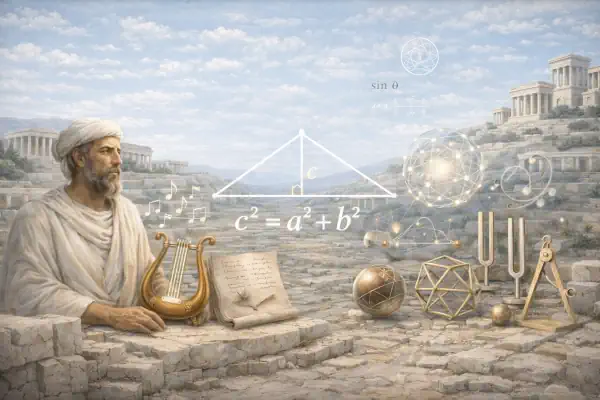
With Pythagoras and the Pythagoreans, mathematics acquired an exceptional philosophical reach. The idea that "all is number" does not simply mean that everything can be counted. It expresses a deeper conviction: reality possesses a harmonious structure, accessible to intelligence through numerical relations.
Musical proportions, relations between lengths, and the regularity of figures all seem to suggest that the order of the world is not arbitrary. The Pythagorean theorem, even if practical forms of it already existed elsewhere, takes on a new meaning here: it becomes a demonstrated truth, independent of any particular case. The passage from empirical observation to universal demonstration marks a major turning point.
This gesture has immense scope. Numbers are no longer mere signs for handling quantities; they become keys to intelligibility. Through them, the mind discovers that the invisible can be thought with rigor.
Euclid: Building an Architecture of Demonstration
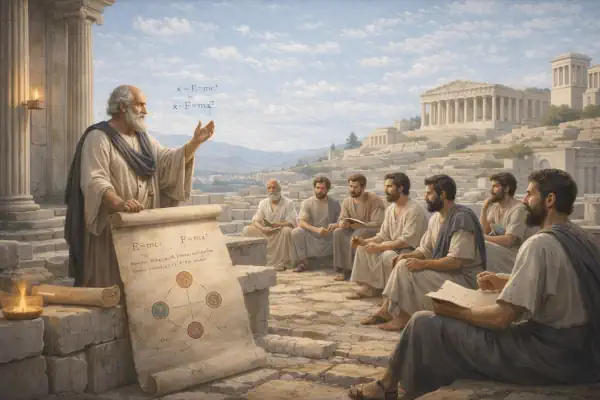
Two centuries after Pythagoras, Euclid gave geometry its classical form. With the Elements, he did not produce a mere collection of results, but an intellectual construction of extraordinary power. Definitions, axioms, postulates, and propositions follow one another with such rigor that each statement depends on those preceding it.
What makes the Elements so great is not only their content, but their method. Euclid shows that knowledge can be organized as a system: begin from simple, explicit principles, then advance through successive demonstrations. Mathematical truth thus becomes the consequence of a rational order built with method.
The reach of this work is immense. For nearly two millennia, it served as a model of teaching, reasoning, and proof. Through it, geometry became not only a science of forms, but also a general school of rigorous thinking.
To Demonstrate Rather than Merely Observe: The Birth of Proof
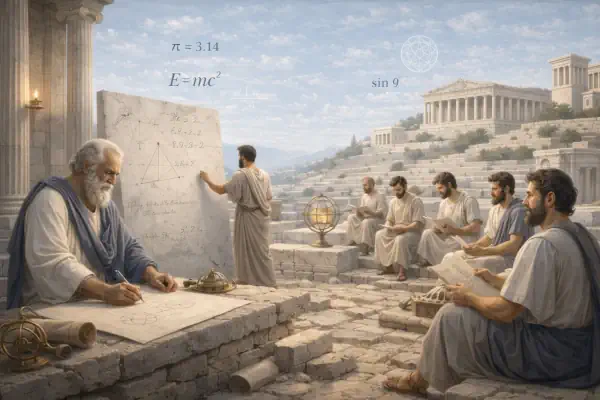
One of the greatest Greek inventions is neither an instrument nor a monument. It is an intellectual demand: logical proof. Before it, many forms of knowledge were effective; with it, they also had to be justified. What matters is no longer simply that a result is true in fact, but that it is necessary in reason.
This transformation profoundly changes the relation to knowledge. A truth is no longer accepted because it is ancient, useful, or confirmed by habit; it must be able to withstand rational examination. Mathematics then becomes a model of certainty precisely because it imposes a discipline on the sequence between ideas.
What Mathematical Proof Changes for Good
- it replaces simple practical verification with universal justification
- it makes mathematics a school of rigor for philosophy, logic, and science
- it establishes the idea that solid knowledge must be clear, ordered, and demonstrated
This revolution is quiet, but profound. By learning to demonstrate, Greek thought also learns to distinguish what is certain from what is merely plausible.
A Legacy That Crosses the Centuries into Modern Science
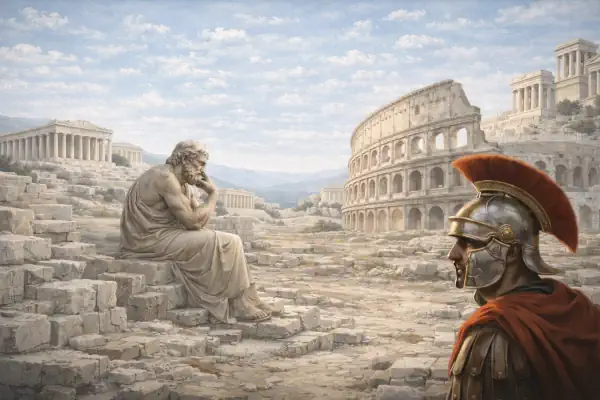
When Rome inherited Greek culture, it also inherited its intellectual methods. Later, scholars in the Arabic-speaking world translated, commented upon, and extended these texts, enriching the Greek legacy with algebra, astronomy, and new conceptual tools. Greek mathematics thus became a durable core of learned Mediterranean and later European culture.
During the Renaissance and the classical age, the idea that nature can be written in mathematical language acquired new force. Yet this gesture was not born from nothing: it extends the Greek intuition that reality possesses a formal intelligibility. Modern physical models, demonstrations, theories, and even algorithms still belong to that lineage.
The Greek contribution therefore lies not only in a few famous results. It lies above all in a way of thinking: clarifying principles, constructing demonstrations, accepting abstraction as a path toward intelligibility, and making coherence a condition of knowledge.
Why This Legacy Still Continues to Structure Us
Greek mathematics still fascinates because it shows that the human mind can reach truths beyond immediate experience. It reminds us that a world which appears complex or chaotic may nevertheless be traversed by forms, relations, and reasons.
Its beauty lies not only in the elegance of its figures or the fame of its theorems. It lies in the fact that it taught humanity that it is possible to understand the invisible, provided one thinks it through with enough patience, method, and rigor.
That is why ancient Greece remains a foundational moment. By giving numbers and forms the dignity of a language of truth, it offered scientific thought one of its most enduring foundations.
A Personal Perspective: When Mathematics Reveals the Real
From my point of view, mathematics is not merely an invention of the human mind. It is a discovery of reality, and the Greeks gave us a new possible vision of the world by showing that this reality could be approached through reason, proof, and abstraction. Their greatness lies not only in having produced remarkable theorems, but in having taught us that truth can be sought beyond appearances through disciplined thought.
That is also why proof still matters so deeply today. When an idea is not argued, it remains only an opinion without foundation, something that may reflect desire or intuition but not the real world itself. Proof, in that sense, is not a cold exercise: it is a form of intellectual honesty. It obliges us to clarify what we claim, and it forces thought to become more solid than impression.
At the same time, I do not believe mathematics is enough by itself. Reality may be fundamentally mathematical, but we still need philosophy and reflection if we want to keep looking farther into what remains unknown. Numbers can reveal structure, but they do not replace the deeper movement of thought that asks why knowledge matters, where it leads us, and what horizon of meaning it should serve.
In that sense, the Greek legacy still gives us a direction. It preserves a compass for philosophy and reflection. It teaches us that rigor does not have to exclude vision, and that the search for truth becomes stronger when demonstration and thought continue to advance together.