When Reality Stops Being Merely Told and Begins to Be Observed
The greatness of Greek science does not lie only in a few famous discoveries. It lies first in a transformation of intellectual posture. In the Greek world, nature gradually becomes an object of inquiry. The sky, the body, proportions, motion, and physical phenomena no longer belong exclusively to sacred narratives: they call for causes, measurements, descriptions, and reasoning.
This mutation becomes possible through the rise of logos, through the circulation of knowledge across the Mediterranean, through the culture of debate in the city-states, and through the increasingly powerful idea that the world is intelligible. The Greeks do not invent all knowledge on their own, but they give it a new form: more abstract, more argumentative, and more systematic.
In that sense, Greek sciences are less a closed set of results than a new way of searching. To observe, compare, calculate, classify, and reason: these gestures become the basis of an unprecedented relationship to reality.
To me, this is why Greece remains so decisive. It did not merely produce knowledge; it taught humanity that understanding the world requires a disciplined gaze. The foundations of science, logic, and debate begin here, in the moment when the human mind accepts that reality can be questioned publicly, rigorously, and without fear of leaving myth behind.
With Greek sciences, the world is no longer only admired or feared: it becomes measurable, debatable, and partially understandable.
Astronomy: When the Greeks Dare to Measure the Sky and the Earth
Very early on, certain Greek thinkers conceive of the cosmos as an order that can be represented and understood. With Anaximander, the Earth is no longer merely a sacred place surrounded by divine powers; it becomes an object situated within a structured space. This shift is decisive: the sky begins to be thought of as a domain of regularities.
But one of the most impressive gestures of this tradition appears with Eratosthenes in the third century BCE. Using the shadow cast by the sun in two different cities, along with the approximately known distance between them, he manages to calculate the circumference of the Earth with remarkable precision. This reveals something essential: the world is not only observable, it can also be quantified.
Through this kind of operation, Greek sciences show that geometric reasoning can be applied to physical reality. The sky ceases to be a mere spectacle; it becomes a field of intellectual investigation.
Medicine: Observing the Body Instead of Summoning the Gods
In medicine, the Greek rupture is just as profound. With Hippocrates and the school associated with him, disease is no longer systematically interpreted as divine punishment or sacred disorder. It becomes a natural phenomenon that can be observed, described, and compared.
This transformation rests on a discipline of attention. The physician examines symptoms, records the development of a fever, takes climate, seasons, diet, and bodily rhythms into account. Diagnosis begins to rely on observation rather than invocation. This is a major turning point: the human body becomes a field of study.
Greek medicine remains far removed from modern biology, yet it introduces a fundamental demand that will outlive it: look at reality before interpreting it. In this sense, clinical observation is one of the first genuinely scientific gestures of antiquity.
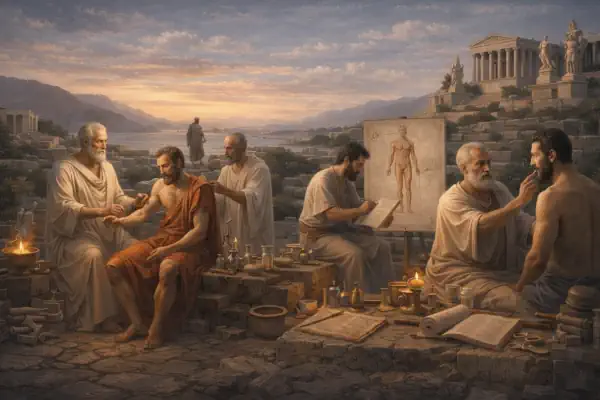
What I find striking is how modern this gesture still feels. Science begins when one chooses to observe carefully instead of hiding behind authority. That lesson still matters for medicine, research, education, and even public debate today: intellectual progress depends on the courage to look closely, question inherited explanations, and accept evidence as a discipline rather than a slogan.
Physics and Mechanics: Archimedes, or the Poetry of Natural Laws
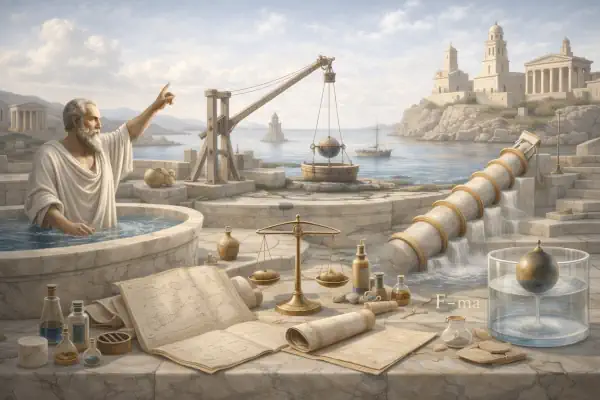
In the third century BCE, Archimedes embodies in exemplary fashion the meeting point between mathematics, observation, and engineering. With him, nature is no longer merely described; it is submitted to formalizable principles. The laws of the lever, the study of equilibrium, buoyancy, and systems of pulleys show that physical phenomena can be understood in terms of ratios, forces, and calculations.
What makes Archimedes so important is not only the ingenuity of his machines. It is the idea that reality obeys regularities that mathematical thought can express. Objects fall, float, move, or lift weights according to principles that do not depend on the whims of gods, but on intelligible natural structures.
In this way, Greek mechanics opens a crucial path: one in which theory does not remain separated from the concrete world, but becomes capable of illuminating it and sometimes transforming it.
What Greek Sciences Owe to Mathematics
One of the major strengths of Greek science lies in its alliance with mathematics. To measure the Earth, describe a trajectory, compare lengths, understand a proportion, or reason about a force presupposes an abstract language capable of stabilizing phenomena. The Greeks thus discover that part of reality can be made intelligible through geometric and numerical relations.
This alliance is not secondary. It gives scientific thought a more rigorous form. Mathematics is not used merely to count; it becomes a way of demonstrating. When a result can be proved, it acquires an authority different from that of tradition. It rests on the coherence of reasoning.
What Greek science establishes for the long term
- the idea that natural phenomena have causes accessible to reason
- the practice of observation and methodical description
- the use of calculation, proportion, and demonstration to understand reality
It is this triple inheritance — causes, observation, formalization — that makes Greek sciences foundational, even where they remain incomplete.
A Powerful Science, Yet Still Limited by Its Own Method
Greek science is brilliant, but it is not yet modern experimental science. Its strength lies in abstraction, logical analysis, the beauty of demonstrations, and the ambition to give reality a structure. Its weakness more often lies in an experimental practice that remains insufficiently systematic.
The Greeks often privilege the rational coherence of a theory without always submitting it to repeated, controlled, reproducible protocols in the modern sense. Some constructions therefore remain remarkably elegant without being fully verified by experience. This limit matters, but it should not obscure the scope of their contribution.
For precisely this reason, modern science will not arise against Greece, but from it. The Greeks do not complete the scientific method; they establish its fundamental intellectual conditions.
I see here a lesson that still feels extremely contemporary. Modern science, education, and critical culture do not grow by intuition alone. They require both the Greek courage to think and the later discipline to test. Greece gave us the ambition to understand the world rationally; our responsibility is to extend that inheritance through research, public reasoning, and the patient cultivation of critical minds.
Why Greek Sciences Remain a Foundational Moment of Scientific Thought
Between the sixth and third centuries BCE, ancient Greece accomplishes a decisive transformation. Through Eratosthenes, the world becomes measurable. With Hippocrates, the body becomes observable. With Archimedes, physical laws become calculable. In each of these cases, we are dealing not merely with isolated discoveries, but with a new relationship to reality.
Greek sciences transmit an enduring conviction: reality can be questioned publicly, analyzed without systematic recourse to the sacred, clarified through concepts, and sometimes expressed through number. This conviction irrigates the history of science from late antiquity to the modern world.
That is why their legacy remains immense. Ancient Greece did not produce all of Western science on its own, but it taught humanity that it is possible to understand the world by looking at it, measuring it, and thinking it with rigor.
My own reading is profoundly analytical, inspiring, and forward-looking. Greece did not simply invent a few sciences; it established the mental architecture that still sustains modern research, education, scientific culture, and freedom of thought. Debate, critical reason, public inquiry, and the disciplined search for truth all grow from that soil. To me, that is why Greek science remains premium in the deepest sense: it does not only belong to the past, it continues to define the level of intellectual seriousness a civilization must reach if it wants to understand the world and build the future with clarity.