

Why the first civilizations arose around rivers
The birth of river civilizations belongs to a long historical process. After the end of the last Ice Age, the Holocene provided a more stable climatic setting. In the Fertile Crescent, human communities began cultivating cereals, storing food, planning ahead, and settling more permanently. This Neolithic shift did not yet produce the great states, but it created the decisive conditions for their emergence: surplus production, sedentarization, demographic growth, and specialization of labor.
The great rivers then played a determining role. They concentrated what no arid territory could guarantee over the long term: a reliable water supply, fertile alluvial soils, and the possibility of turning floods into agricultural yield. Where water could be managed, harvests became more predictable; where harvests became predictable, denser and more organized societies became possible.
What rivers made possible
- more intensive and more stable agriculture
- the lasting settlement of populations on a territory
- large-scale coordination of labor around irrigation, storage, and redistribution
In that sense, the Nile, the Tigris, and the Euphrates were not merely geographical backdrops. They were the material matrices of a new social order. Water became infrastructure; infrastructure became power.
River civilizations are born when water is no longer merely endured: it becomes planned, distributed, recorded, and integrated into collective organization.
The Nile: hydraulic regularity that favors centralization
In Egypt, the Nile offered a decisive advantage: the relative regularity of its floods. Each year, its waters deposited fertile silt that renewed cultivated land. That predictability changed everything. It reduced agricultural uncertainty, made crop planning possible, and supported a territorial continuity that was rare in the ancient world.
This environmental stability contributed to the consolidation of central power. Administration could survey land, organize public works, collect resources, and redistribute surplus. The unified kingdom of Egypt, traditionally associated with Narmer around 3100 BCE, rested on this articulation between territory, water, and political authority.
The river therefore nourished far more than fields. It supported a model of government in which the pharaoh became the guarantor of order, fertility, and the continuity of the land. The Nile protected, connected, and stabilized; it enabled Egypt to develop one of the most enduring civilizations of the ancient world.
The Tigris and the Euphrates: instability that compels collective invention
In Mesopotamia, the setting was very different. The Tigris and the Euphrates followed more irregular regimes, at times violent, at times insufficient. Floods could destroy as much as they could fertilize. That unpredictability imposed a different historical trajectory: to survive, populations had to shape space, dig canals, raise dikes, and divert water.
This need for artificial irrigation drove large-scale cooperation. It was no longer simply a matter of managing a family harvest; it became a matter of coordinating hydraulic networks, collective works, reserves, and distribution. In this context, the first great Mesopotamian cities, such as Uruk, Ur, and Lagash, emerged as centers of both technical and political organization.
Where the Nile favored unity, Mesopotamia tended instead to produce a mosaic of city-states. Each urban center administered its territory, its canals, its stores, and its sanctuaries. Water became a factor of rivalry as much as one of development. Out of hydraulic disorder arose an extraordinary administrative genius.
From agriculture to cities: when surplus creates an urban world
The transition from agriculture to civilization did not happen overnight, but according to a deep structural logic. Once harvests could be stored, human groups could remain in place, accumulate, exchange, and invest in work not immediately tied to subsistence. Sedentarization opened the way to permanent villages; villages, in turn, could become towns and then cities.
In Mesopotamia, Uruk around 3500 BCE illustrates this leap in scale. The concentration of population, the presence of specialized districts, monumental temples, and a structured administration show that this was no longer merely an agricultural settlement. The city became a device of social, economic, and symbolic organization.
The direct consequences of agricultural surplus
- the appearance of storage and redistribution centers
- the development of trade, craft production, and religious functions
- the emergence of authorities capable of coordinating a larger population
From that point onward, human space changed in nature. It was no longer only a matter of inhabiting a place, but of administering a territory, allocating resources, planning labor, and producing a collective memory.
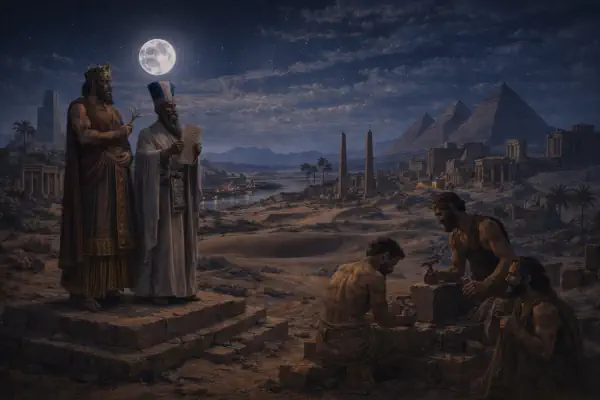
Writing first emerges as a technology of management
One of the most decisive contributions of river civilizations is the transformation of memory into an administrative tool. In Mesopotamia, the first cuneiform tablets, around 3300 BCE, were used to record stocks, harvests, distributions, and obligations. Writing thus first appeared as a practical response to the growing complexity of exchange and territorial management.
In Egypt, hieroglyphs emerged at roughly the same major moment of state formation. They fixed names, accounts, rites, and authority. In both cases, to write meant to stabilize power: what was inscribed could be checked, transmitted, archived, and compared.
This innovation marked a fundamental rupture. A society capable of writing no longer administered only through the immediate presence of chiefs or priests. It also administered through documents, signs, and durable traces. Writing became a material extension of government.
Social hierarchies, religion, and the first states
As soon as agriculture produced enough and hydraulic management required complex coordination, not everyone occupied the same function. Artisans, priests, administrators, political leaders, and specialized workers appeared. River civilizations saw the emergence of the first durable social hierarchies.
Religion played a central role there, not as a mere private belief, but as a language for organizing the world. In Egypt, the pharaoh embodied cosmic order; in Mesopotamia, temples were powerful economic and political centers. The sacred justified authority, structured calendars, accompanied the measurement of time, and organized the redistribution of wealth.
Thus, the mastery of water produced far more than agricultural success. It created a complete system in which environment, power, belief, taxation, and labor were deeply linked. The first states emerged when that articulation became stable enough to endure beyond a single generation.
Why river civilizations bring humanity into History
The Nile, the Tigris, and the Euphrates do not alone explain the birth of civilizations, but they provide their material framework. Thanks to them, humanity moved from scattered subsistence economies to societies capable of producing, counting, deciding, building, and transmitting on a large scale.
The legacy of Egypt and Mesopotamia lies precisely in this exceptional combination: intensive agriculture, hydraulic engineering, urbanization, administration, writing, and a political vision of territory. These mechanisms, even more than monuments alone, founded the historical power of those ancient worlds.
In the rhythm of floods and canals, a civilizational shift takes shape. Human societies no longer merely live within nature: they learn to organize it, record it, and turn it into the basis of a durable collective order. It is there, along the rivers, that the adventure of the first great historical worlds begins.
