When opening the body becomes an act of knowledge
The great rupture of Renaissance medicine began with a gesture that had long been problematic: dissecting a human body. In Italian universities, especially in Bologna, the first public dissections reintroduced a practice that profoundly transformed teaching. No longer did scholars merely present ancient doctrines; they confronted texts with the material reality of the body.
Mondino de Luzzi, at the beginning of the 14th century, played an important role in this transition. His Anathomia structured the teaching of anatomy for a long time, but the essential shift lay elsewhere: anatomy began to rest on the concrete presence of the dissected body. The professor commented, the assistant made the incision, the students looked. Medical truth was no longer deposited exclusively in the authority of books; it began to pass through direct observation.
This development remained incomplete at first. The theoretical frameworks inherited from Galen still dominated. Yet the shift was decisive: seeing became a condition of knowledge. From that moment onward, medicine gradually entered the same movement as the other sciences of the Renaissance: comparing, correcting and verifying.
Modern medicine is born when the human body ceases to be merely commented upon and finally becomes observed, dissected, described and confronted with facts.
Vesalius: anatomy becomes a science of vision
With Andreas Vesalius, the transformation changed scale. In 1543, the publication of De humani corporis fabrica marked a major rupture in the history of medicine. For the first time, an anatomist relied systematically on human dissections performed by himself in order to correct the errors accumulated through centuries of learned repetition.
Vesalius’s gesture was doubly revolutionary. On the one hand, he challenged the authority of Galen whenever it did not correspond to what the human body actually showed. On the other hand, he restored a demonstrative dimension to anatomy: medical knowledge had to be visible, describable and transmissible through image as much as through text.
The plates of the Fabrica were not simple illustrations. They constituted a scientific tool in their own right. The body appeared there as structured, organized and intelligible. Muscles, bones, organs and systems were represented with a precision that turned anatomical imagery into a form of proof. Modern anatomy was born from this new balance between observation, drawing and criticism of ancient authorities.
Leonardo da Vinci: seeing the body as a living mechanism
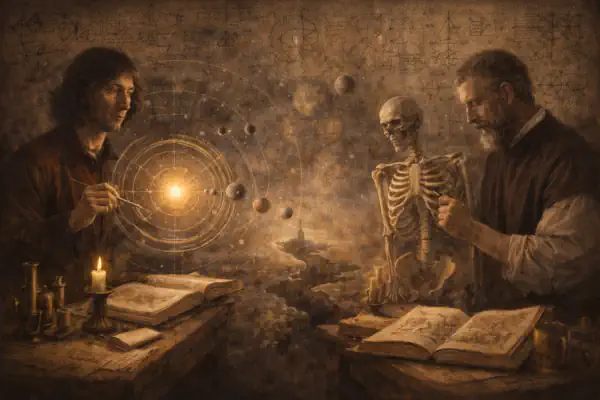
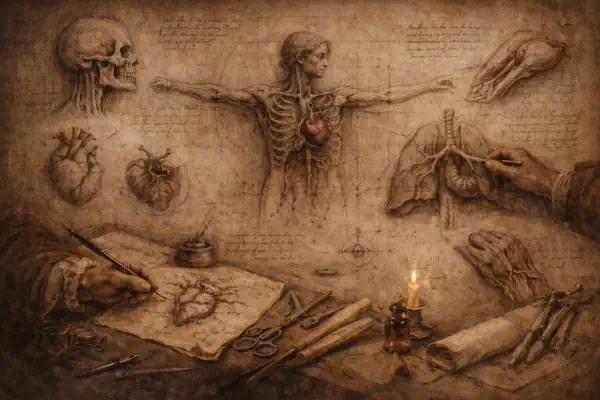
Alongside university medicine, Leonardo da Vinci conducted an exceptional investigation of the human body. His dissections, carried out between the end of the 15th century and the beginning of the 16th, gave rise to hundreds of anatomical drawings of remarkable finesse. But Leonardo’s originality lay not only in the quality of his line: it lay in the way he framed the problems.
Leonardo did not merely want to locate organs. He sought to understand how they functioned, how they were connected, how they produced movement. Tendons, bones, muscles, heart valves and the spine were studied as systems of traction, pivoting, circulation and balance. The artist observed like an engineer.
This approach turned the body into a dynamic structure. Where descriptive anatomy isolated parts, Leonardo was already interested in their functional relationships. Life became a field of analysis in which art, mechanics and empirical observation converged.
The end of ancient certainties: observe, compare, correct
Renaissance medicine did not advance through a single discovery, but through a series of corrections. As dissections multiplied and descriptions became more refined, old errors appeared more clearly. Some came from excessive reliance on authorities, others from the fact that several ancient bodies of knowledge rested on the study of animals rather than human bodies.
This transition introduced a new intellectual method. The body was no longer a support simply used to illustrate received doctrines; it became an object of inquiry capable of contradicting tradition. Authority changed place: it did not disappear, but it now had to answer to the test of observation.
What this new method changes
- direct observation competes with ancient texts
- anatomical descriptions become more precise and more visual
- error can be identified, discussed and corrected publicly
This process went beyond anatomy alone. It announced a new way of producing scientific knowledge: beginning from reality, organizing observations, confronting hypotheses and accepting the revision of certainties.
From anatomy to physiology: understanding the movement of life
The next step was to move from structure to function. Describing a heart, vessels or lungs was no longer enough; it became necessary to understand how they acted. It was in this context that modern physiology gradually emerged, that is, the study of the functions of living beings.
The decisive moment came with William Harvey. In 1628, in De Motu Cordis, he demonstrated that blood circulates in a closed circuit driven by the heart. This thesis did not rest on the authority of the ancients, but on a combination of observations, animal dissections and quantitative reasoning.
Harvey showed in particular that the quantities of blood involved made the old model impossible, according to which blood was simply consumed by the organs. The body then became thinkable as a system of continuous flows, governed by stable functional relations. Physiology was born when life was understood no longer as a juxtaposition of parts, but as a dynamic organization of circulations.
A scientific, but also anthropological, revolution
The rediscovery of the human body during the Renaissance did not concern medicine alone. More broadly, it changed the way human beings understood themselves. For the first time on such a scale, the body became a territory of inquiry grounded in opening, drawing, measurement, comparison and demonstration.
This shift had immense consequences. It prepared modern surgery, experimental medicine, biology and, more broadly, an entire scientific culture that considered life intelligible. But it also produced a major symbolic effect: the human being became both a thinking subject and an object of knowledge.
The Renaissance therefore did not merely rediscover ancient medicine; it rediscovered the body as an observable, contestable and knowable reality. It is this conquest of the visible that made modern anatomy and physiology one of the great laboratories of emerging science.