Creating before writing: the first forms of artistic expression
When prehistory is discussed, attention often turns to survival, hunting or toolmaking. Yet one of the strongest proofs of this period’s human depth lies in the appearance of artistic forms. These creations show that our ancestors were not content simply to act upon the world in response to practical necessity: they were also beginning to represent it, stylize it and invest it with meaning.
Prehistoric art appears in many forms: paintings and engravings on rock walls, sculpted objects, ornaments, sound instruments and funerary deposits. This diversity reveals an already advanced capacity for abstraction. Representing an animal, shaping a figurine or repeating a motif presupposes visual memory, intention, technique and a form of cultural sharing. The artistic act thus becomes a major indicator of cognitive complexity.
More than that, these gestures show that culture does not begin with writing. It already exists when human groups transmit forms, signs, implicit narratives and symbolic practices. Prehistoric art is therefore not a marginal decoration; it is one of the great gateways to understanding the rise of the human imagination.
Prehistoric art proves that very early on, human beings did not merely seek to live in the world: they were already striving to represent it, make sense of it and share it.
Rock art: painting the wall, organizing the memory of the group
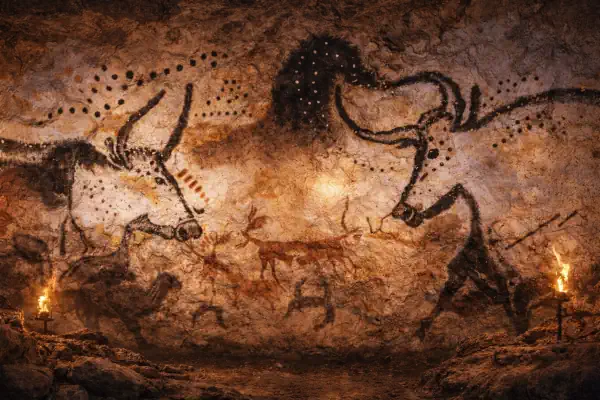
Rock art is one of the most spectacular expressions of prehistoric culture. In caves and rock shelters, humans painted, engraved and composed scenes in which animals often dominate: bison, horses, deer and aurochs. Far from being simple copies of reality, these representations reveal a remarkably fine attention to movement, proportions and the behavior of living beings.
Great decorated caves such as Lascaux and Chauvet display an already remarkable technical mastery. Artists used natural pigments — ochre, charcoal and clay — exploited the relief of the rock to create volume, and selected spaces that sometimes suggest a symbolic circulation. The image was therefore not placed at random: it was conceived within a site, through a material and with a visual effect in mind.
Interpretations remain open. Some frescoes may have been linked to rituals, narratives, animal memory or collective teaching. Whatever their exact function, they testify to an essential fact: prehistoric groups were capable of producing a structured visual language, transmissible across generations and charged with shared meaning.
What rock art reveals most powerfully
- a precise observation of the animal world and of movement
- symbolic thinking that extends beyond purely utilitarian use
- a visual culture capable of transmitting collective meanings
In that sense, parietal art must be understood as far more than decoration: it participates in the intellectual organization of the group and in the construction of a shared mental universe.
Sculpting matter: portable objects, enduring forms and embodied thought
Alongside decorated cave walls, prehistory has yielded many sculpted objects: figurines, stylized animals, decorated tools, ornaments and pieces worked in bone, ivory, soft stone or clay. These creations are especially important because they could be carried, handled, exchanged or integrated into ritual and social practices.
Sculpture introduces another relationship to art. It no longer depends on the fixed wall of a cave, but on the direct transformation of a raw material into a meaningful form. This work requires visualizing an outcome, anticipating the carving process, mastering precise gestures and selecting suitable supports. In other words, it already involves an elaborate relationship between mental intention and technical execution.
These objects also reveal how closely aesthetics and symbolism were intertwined. A figurine was not merely beautiful or well made: it could embody an idea, a value, a status or a belief. The object thus became a medium of memory, cultural circulation and, at times, symbolic power.
Prehistoric Venuses: figures of the body, fertility and continuity
Among Paleolithic sculptures, the prehistoric Venuses occupy a central place. These small female statuettes, often characterized by strongly emphasized forms — breasts, belly and hips — do not seem to refer to a realistic portrait. Instead, they condense an idea: fertility, motherhood, abundance or the continuity of life.
The Venus of Willendorf remains the most famous example, but it is far from unique. Its small size indicates that it could be carried, kept or used in specific contexts. Its significance lies not only in its antiquity, but in what it suggests: the capacity to transform the body into a sign, to select certain attributes and to produce an image charged with strong symbolic density.
These figurines show that prehistoric art was not solely narrative or descriptive. It could be conceptual, condensed and directed toward vital concerns. The Venuses remind us that early humanity was already thinking in terms of transmission, cycles, group survival and the force of life. In this perspective, the sculpted body becomes a visual language of permanence.
They also testify to a significant level of abstraction: our ancestors did not merely represent what they saw, they gave form to what they considered essential.
When art becomes sound: music, rhythm and emotional cohesion
Prehistoric art was not expressed only through image or sculpted matter. It also took the path of sound. The prehistoric flutes discovered at various European sites show that some human groups were very early makers of instruments capable of producing organized notes. This is crucial evidence: it broadens our understanding of ancient culture into an acoustic and emotional dimension.
Made from bird bones, ivory or other carefully worked materials, these flutes required an empirical understanding of matter, perforation, tube length and the variation of sounds. Their existence suggests not only technical skill, but also an interest in repetition, rhythm, listening and the sensitive shaping of collective experience.
Music likely served several roles: accompanying rituals, strengthening group cohesion, staging a narrative, creating shared emotion, offering aesthetic pleasure or structuring social time. Here again, the issue goes beyond ornament. Producing organized sound already means transforming the environment into a cultural experience.
Why prehistoric music matters so deeply
- it proves a creativity that is not limited to the visible
- it strengthens the link between technique, emotion and collective life
- it shows that prehistoric culture already invested time, rhythm and listening
In discovering these instruments, we understand that the human imagination unfolded very early across several sensory dimensions at once.
Burials and symbolism: thinking death, honoring memory, structuring the sacred
Prehistoric burials are among the most powerful signs of an elaborate symbolic culture. Burying the dead with care, placing objects beside them, using pigments such as ochre, organizing a funerary space: all these gestures reveal a mode of thought that goes beyond the simple material management of the body. Death becomes a cultural, relational and perhaps spiritual event.
Some graves show that the deceased were accompanied by tools, ornaments, worked stones or colored elements. These practices suggest that human groups attributed a particular meaning to the passage from life to death. They also indicate a relationship to memory: the dead were not abandoned, but inscribed within a ritual, a collective gesture, a form of symbolic continuity.
Funerary symbolism thus connects art, culture and spirituality. The deposited objects are not merely utilitarian; they participate in staging a worldview. They reveal a capacity to think the invisible, to formulate a relationship to time, and to express social attachment through concrete forms.
In this sense, prehistoric burials are not only archaeological data: they make visible the emergence of a humanity capable of reflecting on itself, on its finitude and on the trace it leaves within the group.
The birth of the collective imagination: when culture becomes a shared world
Taken together, these productions — paintings, sculptures, figurines, music and funerary rites — lead to an essential idea: prehistory witnessed the birth not only of works, but of a truly shared cultural fabric. Human groups developed forms that allowed them to transmit more than technical gestures. They shared signs, emotions, implicit narratives, values and collective representations.
This is where the notion of the collective imagination becomes meaningful. A community is not held together merely by physical proximity or practical cooperation; it is also sustained by what it imagines together, by what it celebrates, by what it fears, by the figures it reproduces and by the objects it invests with meaning. Prehistoric art shows that this dimension existed long before the great historical civilizations.
Cave frescoes, Venuses, flutes and burials are therefore not isolated testimonies. They belong to a single dynamic: the process by which the human species began constructing a shared symbolic heritage. This legacy is not only aesthetic; it founds culture as a space of memory, identity and transmission.
To study prehistoric art and culture is ultimately to observe one of the moments when humanity became capable of transforming its experience into a shared world. It is there, in this collective shaping of the invisible, that the deepest roots of human cultural history are found.