When electricity redraws the world
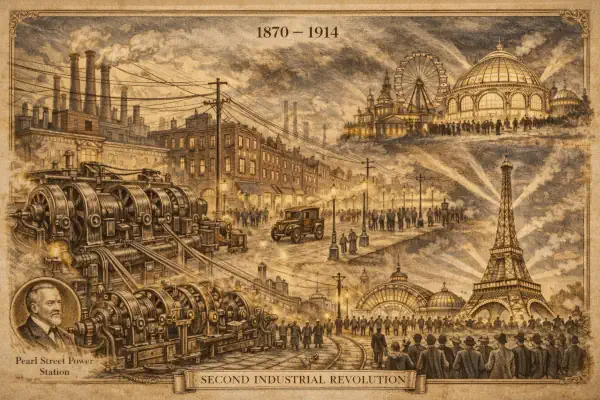
Between 1870 and 1914, the Second Industrial Revolution opened a phase of historical acceleration without precedent. After coal and steam came new technical forces: electricity became usable on a large scale, internal combustion engines transformed mobility, chemistry altered matter itself, telecommunications drew continents closer together, and scientific medicine began to understand the invisible.
This period was not merely about improving workshops or factories. It changed the structure of the modern world. Industrialization became more global, more interconnected, and more dependent on energy networks, new firms, laboratories, and infrastructures.
It was also at this moment that modernity ceased to be an abstract idea. It took concrete form in illuminated cities, telephone lines, engines, power stations, laboratories, and the great technical exhibitions of the age.
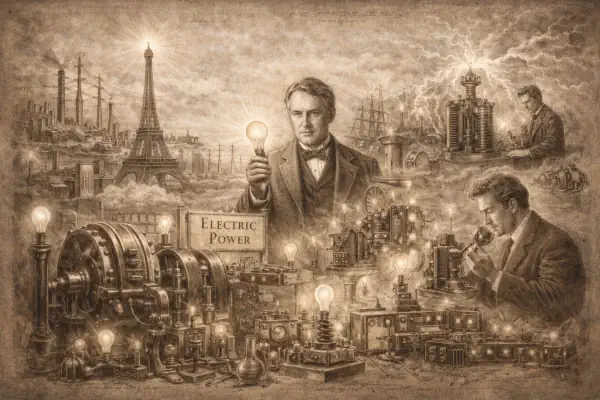
The Second Industrial Revolution did not merely add new machines: it changed the way energy, information, production, and science circulated through society.
Electricity: mastering the invisible
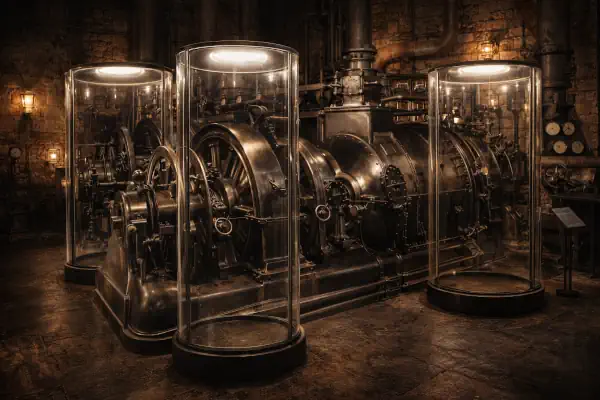
One of the major turning points of the period lay in the ability to produce, transport, and use electricity reliably. With the dynamo, and then the electrification of cities and factories, electricity ceased to be a spectacular or experimental phenomenon. It became infrastructure.
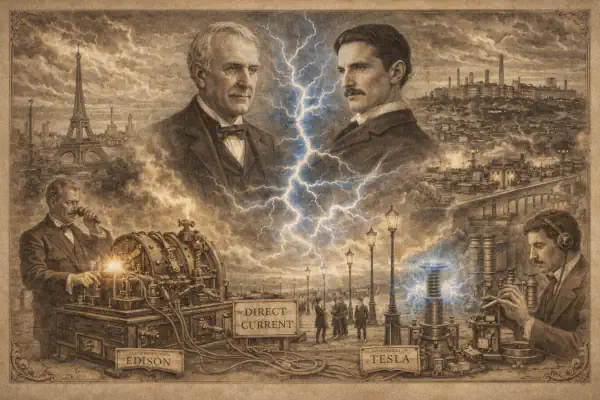
The debates between Thomas Edison and Nikola Tesla over direct current and alternating current symbolized the scale of the challenge. Behind that technical rivalry stood a crucial question: how could entire territories be supplied sustainably, human activity be extended, and industry be given greater flexibility?
Electricity profoundly altered the organization of space and time. Cities lit up, night changed its face, workshops no longer depended solely on localized energy sources, and the very idea of a modern network began to take shape.
The combustion engine: mobility catches fire
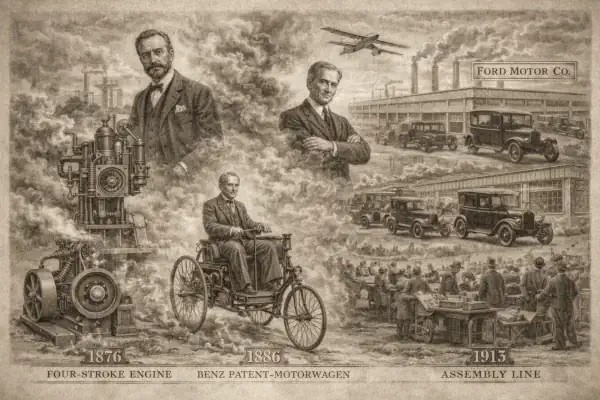
While steam continued to shape heavy transport, another mechanical principle gradually asserted itself: the internal combustion engine. With Nikolaus Otto, Karl Benz, and later the industrialization driven by Henry Ford, propulsion became more compact, more adaptable, and more directly tied to individual and mass mobility.
This shift was not merely technical. It transformed lived distance, economic organization, and material culture. The automobile was not yet everywhere, but it already announced a new relationship to space, tempo, and movement.
What this transformation made possible
- a new scale of road mobility
- the industrial standardization of mechanical production
- the rise of modern large-scale firms organized around production lines
Production did not merely become faster. It became more systematic, more planned, and more dependent on large industrial organizations.
Industrial chemistry: transforming matter
The Second Industrial Revolution did not stop with machines. It also changed the way humanity acted upon matter itself. Industrial chemistry opened a new era in which laboratories, synthetic processes, and large-scale production became central instruments of economic power.
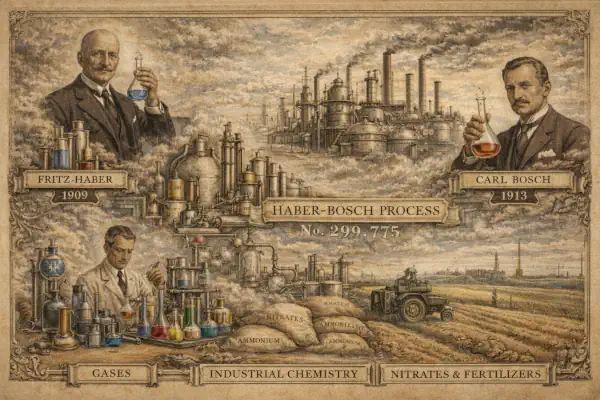
Synthetic dyes, advanced manufacturing processes, and above all the synthesis of ammonia through the Haber-Bosch process showed that the world was entering an age in which industry no longer merely extracted or transformed: it began to produce artificial substances capable of reshaping agriculture, materials, and systems of production.
This stage was decisive because it announced a world in which technology was no longer limited to mechanics. It also became chemical, invisible, molecular, and deeply structuring for everyday life.
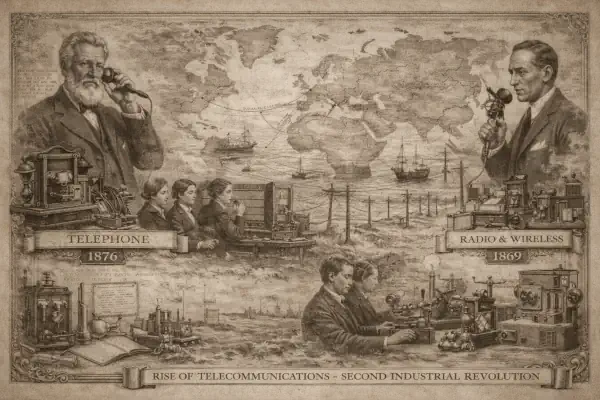
Telecommunications: the world becomes instantaneous
First with the telegraph and then with the telephone, information began to circulate at a speed that radically changed the scale of the world. What transport once connected in days or weeks could now be coordinated almost immediately.
The innovation here was not merely technical. It was organizational, economic, and geopolitical. Commercial exchanges accelerated, decision-making became more centralized, and distances contracted symbolically. The world entered a network logic.
This acceleration prepared the modernity of contemporary communications. The Second Industrial Revolution did not yet create the digital universe, but it installed a powerful prefiguration of it: a world increasingly interconnected.
Modern medicine and a new perception of progress
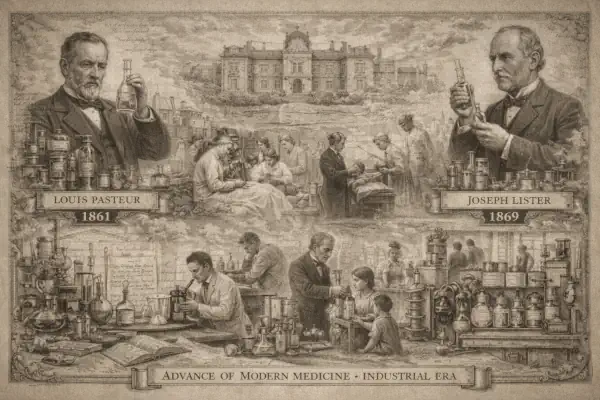
The industrial revolution of this period also transformed medicine. With the work of Pasteur, Koch, and the advance of scientific hygiene, disease gradually ceased to be seen as an obscure fatality. Microorganisms became identifiable, prevention became structured, surgery improved, and vaccination entered a logic of proof.
This transformation was fundamental because it showed that industrial modernity was not merely a story of factories and energy. It also acted upon bodies, life expectancy, demography, and the growing confidence placed in applied science.
On the eve of 1914, the world appeared more connected, faster, more productive, and more ambitious. Yet that modernity remained fragile: it already carried within it the social, economic, and imperial tensions that would accompany the brutal entry into the 20th century.
The Second Industrial Revolution therefore changed the very perception of progress. Electric light became a symbol of the future, the engine embodied movement, chemistry promised abundance, telecommunications gave the illusion of a united world, and medicine finally seemed capable of understanding the invisible.