How did humans live before complex societies?
Prehistory was neither a frozen age nor a mere era of raw survival. It was an immense span of time during which humans invented ways of living together, dividing tasks, occupying territory, and transmitting knowledge. The traces left by dwellings, tools, burials, and hearths reveal groups capable of cooperation, adaptation, and collective memory.
The earliest human communities were often mobile. Their organization depended on the seasons, available resources, game, access to water, and climatic constraints. This mobility favored relatively small, flexible groups in which each individual played a meaningful role in the survival of the collective.
Over time, the emergence of agriculture and animal husbandry profoundly transformed this model. Settlements became more stable, villages appeared, resources could be stored, tasks became more specialized, and social relations grew more structured. The history of prehistoric ways of life is therefore also the history of the gradual birth of human society itself.
Before cities and kingdoms, human society was first built on a small scale: around the group, the fire, the territory, and the sharing of resources.
Family groups: the basic unit of the prehistoric world
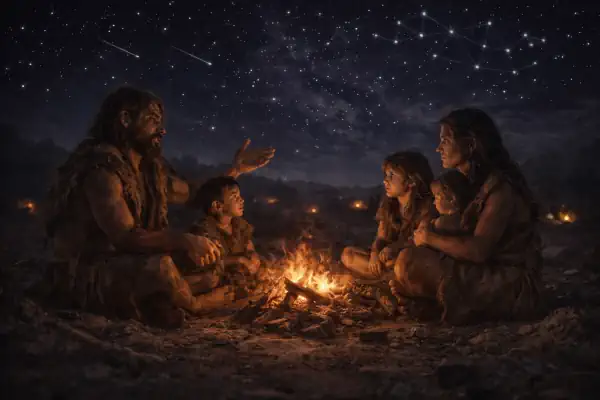
Early human groups were built around small social units, often composed of related or allied families. These compact structures made everyday cooperation easier: moving from place to place, protecting children, sharing food, crafting tools, or organizing a hunt all required a strong sense of solidarity. In an unstable world, the family group was the first framework of safety and transmission.
This structure was not merely emotional. It fulfilled a decisive practical function. Essential knowledge—recognizing plants, following tracks, knapping stone, maintaining fire—was passed on through observation and imitation within the group. Children grew up in a continuous process of learning woven directly into daily life.
We should not imagine a single universal model. Depending on region, resources, and period, social organization could vary considerably. Yet one constant remains: very early on, humans understood that surviving alone was nearly impossible, and that social cooperation was one of the keys to their evolutionary success.
Hunter-gatherers: a mobile, expert, and highly adaptable society
For the overwhelming majority of prehistory, humans lived as hunter-gatherers. Their subsistence relied on a subtle balance between hunting, fishing, plant gathering, seasonal resource use, and an extraordinarily precise knowledge of the natural environment. Far from being disorganized, these societies mastered their ecosystems with remarkable skill.
Their movements often followed regular cycles. Certain favorable places were revisited, rich zones were exploited according to the season, game routes were known, and gathering sites were memorized. This mobility was not aimless wandering; it rested on a true mental geography of the land, built on the group’s accumulated experience.
Their social organization generally remained flexible. Tasks were distributed according to skill, age, ecological context, or immediate need. This flexibility was one of their greatest strengths: it allowed groups to adapt quickly to climate shifts, resource scarcity, or new opportunities offered by a particular territory.
What defines these societies
- high mobility shaped by seasons and available resources
- shared knowledge and everyday cooperation
- limited material accumulation but deep ecological expertise
Mobility and territory: inhabiting a world without fixed borders
For prehistoric groups, territory was not a mapped surface in the modern sense. It was a lived, traversed, memorized, and interpreted space. A river, a cliff, a flint source, a game-rich valley, or a rock shelter became essential landmarks. Humans read the landscape with exceptional attention because their survival depended directly on it.
This mobility required a social organization adapted to movement. It was necessary to know what to carry, where to establish camp, when to move on, and how to distribute collective effort. Social life was therefore shaped through a dynamic relationship with space, in which the environment was never a passive backdrop but an active force in the organization of the group.
With the Neolithic, this logic changed without disappearing entirely. Movements became shorter and more targeted, but territory acquired a new dimension: it was cultivated, occupied over the long term, built upon, and increasingly transmitted. This was a major turning point, because a worked landscape also became a defended and organized one.
Habitats: caves, huts, and long-lasting Neolithic villages
Prehistoric habitat was never limited to the cave. Humans consistently sought solutions adapted to their environment, their mobility, and their collective needs. Caves could serve as shelters, seasonal bases, or symbolic places, but they were never the only way of living.
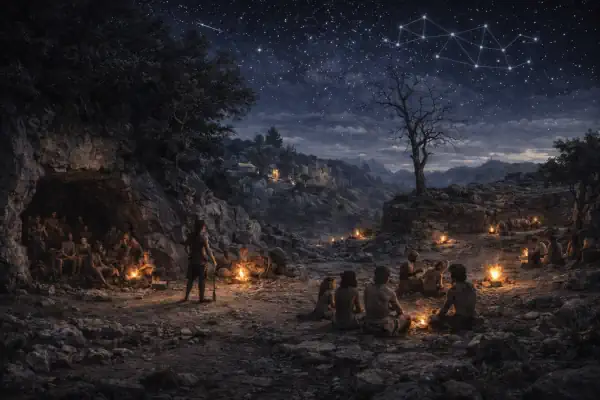
Hunter-gatherers also built huts from wood, branches, hides, and other locally available materials. These light, adaptable structures made it possible to follow resources while maintaining an organized domestic space. Camps already reveal a structured use of space: sleeping areas, work zones, hearths, storage spots, or knapping areas.
With the Neolithic, dwellings became more stable. Villages emerged, houses were built more durably—often from wood, daub, or stone—and communal space became more clearly organized. This change was not merely architectural. It marked the rise of new forms of neighborhood, cooperation, storage, and social continuity.
Social roles and specialization: when society becomes more complex
In the oldest societies, roles were often flexible and closely tied to the immediate needs of the group. But as techniques improved and communities became more stable, certain skills gained particular importance. Knowing how to shape a fine blade, build a dwelling, fashion pottery, or master medicinal knowledge could bring real prestige.
Specialization advanced especially with sedentary life. When resources became more regular, some individuals could devote more time to specific tasks. This does not yet imply the presence of complex institutions, but it does reveal more differentiated functions that already foreshadow increasingly hierarchical forms of organization.
This development shows that social roles did not suddenly emerge with Antiquity. They are rooted in a long prehistoric transformation in which tasks, expertise, and responsibilities diversified as communities gained stability and social density.
The first inequalities: a slow process linked to sedentary life and storage
As long as groups remained highly mobile, the accumulation of goods was limited. People carried little, shared more, and a relative degree of equality was encouraged by the lifestyle itself. But once agriculture and animal husbandry made it possible to produce and preserve surpluses, the relationship to resources changed profoundly.
Possessing larger harvests, more livestock, better tools, or rare goods could now create durable differences. Archaeologists observe these distinctions in certain burials, in the quality of grave goods, or in the unequal distribution of objects. We begin to see the first signs of differentiated status, sometimes passed down within family lines.
These were not yet the state hierarchies of Antiquity, but they mark a decisive shift. Late prehistory shows that social inequality did not appear all at once; it developed gradually, as some communities gained the ability to produce, store, defend, and control greater resources.
Strong continuities between prehistory and Antiquity
The boundary between prehistory and history should not obscure the deep continuities linking the two. Ancient societies did not arise out of nothing: they inherited family structures, economic practices, technical skills, beliefs, and territorial organization already taking shape during prehistory.
Neolithic villages prefigure the first durable communities. Task specialization anticipates crafts and trades. Resource storage opens the way to collective management and, eventually, organized power. The first signs of social distinction foreshadow future hierarchies. In this sense, prehistory is not a mere prelude: it is the social foundation of civilization.
To understand prehistoric social organization is therefore to understand how humanity slowly learned to live in groups, establish implicit rules, share a common space, and build increasingly elaborate forms of society. It is one of the most important transitions in all of human history.