From the Renaissance to industry: a long preparation of the world
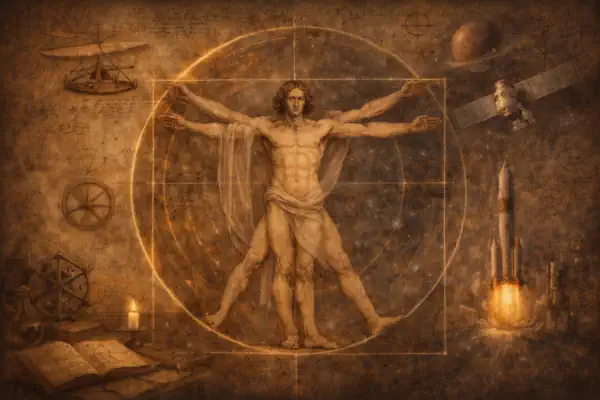
The First Industrial Revolution did not emerge in an intellectual vacuum. It extended a transformation that had begun centuries earlier, when the Renaissance placed observation, comparison of knowledge, and confidence in the human ability to understand the mechanisms of reality back at the center. The world was no longer merely described: it became measurable, transformable, and exploitable.
This new culture of proof prepared decisive ground. Workshops, laboratories, ports, and mines were no longer separated by rigid frontiers between theory and practice. Technical knowledge circulated, accumulated, and corrected itself. It was in this context that eighteenth-century Europe entered a phase of unprecedented material acceleration.
England then enjoyed a rare strategic advantage: abundant coal, vast markets, intense commercial exchanges, and sufficient economic pressure to make innovation profitable. When experimentation met economic interest, technology changed status: it ceased to be local and became systemic.
The First Industrial Revolution is not only the story of a machine: it is the moment when a culture of applied knowledge becomes an economic, territorial, and social power.
Steam: from mining utility to an energy rupture
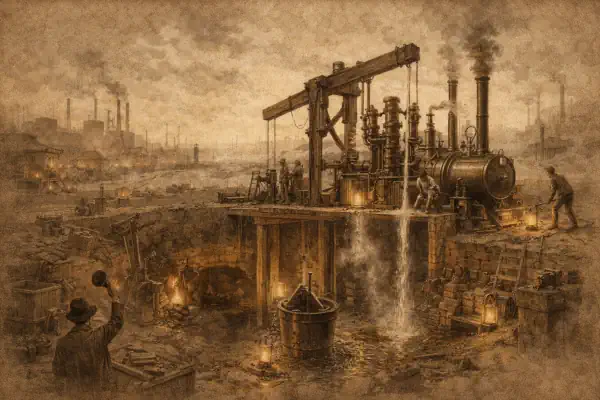
At the beginning of the eighteenth century, energy still depended largely on human labor, animal power, water, or wind. The rhythm of work followed the pace of seasons, rivers, and local constraints. Yet English mines faced a major obstacle: water flooded the galleries and slowed the extraction of coal, a resource vital to the economy.
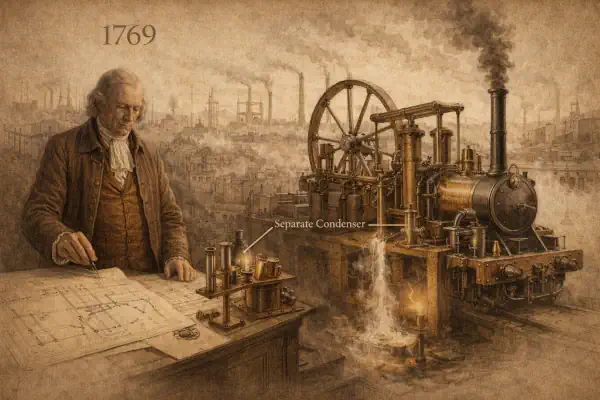
In 1712, Thomas Newcomen designed a steam engine capable of pumping water out of mines. The invention worked, but its efficiency remained low. The real turning point came in 1769 when James Watt improved the system by adding a separate condenser. That refinement reduced energy loss and made steam far more efficient.
Why Watt's improvement changed everything
- it increased energy efficiency compared with earlier models
- it broadened the use of steam beyond mine pumping
- it made production less dependent on waterways and geographical constraints
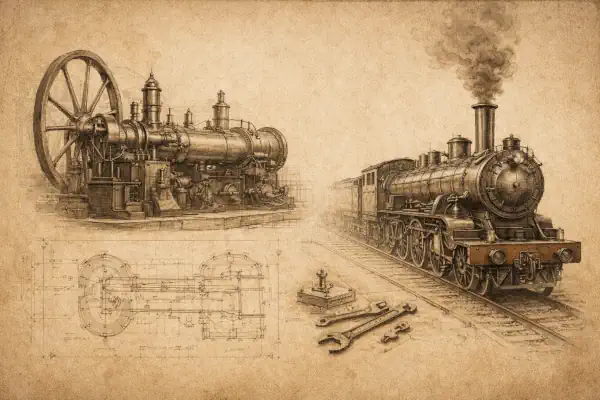
From that point onward, steam was no longer merely a technical solution to a local problem. It became a mobile, adaptable source of energy that could be integrated into the factory, the mechanized workshop, and then transport. This energetic shift was one of the founding acts of the industrial world.
From artisanal textiles to the logic of the factory
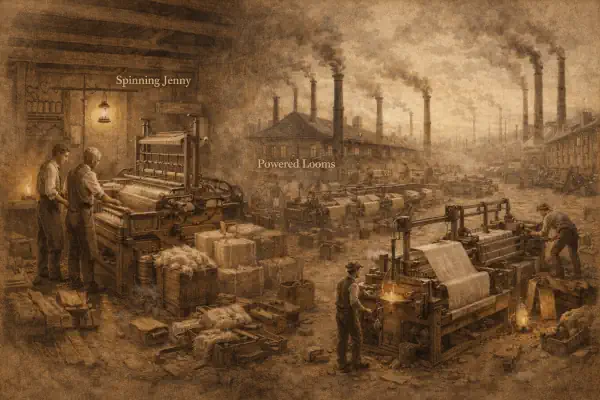
Textiles were one of the first sectors to absorb the new mechanical power. In the British countryside, production still largely relied on the dispersed labor of households and family workshops. That organization offered a degree of autonomy, but it sharply limited volume, speed, and standardization.
Innovations multiplied: James Hargreaves's Spinning Jenny, faster looms, and mechanized devices capable of intensifying spinning and weaving. Raw cotton arrived in massive quantities, notably through colonial trade circuits, and left in the form of cloth produced at an unprecedented pace. The change was not only technical: it was spatial. Production became concentrated.
The factory gradually replaced the domestic workshop. Buildings expanded, chimneys rose, and time discipline intensified. Working time detached itself from natural cycles and came to follow the cadence of machines. With the factory appeared a new social organization: more centralized, more repetitive, more productive, but also more constraining.
Iron, ironmaking, and the framework of the new landscape
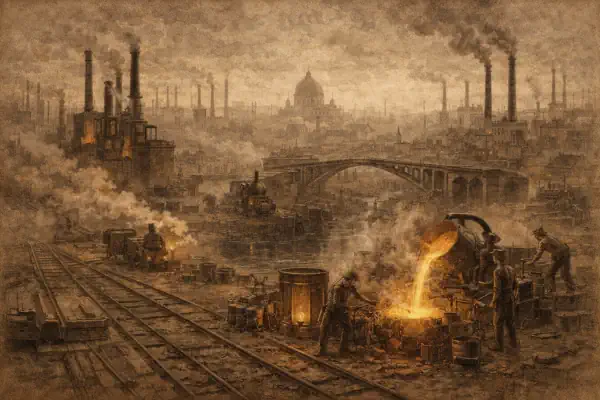
Steam needed metal, and industrialization answered that demand with the rise of ironmaking. As early as 1709, Abraham Darby experimented with the use of coke to smelt iron at Coalbrookdale. The process reduced dependence on wood and opened the way to more massive, more regular production, better suited to the needs of a mechanized economy.
By the turn of the nineteenth century, iron had become the backbone of industrial modernity. It entered machines, rails, bridges, tools, urban structures, and transport infrastructure. Raw material was no longer a simple support: it became the visible framework of a world equipping itself to endure.
Certain industrial regions, such as Ironbridge, embodied that turning point with exceptional symbolic force. The first cast-iron bridge, inaugurated in 1779, was not merely a technical feat. It materialized the passage from an economy still largely organic to a universe shaped by coal, fire, and metal.
Rail: when space contracts and time accelerates
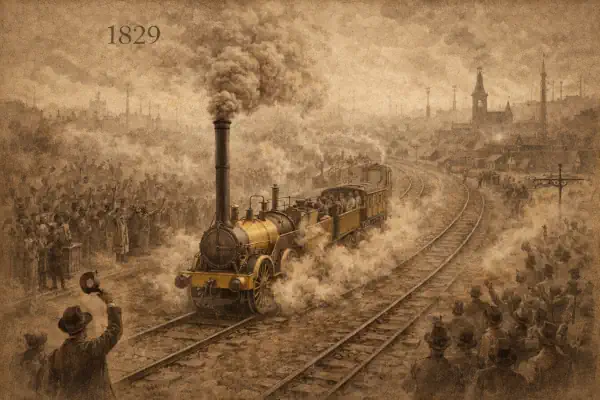
The Industrial Revolution did not transform production alone. It also radically changed circulation. In 1829, during the Rainhill Trials, the Rocket locomotive, designed by George Stephenson and his son Robert, impressed observers with its speed and reliability. That moment marked a threshold: rail became a credible system on a large scale.
Very quickly, railways linked mines, cities, ports, and industrial basins. Economic distances shrank. What had once taken days or weeks could now be organized according to much tighter schedules. Markets became more integrated, flows intensified, and industrial logistics gained coherence.
Perhaps the deepest change lay elsewhere: rail transformed the perception of time. Timetables became a collective constraint, regularity imposed itself as a norm, and the synchronization of territories became a practical necessity. The industrial world did not merely accelerate things: it accelerated social life itself.
The industrial city: growth, concentration, and social fracture
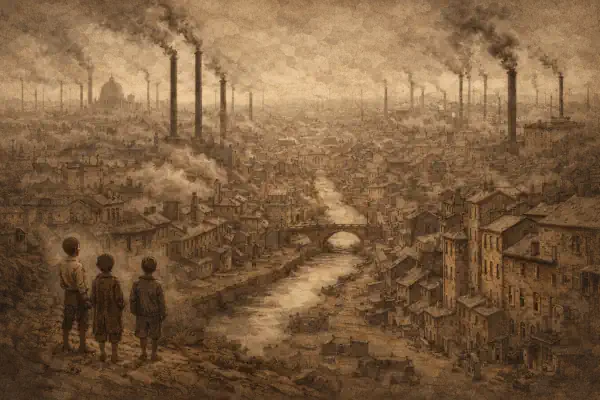
Between 1750 and 1850, the Industrial Revolution changed human geography. Birmingham, Manchester, Leeds, and Glasgow experienced rapid growth. The countryside partially emptied, workers moved toward centers of production, and the city became the principal stage of the new economy.
This urbanization created power, but also major imbalances. Housing became overcrowded, pollution intensified, and social divides widened. Industrial modernity did not bring only more efficient machines; it also produced a new kind of collective vulnerability, visible in housing, public health, and working conditions.
It is this contrast that gives the First Industrial Revolution its historical depth. It gave birth to the modern world through its transformative capacities, while immediately revealing the tensions generated by that power: exploitation, concentration, energy dependence, inequality, and the reconfiguration of social relations.
A lasting rupture in the history of progress
Between 1760 and 1850, production, mobility, and social organization changed scale. What was at stake was not merely a series of technical innovations, but a general transformation in the relationship between human beings, energy, matter, and time. Steam became the symbol of a civilization determined to act faster, farther, and on a larger scale.
In that sense, the First Industrial Revolution appears as the culmination of a long intellectual path that had begun well before the factory: the one linking the scientific curiosity of the Renaissance, the progress of experimentation, the needs of trade, the mastery of resources, and the logic of efficiency.
The modern world is born here, in this junction between knowledge, technology, economy, and infrastructure. In the breath of pistons, in the clamor of workshops, and in the timetables of railway stations, a new idea of human power takes shape: no longer merely to understand reality, but to reconfigure it on a large scale.