When the cosmos stops being centered on Earth
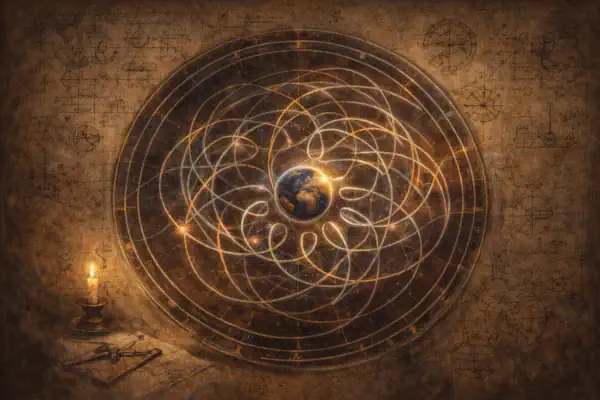
The astronomical revolution begins with a conceptual displacement of enormous scope. In the model inherited from Ptolemy, Earth rests motionless at the center of a closed, hierarchical and ordered universe. That framework long seemed compatible with ancient philosophy, medieval theology and everyday experience: after all, nothing appears to move beneath our feet.
Yet as more corrective additions accumulated, the geocentric system became increasingly cumbersome. Astronomers multiplied epicycles, those secondary circles meant to explain the apparent irregularities of the planets. The theory still functioned, but only at the cost of growing complexity. When a model must be constantly repaired in order to remain coherent, it is often a sign that it has reached its limit.
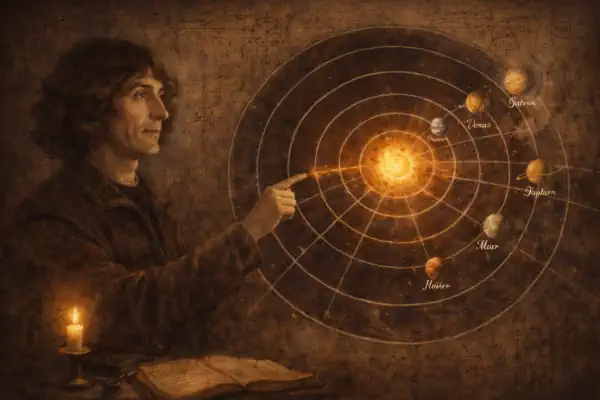
It is in this context that Nicolaus Copernicus formulated a radical hypothesis: make the Sun, not Earth, the organizing center of the system. This gesture was not merely geometric. It changed the perspective from which humanity thought about itself. Earth became one planet among others, engaged in a daily rotation and an annual revolution.
The astronomical revolution does not simply move the planets: it removes humanity from the cosmic center and forces science to prove in a new way what it claims.
Copernicus: a simple hypothesis with immense consequences
When De revolutionibus orbium coelestium appeared in 1543, Copernicus’s work did not look like a provocation. It was a dense, cautious and methodical mathematical study. Its first ambition was to make the architecture of the heavens more coherent. By placing the Sun at the center of the system, the apparent retrograde motions of the planets ceased to be mysterious anomalies: they became perspective effects produced by Earth’s own movement.
What gives the Copernican model its strength is not only its boldness, but its ability to simplify the sky. Where geocentrism piled up patches, heliocentrism reorganized the phenomena within a more intelligible framework. The change was still incomplete, because Copernicus preserved the ancient ideal of the perfect circle. But the essential rupture was already there: the cosmos was no longer thought from our supposed immobility.
From that moment on, an irreversible idea entered the history of science: immediate appearances are not enough to tell the truth of the world. What we see from Earth must be reconstructed through a model, a calculation and a method.
Tycho Brahe: measuring the sky before the telescope
A new theory cannot endure without reliable data. That is precisely the importance of Tycho Brahe, who at the end of the sixteenth century turned astronomy into a science of precision. Installed in his observatory at Uraniborg, he accumulated for years measurements of exceptional quality, obtained without a telescope, thanks to monumental instruments and remarkable observational discipline.
His contribution is decisive for a simple reason: it made the cosmological debate less speculative. The positions of the stars and planets could now be recorded with an extremely small margin of error. The gaps between theory and reality became visible, quantifiable and impossible to ignore. In 1572, the observation of a supernova in Cassiopeia showed that the sky was not immutable. In 1577, the study of a comet weakened the Aristotelian idea of solid celestial spheres.
Tycho Brahe did not yet deliver the final theory of the cosmos, but he prepared the most important ground of all: measured proof. Thanks to him, astronomy gradually left the register of ordered speculation and entered that of rigorous confrontation between model and observation.
Kepler: when planets stop moving in perfect circles
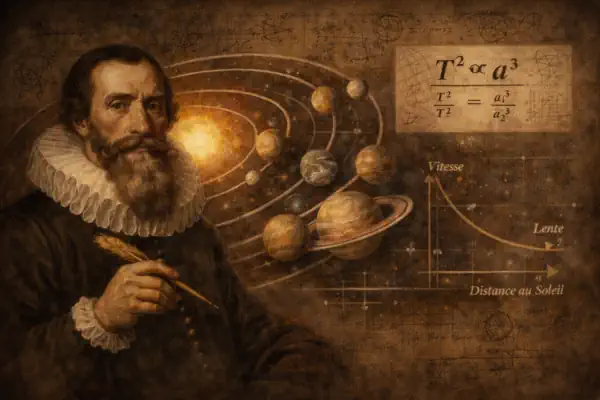
By inheriting Tycho Brahe’s records, Johannes Kepler received far more than a set of data: he received the possibility of genuinely testing a model of the world. The case of Mars is especially revealing. The observed positions were so precise that they resisted traditional schemes. For years, Kepler tried to save the ancient ideal of the circle, but a slight discrepancy remained. For many, eight arcminutes might have seemed a negligible approximation. For him, they became the breaking point.
In 1609, he accepted what classical astronomy still refused: planets do not trace circles, but ellipses, with the Sun at one focus. The consequence was immense. The sky was no longer governed by an inherited geometric perfection; it obeyed a mathematical structure that had to be discovered as it was, not as one wished it to be.
Kepler also showed that the speed of planets varies according to their position on the orbit. Then, in 1619, he formulated the relation that became famous:
T² ∝ a³
The square of the orbital period is proportional to the cube of the mean distance from the Sun. For the first time, planetary motions were captured in an abstract law capable of relating all orbits within a single quantitative structure.
What Kepler changed permanently
- he abandoned the perfect circle in favor of the observed ellipse
- he connected trajectory, speed and distance in a unified mathematical framework
- he turned the sky into a domain where law prevails over mere description
Galileo: making the sky visible and nature measurable
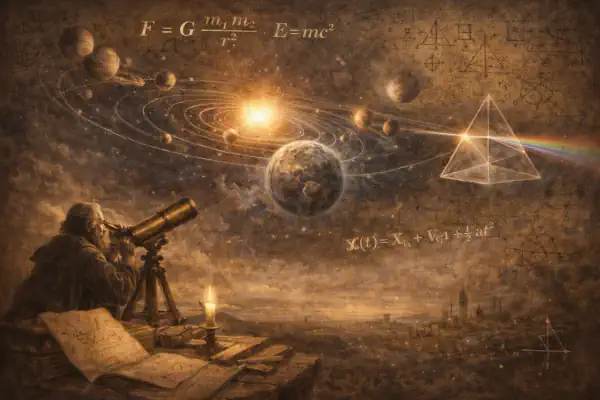
With Galileo Galilei, the astronomical revolution changes register. It no longer rests only on calculations or cosmological hypotheses: it is grounded in instrument-based observation. By improving the telescope in the early seventeenth century and turning it toward the sky, Galileo introduced a new kind of proof. The human eye was no longer alone; it was extended, strengthened and sometimes contradicted by technology.
The discoveries followed one another and weakened ancient certainties. The surface of the Moon was not perfect, the Milky Way revealed itself to be composed of countless stars, Venus displayed phases compatible with heliocentrism, and above all four satellites revolved around Jupiter. Not everything therefore orbited Earth. That conclusion, grounded in observation, had enormous methodological weight.
But Galileo did not transform astronomy alone. In studying motion and falling bodies, he showed that nature could be translated into quantitative relations. The displacement of an object became measurable, calculable and reproducible. The idea that the book of nature is written in mathematical language condenses the full ambition of modern science.
A battle of the cosmos between authority, proof and method
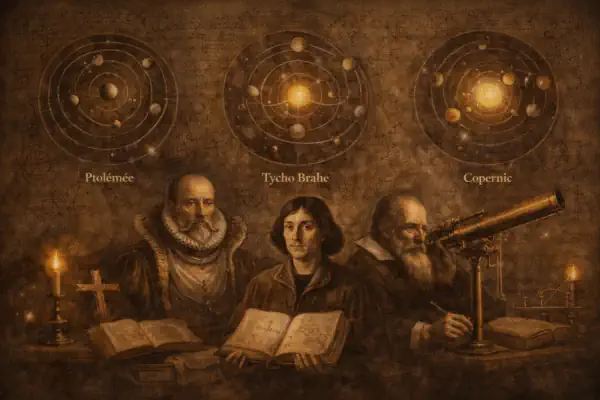
The passage from geocentrism to heliocentrism did not take place suddenly or without resistance. At the beginning of the seventeenth century, several systems still coexisted. The model of Ptolemy kept Earth motionless at the center. That of Copernicus reorganized the system around the Sun. Between the two, Tycho Brahe proposed a compromise in which the planets revolved around the Sun, which itself orbited Earth.
This competition shows that the issue was not only astronomical. It engaged physics, intellectual habits, humanity’s place in creation and interpretive frameworks inherited from authoritative texts. Galileo’s observations and Kepler’s laws gradually gave a decisive advantage to heliocentrism, but institutional acceptance remained slow. The condemnation of heliocentrism in 1616 reminds us how a scientific theory can affect broader cultural balances.
What then changed irreversibly was not only the image of the cosmos. It was the hierarchy of truth criteria. Authority retreated before demonstration, inherited frameworks had to answer to measurement, and a theory was no longer judged only by its conformity to tradition, but by its ability to explain, predict and withstand the test of facts.
Newton: when heaven and Earth obey the same laws
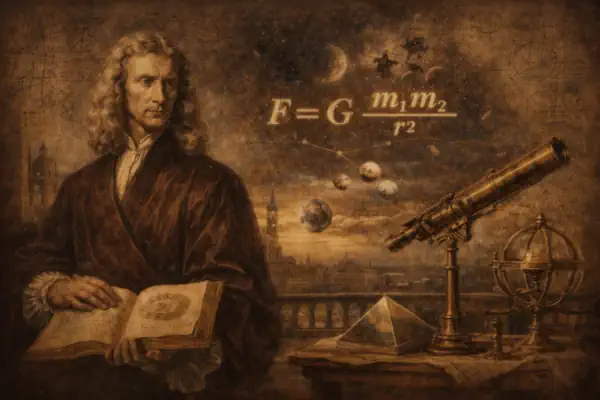
The decisive synthesis arrived in 1687, when Isaac Newton published the Philosophiæ Naturalis Principia Mathematica. With him, the pieces of the Renaissance puzzle assembled. Brahe’s precise observations, Kepler’s planetary laws, Galileo’s demand for measurement and the heliocentric framework inherited from Copernicus all found a common physical principle.
Universal gravitation states that the same force explains the fall of a body toward Earth, the orbit of the Moon and the motion of the planets around the Sun. The universe then ceased to be divided between two separate worlds, one earthly and imperfect, the other celestial and governed by other rules. It became a single system ruled by identical laws everywhere.
F = G × (m₁m₂ / r²)
Behind this equation lies the most powerful unification of emerging modern science: Kepler’s ellipses were no longer merely observed, they were explained. Celestial phenomena became predictable in the same mathematical language as terrestrial phenomena.
With Newton, astronomy fully became a science of prediction. Observing the sky no longer meant only recording regularities; it became possible to deduce trajectories, forces and future behaviors. The cosmos was not merely displaced: it had now become calculable.
The great displacement of the human gaze
The astronomical revolution of the Renaissance did not simply replace one model with another. It profoundly transformed humanity’s relation to reality. Earth was no longer the center of the world, the heavens were no longer perfect by definition, and the universe was no longer a closed order interpreted only through the authority of the Ancients.
In exchange for that symbolic loss, an immense gain appeared: the cosmos became intelligible in a new way. It could be observed with instruments, reconstructed through models, described through equations, and discussed on the basis of shareable evidence. In other words, humanity’s greatness no longer lay in a privileged cosmic position, but in its ability to understand a universe that does not revolve around it.
That is perhaps the deepest legacy of this rupture. By decentering humanity, modern astronomy gave it in return a more durable promise: that of a world reason can endlessly explore, provided it accepts the rigor of observation, measurement and calculation.